


Two-Stage Screw Air Compressor Technology Guide for South China Industries (2026)
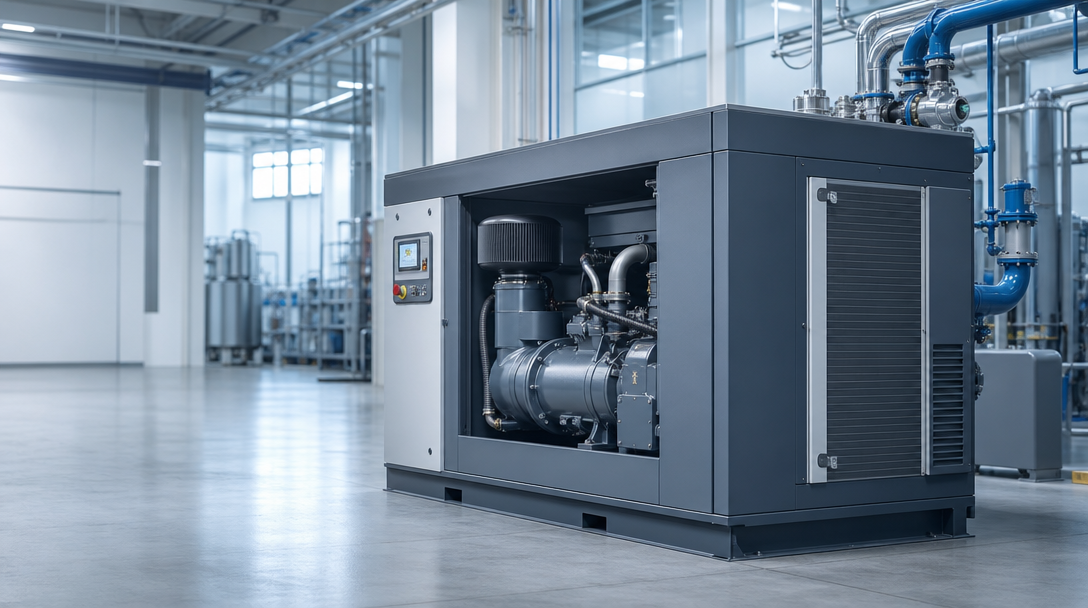
According to recent industry reports, the global industrial air compressor market is projected to grow significantly through 2030, with the Asia-Pacific region accounting for the largest share of growth. Within China, South China represents a significant and growing market for Two-Stage Screw Air Compressor, driven by ongoing industrial automation, factory modernization initiatives, and increasing emphasis on energy efficiency. Understanding the key trends shaping this market is essential for making informed procurement decisions.
This report provides a thorough analysis of the Two-Stage Screw Air Compressor market in South China, including technology trends, competitive landscape, pricing dynamics, and selection criteria. Drawing on industry data, manufacturer specifications, and real-world installation experience, we offer practical guidance for South China facilities seeking to optimize their compressed air infrastructure.
Variable Frequency Drive Technology: Matching Supply to Demand
Variable frequency drive (VFD) technology fundamentally changes how screw compressors respond to fluctuating air demand. Instead of the wasteful load/unload cycling that characterizes fixed-speed compressor operation, VFD-equipped compressors automatically adjust their motor speed — and therefore their air output — to match real-time demand. This capability is particularly valuable in South China manufacturing environments where air demand frequently varies between shifts, production runs, and seasonal production cycles.
The energy savings from VFD technology are well documented. A Two-Stage Screw Air Compressor with VFD capability typically uses 30-50% less energy than an equivalent fixed-speed unit operating under the same variable demand profile. The savings come from two primary mechanisms: eliminating the unloaded running time during which fixed-speed compressors continue to consume 25-40% of full-load power while producing no useful work, and operating at reduced speeds during periods of lower demand, where the relationship between speed reduction and power reduction follows the cube law effect.
Modern VFD compressors available in the South China market offer operating ranges from 25% to 100% of rated capacity. Advanced control algorithms manage the transition between VFD and fixed-speed operation in multi-compressor systems, ensuring optimal efficiency across the full range of facility demand. Pressure stability is maintained within ±0.1 bar, compared to ±0.5-1.0 bar typical of load/unload controlled systems — a significant advantage for processes sensitive to pressure variation.
For South China manufacturers with variable air demand — which includes most facilities outside of truly continuous 24/7 operations — VFD technology represents the most cost-effective path to reduced compressed air energy costs. The typical payback period for the VFD premium in South China industrial applications ranges from 12 to 24 months, after which the savings contribute directly to improved profitability.
The Science of Air Compression: How Two-Stage Screw Air Compressor Achieve Efficiency
At its core, air compression is a thermodynamic process that follows the fundamental laws of gas behavior. When air is compressed, its temperature rises significantly — a 100 kPa (1 bar) increase in pressure can raise the air temperature by approximately 80-100°C under adiabatic conditions. Managing this heat is one of the key challenges in compressor design, as excessive temperatures can degrade lubricating oil, damage components, and reduce overall system efficiency.
Modern Two-Stage Screw Air Compressor address this challenge through sophisticated thermal management systems that optimize the compression process across a wide range of operating conditions. Oil-injected screw compressors use the injection of specially formulated compressor oil directly into the compression chamber to seal rotor clearances, lubricate the rotors and bearings, and absorb the heat of compression. The oil is then circulated through an oil cooler before being reinjected, maintaining optimal operating temperatures even under continuous full-load operation.
The specific power consumption of a compressor — measured in kW per m³/min of delivered air — is the most important indicator of its energy efficiency. Premium Two-Stage Screw Air Compressor in the South China market typically achieve specific power values ranging from 5.5 to 6.5 kW/(m³/min) at full load, with the most efficient models falling below 5.5 kW/(m³/min). By comparison, older or lower-quality units may require 7.0 kW/(m³/min) or more, representing a 20-30% efficiency penalty that translates directly to higher electricity costs over the equipment’s operating life.
Understanding these technical fundamentals is essential for making informed procurement decisions. When evaluating Two-Stage Screw Air Compressor options in South China, look beyond the headline specifications to examine the specific power curves at different load points, the efficiency of the drive system, and the effectiveness of the cooling and oil management systems. These factors collectively determine the real-world performance and operating cost of the equipment.

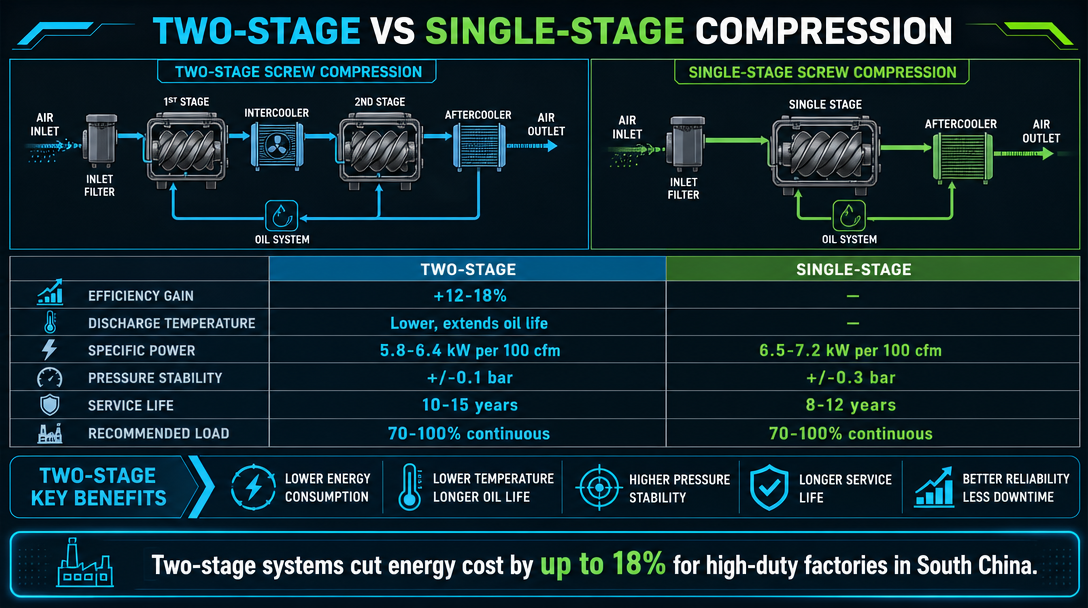
Visual Guide: How Two-Stage Screw Air Compressor Compares
Preventive Maintenance Schedule for Two-Stage Screw Air Compressor in South China
A well-planned preventive maintenance (PM) program is essential for maximizing the life and efficiency of your Two-Stage Screw Air Compressor investment. Studies show that a properly maintained compressor consumes 5-10% less energy than one receiving only reactive maintenance, and its service life can be extended by 30-50%.
Daily tasks: Check oil level; inspect for oil leaks; monitor discharge temperature; check operating pressure and temperature readings; listen for unusual noises; drain condensate from the receiver tank.
Weekly and monthly tasks: Inspect and clean air filter elements; check belt tension; verify safety valve operation; inspect electrical connections; check VFD cooling fan; review operating data for trends.
Quarterly and annual tasks: Perform oil analysis; replace oil and oil filter; replace air filter and oil separator; inspect and clean cooling system; check sensor calibration; conduct full system performance test.
For South China manufacturers, maintaining a detailed maintenance log that records all inspections, measurements, and component replacements is essential for tracking the compressor’s condition over time.
Long-Term Storage and Preservation of Two-Stage Screw Air Compressor in South China
There may be occasions when Two-Stage Screw Air Compressor equipment needs to be stored for extended periods. Proper preservation is essential to prevent corrosion, bearing damage, and seal deterioration.
For short-term storage (1-3 months), seal all openings, fill with oil to normal level, rotate the airend monthly, maintain storage area between 5-40°C with humidity below 70%.
For long-term storage (3+ months), fill with rust-inhibiting preservation oil, coat exposed metal surfaces with corrosion-preventive compound, place desiccant bags inside the enclosure, and rotate the airend monthly.
Before returning stored equipment to service, inspect thoroughly for corrosion or damage, replace all filters and oil separator, fill with fresh oil, check electrical connections, and run unloaded for 30 minutes before connecting to the distribution system.
Industry Q&A: Your Two-Stage Screw Air Compressor Questions Answered
What is the best way to reduce Two-Stage Screw Air Compressor energy consumption?
Most impactful: fix compressed air leaks (20-30% savings). Second: reduce system pressure (6-8% per bar). Third: implement VFD technology (30-50% savings for variable demand). Fourth: improve air treatment efficiency. Fifth: consider heat recovery. Combined effect can reduce costs by 50-70%.
Should I buy one large compressor or multiple smaller units?
For variable demand, multiple smaller compressors typically outperform a single large unit. A common configuration is 2-3 compressors with a VFD trim unit. This approach provides 10-25% efficiency improvement and valuable redundancy.
What is the difference between rotary screw and centrifugal compressors?
Rotary screw compressors use rotating rotors to compress air, suitable for 5-500 kW range. Centrifugal compressors use high-speed impellers, typically for 500+ kW applications. For most manufacturing facilities, rotary screw is the appropriate technology.
Understanding Compressor Performance Curves
A compressor performance curve plots flow rate against discharge pressure, showing how output varies with pressure. Flatter curves indicate better pressure-holding capability. Efficiency curves show specific power against load percentage, revealing where the compressor operates most efficiently.
When requesting performance data from suppliers, ask for the complete performance curve for the specific model, not just headline specifications. Compare curves at multiple operating points that correspond to your facility’s typical range. Suppliers who provide comprehensive data with transparent methods are generally more confident in their products.
Common Mistakes to Avoid When Buying Two-Stage Screw Air Compressor in South China
Experience shows that South China manufacturers often make predictable mistakes when purchasing Two-Stage Screw Air Compressor. Being aware of these common errors will help you avoid them and make a better procurement decision.
Mistake 1: Buying on Price Alone — The most common and most costly mistake. The compressor with the lowest purchase price is almost never the most economical choice over its operating life. Evaluate proposals based on 5-year or 10-year total cost of ownership, not purchase price.
Mistake 2: Oversizing the Compressor — Many facilities purchase compressors significantly larger than actual needs, causing inefficient part-load operation and wasted energy. Conduct a proper demand assessment and size the compressor to match actual requirements.
Mistake 3: Neglecting System Design — Focusing exclusively on the compressor while neglecting piping, storage, air treatment, and condensate management can negate the benefits of even the best compressor. Evaluate the complete system.
Mistake 4: Ignoring Service Capability — Choosing a compressor without verifying the supplier’s service capabilities in your area is a recipe for future frustration. Verify service network coverage and response time commitments.
Mistake 5: Skipping the Audit — Investing in new equipment without first understanding your current system’s performance is like treating symptoms without a diagnosis. Invest in a professional audit before making procurement decisions.
Rightsizing: Determining the Optimal Capacity for Two-Stage Screw Air Compressor in South China
Determining the optimal capacity for Two-Stage Screw Air Compressor is one of the most critical decisions in the compressor selection process. An undersized compressor cannot meet production demand, while an oversized compressor operates inefficiently.
The first step in rightsizing is accurate demand measurement. Install a flow meter and log demand data for at least one full production week. The data should capture both average demand and peak demand events. For facilities with relatively constant demand, select a compressor with output matching measured average demand plus 20-30% margin.
For facilities with variable demand, a single VFD compressor sized to handle 70-100% of peak demand, or a multi-compressor system with a VFD trim unit, typically provides the best combination of efficiency and capacity. Storage capacity should also be factored in — typically 20-40 liters per m³/min of compressor capacity.
In facilities with significant short-duration peak demand events, additional storage capacity can allow the compressor system to be sized for average demand rather than peak demand, yielding substantial capital and energy savings.
Two-Stage Screw Air Compressor for Textile Manufacturing in South China
Textile manufacturing is a traditional and still-important industry in South China, with substantial compressed air requirements for weaving machines, knitting equipment, air-jet looms, and finishing processes. The compressed air demand in textile facilities is typically continuous and relatively stable.
Air-jet looms — a staple of modern textile production — are particularly sensitive to compressed air quality and stability. These machines use precisely controlled jets of compressed air to insert weft yarns during the weaving process, and any variation in pressure or air quality can cause weaving defects.
The efficiency of compressed air systems is a significant cost factor in textile manufacturing, where energy costs represent a substantial portion of total production costs. For South China textile mills operating multiple air-jet looms, the compressed air system’s energy consumption can account for 20-30% of total facility electricity usage.
For South China textile manufacturers, the selection of Two-Stage Screw Air Compressor should balance efficiency, reliability, and service support. Textile production is typically continuous, so compressor reliability and service responsiveness are particularly important.
Financing Options for Two-Stage Screw Air Compressor Investments in South China
The capital investment required for Two-Stage Screw Air Compressor can be substantial, particularly when premium-efficiency equipment is being considered. Fortunately, South China manufacturers have access to several financing options that can make the investment more manageable and accelerate the realization of energy savings.
Traditional equipment financing — including bank loans and equipment leasing — is the most common approach. Equipment leasing offers advantages including preserving working capital and matching payments to the equipment’s useful life. Some compressor suppliers offer their own financing programs with competitive terms designed to facilitate equipment sales.
Energy performance contracting (EPC) is an increasingly popular alternative for efficiency-focused projects. Under an EPC arrangement, a third-party energy service company (ESCO) finances the equipment upgrade, and the manufacturer repays the investment from the energy savings generated by the new equipment. The ESCO guarantees the savings, making this approach attractive for facilities with limited capital budgets.
Government subsidies and incentives for energy-efficient equipment are also available in many regions of China, including South China. These programs typically provide direct subsidies or tax credits for investments in equipment that exceeds minimum efficiency standards. Working with a knowledgeable Two-Stage Screw Air Compressor supplier who understands the available incentives can significantly improve the financial case for premium-efficiency equipment.
Visual: Energy Savings Roadmap
Energy Cost Savings: Quantifying the Impact of Efficient Two-Stage Screw Air Compressor
For South China manufacturers, energy cost savings represent the largest and most predictable benefit of investing in efficient Two-Stage Screw Air Compressor. The magnitude of these savings depends on the efficiency difference between current and new equipment, the operating profile, local electricity rates, and the specific technology choices made.
The most important metric for comparing compressor energy efficiency is specific power. A typical older fixed-speed compressor might have a specific power of 7.0-7.5 kW/(m³/min). A modern premium-efficiency VFD compressor with PMSM motor technology might achieve 5.2-5.8 kW/(m³/min) — representing a 20-30% improvement. For a facility operating a 75kW compressor 6,000 hours per year, this translates to annual energy savings of 100,000-150,000 kWh worth ¥80,000-150,000.
The savings from VFD technology are additional to the savings from improved mechanical efficiency. For facilities with variable air demand, VFD technology typically reduces energy consumption by an additional 30-50%. The combined effect can reduce total compressed air energy costs by 40-60% compared to older fixed-speed equipment.
For South China facilities considering a compressor upgrade, the following steps will produce a reliable energy savings estimate: measure current compressed air energy consumption; determine your facility’s demand profile; obtain specific power data from suppliers of candidate equipment; calculate potential energy savings; and apply your effective electricity rate to convert energy savings to cost savings.
Looking Ahead: The Future of Two-Stage Screw Air Compressor Technology in South China
As we look toward the future, several emerging trends will shape the Two-Stage Screw Air Compressor market in South China over the coming years. Digitalization and smart connectivity will enable compressor systems that self-optimize based on operating conditions. Motor technology continues to advance toward IE5 and IE6 efficiency classes.
Integration with renewable energy sources will become increasingly important as manufacturing facilities adopt on-site solar and wind generation. VFD compressors with sophisticated control systems are naturally suited for this role, as their output can be modulated in response to available renewable power.
For South China manufacturers investing in Two-Stage Screw Air Compressor today, the key to future-proofing your investment is choosing equipment with robust technology, open standards, and a supplier with a clear technology roadmap.
PRCompressor (Panrui) continues to invest in these technologies to serve the evolving needs of South China manufacturing. Contact us at 13713647073 or visit prcompressor.com.
Keywords: compressor energy efficiency, compressor supplier, south china manufacturer, energy saving compressor, south china compressor, industrial air compressor, two-stage screw air compressor, industrial compressed air, compressor buyer’s guide, screw air compressor
Contact PRCompressor (Panrui) for two-stage screw air compressor in South China: Phone 13713647073 | prcompressor.com