


How to Choose Energy Saving Air Compressor in South China | 2026 Expert Guide
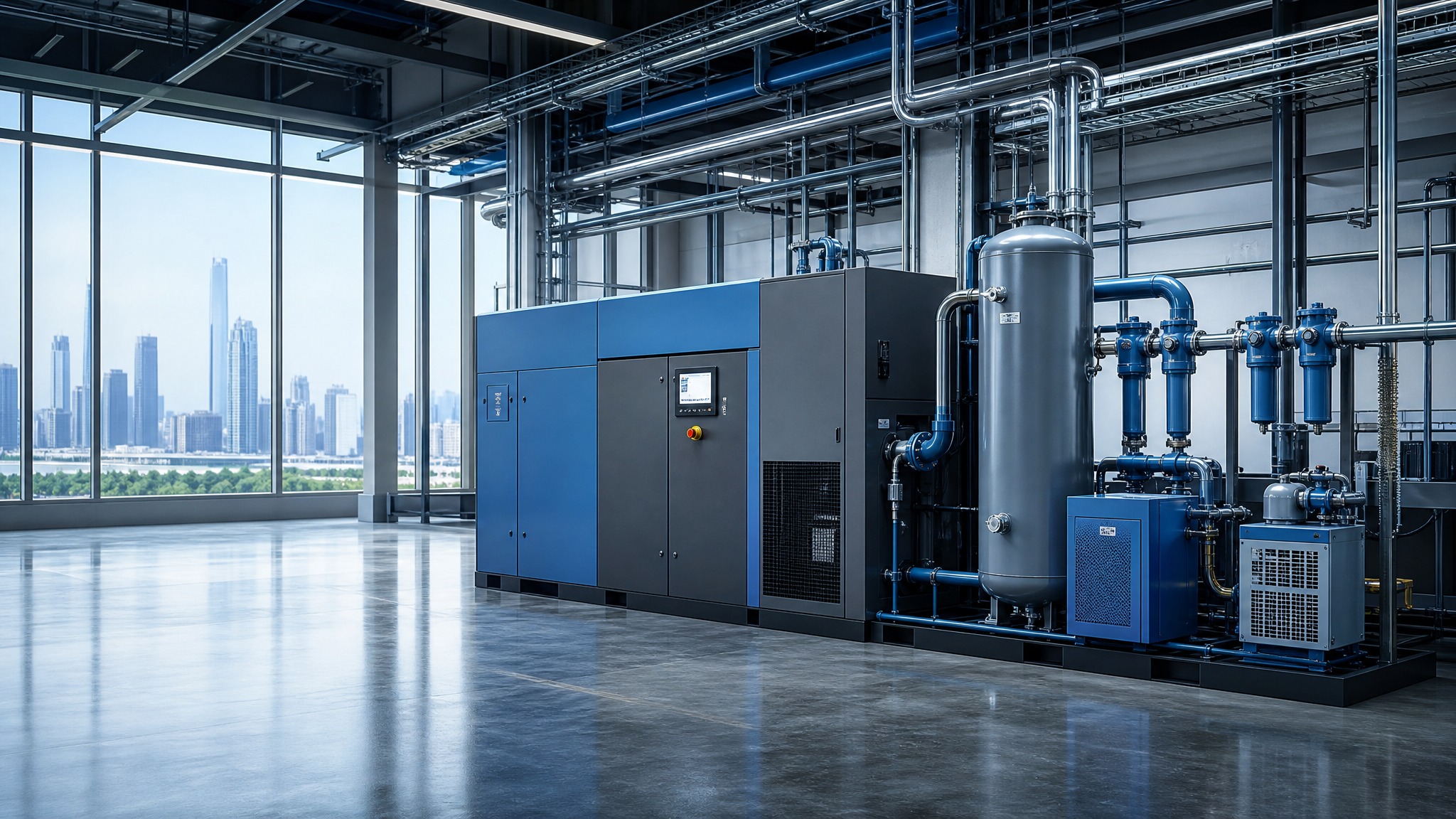
The screw air compressor market in South China offers a diverse range of technologies, from fixed-speed oil-injected units to variable frequency drive (VFD) permanent magnet models and two-stage compression systems. Each technology has distinct advantages and optimal use cases, making it essential for buyers to understand the technical trade-offs involved in selecting Energy Saving Air Compressor. The right choice depends on your specific operational profile, air demand pattern, and performance requirements.
In this detailed guide, we compare the major Energy Saving Air Compressor technologies available in the South China market, examining their operating principles, efficiency characteristics, maintenance requirements, and total cost of ownership. We also provide a structured evaluation framework and practical recommendations to help you select the optimal solution for your manufacturing operation.
Variable Frequency Drive Technology: Matching Supply to Demand
Variable frequency drive (VFD) technology fundamentally changes how screw compressors respond to fluctuating air demand. Instead of the wasteful load/unload cycling that characterizes fixed-speed compressor operation, VFD-equipped compressors automatically adjust their motor speed — and therefore their air output — to match real-time demand. This capability is particularly valuable in South China manufacturing environments where air demand frequently varies between shifts, production runs, and seasonal production cycles.
The energy savings from VFD technology are well documented. A Energy Saving Air Compressor with VFD capability typically uses 30-50% less energy than an equivalent fixed-speed unit operating under the same variable demand profile. The savings come from two primary mechanisms: eliminating the unloaded running time during which fixed-speed compressors continue to consume 25-40% of full-load power while producing no useful work, and operating at reduced speeds during periods of lower demand, where the relationship between speed reduction and power reduction follows the cube law effect.
Modern VFD compressors available in the South China market offer operating ranges from 25% to 100% of rated capacity. Advanced control algorithms manage the transition between VFD and fixed-speed operation in multi-compressor systems, ensuring optimal efficiency across the full range of facility demand. Pressure stability is maintained within ±0.1 bar, compared to ±0.5-1.0 bar typical of load/unload controlled systems — a significant advantage for processes sensitive to pressure variation.
For South China manufacturers with variable air demand — which includes most facilities outside of truly continuous 24/7 operations — VFD technology represents the most cost-effective path to reduced compressed air energy costs. The typical payback period for the VFD premium in South China industrial applications ranges from 12 to 24 months, after which the savings contribute directly to improved profitability.
Permanent Magnet Technology: The Efficiency Revolution in Energy Saving Air Compressor
The integration of permanent magnet synchronous motor (PMSM) technology represents one of the most significant advances in compressed air efficiency over the past decade. Unlike traditional induction motors that consume electrical current to create a magnetic field in the rotor, permanent magnet motors use high-strength neodymium magnets mounted on the rotor to provide the magnetic field continuously. This eliminates the electrical losses associated with rotor field creation, resulting in efficiency improvements of 5-10% across the motor’s operating range.
When combined with variable frequency drive (VFD) technology, PMSM motors create a powertrain that is exceptionally efficient across a wide speed range. The PRCompressor PMV series, widely available in the South China market, exemplifies this approach with IE4 and IE5 efficiency class motors coupled to precision VFD controllers that optimize motor speed and torque for any operating condition. Field data from installations across South China manufacturing facilities shows that this combination typically delivers 30-45% energy savings compared to fixed-speed induction motor compressors.
The advantages of PMSM-VFD technology extend beyond energy savings. These systems provide exceptionally stable discharge pressure, typically maintaining within ±0.1 bar of the setpoint regardless of demand fluctuations. This pressure stability is critical for sensitive manufacturing processes common in South China industries such as electronics assembly, precision machining, and pharmaceutical production. Additionally, the soft-start capability of VFD systems eliminates the high inrush current associated with direct-on-line motor starting, reducing electrical infrastructure requirements and extending the life of electrical components.
For South China manufacturers evaluating Energy Saving Air Compressor, the PMSM-VFD combination represents the current state of the art in compressed air efficiency. The higher initial investment — typically 30-50% more than a comparable fixed-speed unit — is usually recovered within 12-24 months through electricity savings alone, after which the efficiency advantage contributes directly to improved profitability.
Oil-Free vs Oil-Injected Energy Saving Air Compressor: Making the Right Choice for South China
One of the most important decisions when selecting Energy Saving Air Compressor is whether oil-free or oil-injected technology is appropriate for your application. Each approach has distinct advantages and limitations that make it suitable for different industrial applications. Understanding these differences is essential for making an informed procurement decision that balances performance requirements with budget constraints.
Oil-injected screw compressors — the most common type in South China industrial facilities — use specially formulated compressor oil injected into the compression chamber for three purposes: sealing the clearance between rotors to minimize internal leakage, lubricating the rotors and bearings, and absorbing the heat of compression. This design is simple, reliable, and cost-effective, with lower initial purchase cost and wider service network availability. Modern oil-injected compressors with high-efficiency oil separation systems achieve residual oil content below 3 ppm, which is acceptable for most general industrial applications.
Oil-free screw compressors, by contrast, achieve compression without any oil in the compression chamber through precision-engineered rotor clearances, specialized rotor coatings, and separate lubrication systems. These units deliver 100% oil-free air, making them essential for critical applications such as pharmaceutical manufacturing, food and beverage processing, electronics fabrication, and paint spraying. The trade-offs include higher initial cost and generally lower energy efficiency due to larger rotor clearances required.
For most South China manufacturing applications, high-quality oil-injected Energy Saving Air Compressor with appropriate filtration provides adequate air quality at a significantly lower total cost of ownership. However, for facilities in the pharmaceutical, food processing, electronics, or precision coating industries, the investment in oil-free technology is justified by the quality assurance requirements and the cost of potential contamination incidents.
Quick Answers: Popular Questions About Energy Saving Air Compressor
How often should I replace air filters on my Energy Saving Air Compressor?
In clean environments, filters typically last 2,000-4,000 hours. In dusty environments, they may need replacement every 500-1,000 hours. The best indicator is the filter differential pressure gauge — replace when it indicates maximum allowable pressure drop.
Can I use standard compressor oil in any Energy Saving Air Compressor brand?
No. Different brands require different oil specifications. Critical specifications include viscosity grade, base oil type, and additive package. Some manufacturers formulate proprietary oils. Always consult the compressor manual before changing oil types or brands.
How does ambient temperature affect Energy Saving Air Compressor performance?
Higher intake air temperature increases the energy required for compression by approximately 3% per 10°C. In summer conditions (35-40°C), compressor performance can be 5-10% lower than under standard rating conditions (20°C).
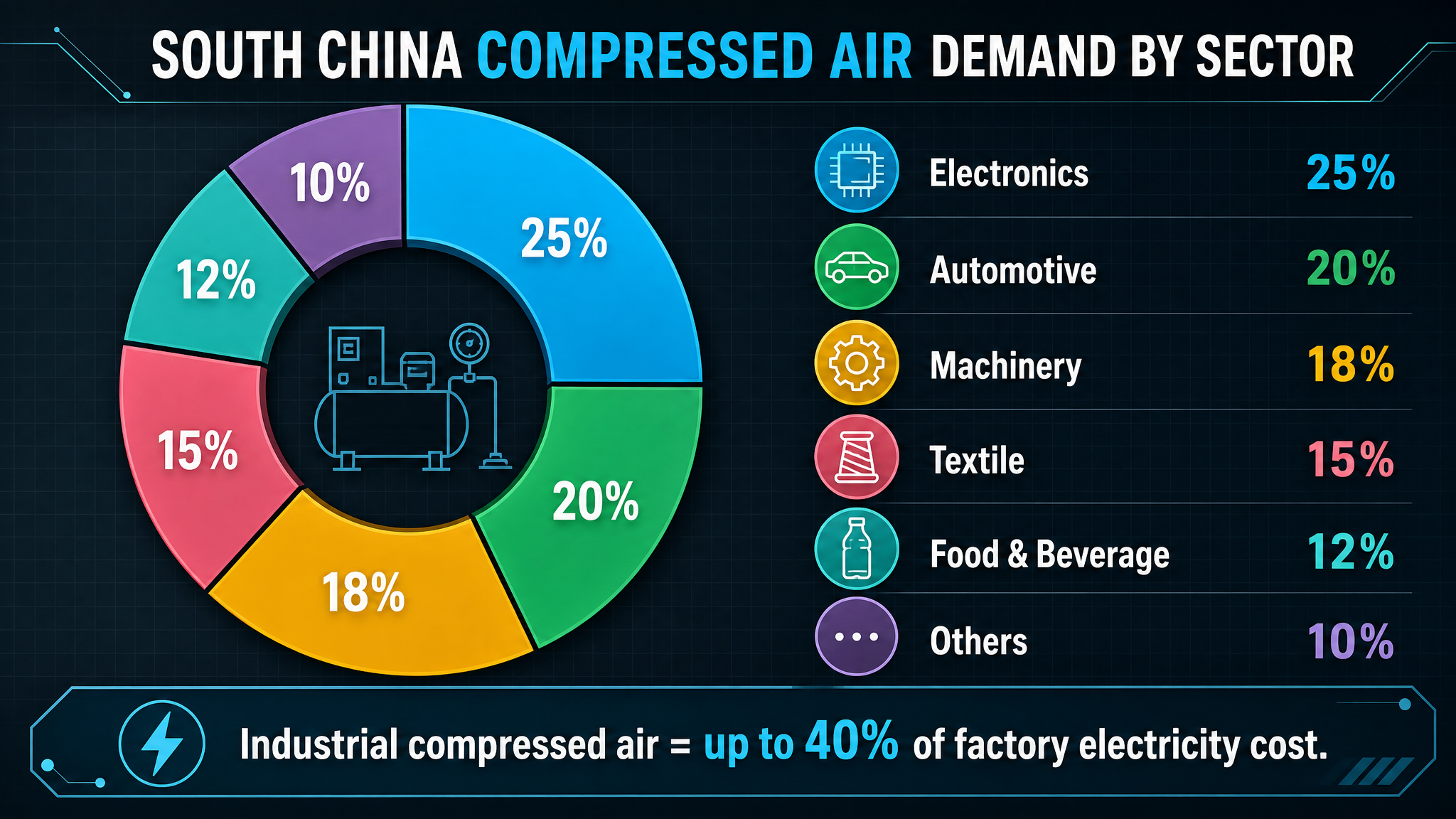
Industry Applications at a Glance
Maintenance Cost Analysis for Energy Saving Air Compressor in South China
Maintenance costs represent a significant component of the total cost of ownership for Energy Saving Air Compressor, typically accounting for 8-12% of lifetime costs. Understanding the maintenance requirements and costs of different compressor types and brands is essential for accurate TCO analysis.
Routine maintenance for oil-injected Energy Saving Air Compressor includes oil and oil filter changes at 2,000-4,000 hour intervals; air filter replacement at similar intervals; oil separator replacement at 4,000-8,000 hour intervals; and annual inspection of safety devices and control system. The annual maintenance cost for a typical mid-range installation in the 37-75 kW range is approximately ¥8,000-15,000 for routine parts and labor.
Major maintenance events, including bearing replacement and airend overhaul, occur at 20,000-40,000 hour intervals with costs ranging from ¥15,000 to ¥80,000 or more depending on unit size. The timing and cost of major maintenance varies significantly between brands and models.
For South China manufacturers, selecting Energy Saving Air Compressor with accessible service points, readily available spare parts, and a competent local service network is essential for controlling maintenance costs. Asking suppliers for detailed maintenance schedules, parts pricing, and service labor rates during the evaluation process will provide the data needed for accurate comparison.
Specification Checklist for Energy Saving Air Compressor Buyers in South China
This specification checklist provides a comprehensive framework for evaluating and comparing Energy Saving Air Compressor options in the South China market.
Performance Specifications: Rated power and rated pressure; free air delivery at rated conditions; specific power at full load and part load; turn-down ratio for VFD units; startup current; noise level.
Technical Features: Compressor type (oil-injected or oil-free); number of compression stages; drive type; motor type and efficiency class; cooling system; controller features and communication protocols.
Quality and Certifications: ISO 9001 certification; CE certification; GB 19153 energy efficiency grade; warranty period and coverage details; extended warranty options.
Service and Support: Service network coverage in South China; response time commitment; spare parts availability; maintenance program options; remote monitoring service availability; training availability.
Common Mistakes to Avoid When Buying Energy Saving Air Compressor in South China
Experience shows that South China manufacturers often make predictable mistakes when purchasing Energy Saving Air Compressor. Being aware of these common errors will help you avoid them and make a better procurement decision.
Mistake 1: Buying on Price Alone — The most common and most costly mistake. The compressor with the lowest purchase price is almost never the most economical choice over its operating life. Evaluate proposals based on 5-year or 10-year total cost of ownership, not purchase price.
Mistake 2: Oversizing the Compressor — Many facilities purchase compressors significantly larger than actual needs, causing inefficient part-load operation and wasted energy. Conduct a proper demand assessment and size the compressor to match actual requirements.
Mistake 3: Neglecting System Design — Focusing exclusively on the compressor while neglecting piping, storage, air treatment, and condensate management can negate the benefits of even the best compressor. Evaluate the complete system.
Mistake 4: Ignoring Service Capability — Choosing a compressor without verifying the supplier’s service capabilities in your area is a recipe for future frustration. Verify service network coverage and response time commitments.
Mistake 5: Skipping the Audit — Investing in new equipment without first understanding your current system’s performance is like treating symptoms without a diagnosis. Invest in a professional audit before making procurement decisions.
Financing Options for Energy Saving Air Compressor Investments in South China
The capital investment required for Energy Saving Air Compressor can be substantial, particularly when premium-efficiency equipment is being considered. Fortunately, South China manufacturers have access to several financing options that can make the investment more manageable and accelerate the realization of energy savings.
Traditional equipment financing — including bank loans and equipment leasing — is the most common approach. Equipment leasing offers advantages including preserving working capital and matching payments to the equipment’s useful life. Some compressor suppliers offer their own financing programs with competitive terms designed to facilitate equipment sales.
Energy performance contracting (EPC) is an increasingly popular alternative for efficiency-focused projects. Under an EPC arrangement, a third-party energy service company (ESCO) finances the equipment upgrade, and the manufacturer repays the investment from the energy savings generated by the new equipment. The ESCO guarantees the savings, making this approach attractive for facilities with limited capital budgets.
Government subsidies and incentives for energy-efficient equipment are also available in many regions of China, including South China. These programs typically provide direct subsidies or tax credits for investments in equipment that exceeds minimum efficiency standards. Working with a knowledgeable Energy Saving Air Compressor supplier who understands the available incentives can significantly improve the financial case for premium-efficiency equipment.
Energy Saving Air Compressor for Pharmaceutical and Medical Device Manufacturing in South China
Pharmaceutical and medical device manufacturing in South China represents the most demanding compressed air applications in the industrial sector. Good Manufacturing Practice (GMP) regulations require that compressed air used in pharmaceutical production be of defined quality with documented verification.
For pharmaceutical applications, 100% oil-free Energy Saving Air Compressor is the standard specification, backed by continuous monitoring and comprehensive documentation. The compressor system must include redundant capacity to ensure uninterrupted operation during maintenance, and all components that contact the compressed air must be constructed of materials suitable for cleanroom environments.
Validation and documentation are critical elements of pharmaceutical compressed air systems. Installation Qualification (IQ), Operational Qualification (OQ), and Performance Qualification (PQ) protocols must be executed and documented for all critical compressed air equipment.
For South China pharmaceutical and medical device manufacturers, selecting Energy Saving Air Compressor from suppliers with experience in the regulated pharmaceutical market is strongly recommended. These suppliers understand the documentation requirements and validation protocols that apply to pharmaceutical compressed air systems.
Energy Saving Air Compressor for Packaging and Logistics in South China
The packaging and logistics sector in South China has grown significantly with the expansion of e-commerce and modern retail distribution. Compressed air powers a wide range of equipment including packaging machines, labeling systems, automated sorting equipment, and material handling systems.
Packaging machinery requires compressed air for pneumatic actuators, vacuum systems, and sensing equipment. These applications typically require moderate air quality at pressures of 6-8 bar. The demand is typically intermittent, with peaks during production runs and low demand during changeovers, making VFD technology particularly beneficial.
Automated storage and retrieval systems and sortation systems in logistics facilities also rely on compressed air. For large logistics hubs in South China, multi-compressor systems with intelligent sequencing provide the best combination of efficiency and reliability.
For South China packaging and logistics facilities, the selection of Energy Saving Air Compressor should prioritize efficiency across a wide operating range, reliability to avoid shipping delays, and responsive service support.
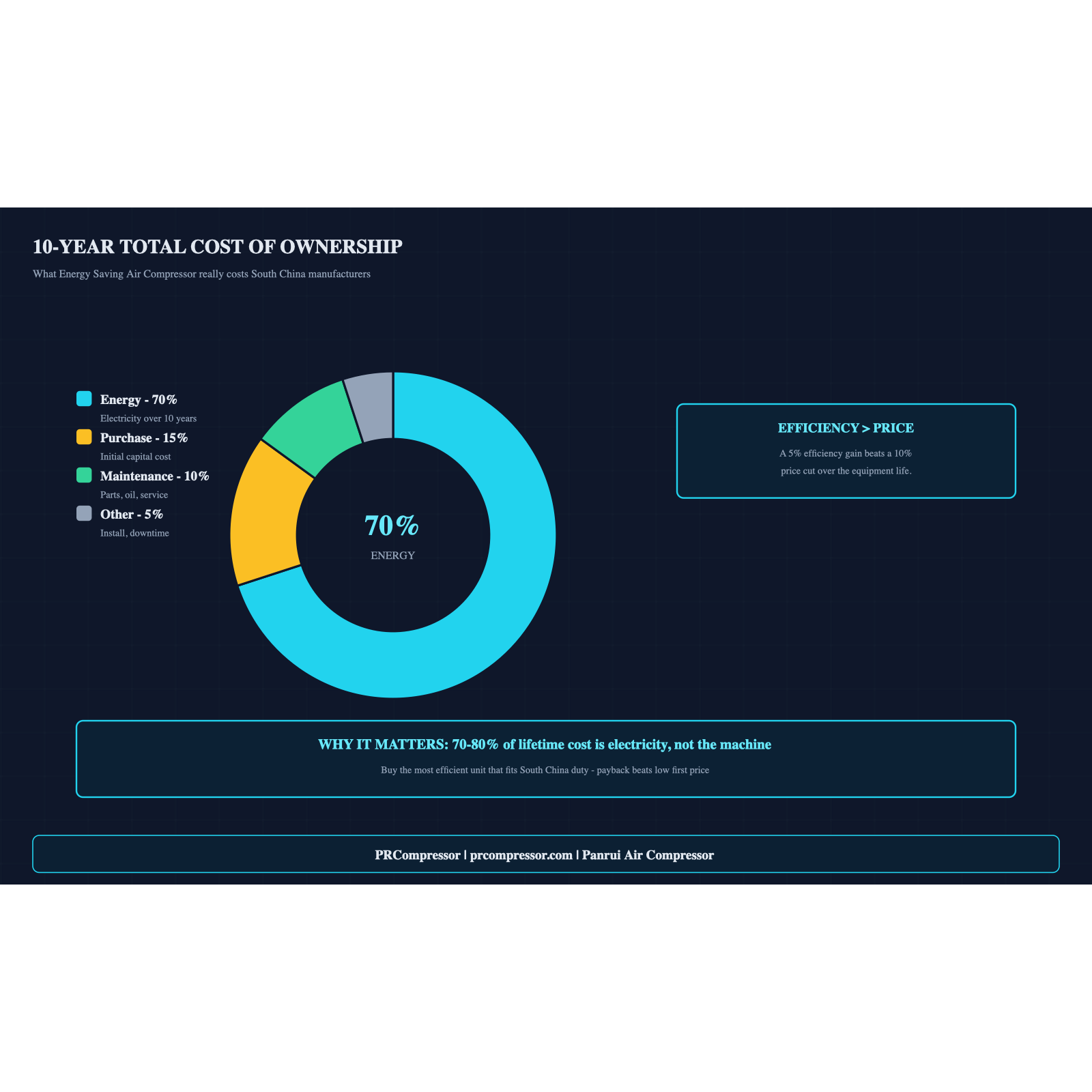
Visual: Total Cost of Ownership Breakdown
Checklist: Your Complete Energy Saving Air Compressor Buying Guide for South China
This comprehensive checklist summarizes the key considerations for your Energy Saving Air Compressor purchase. Use it throughout your procurement process.
Technical Requirements: ☐ Measured compressed air demand; ☐ Required discharge pressure; ☐ Required air quality level; ☐ Operating profile; ☐ Available utilities; ☐ Space for installation.
Equipment Selection: ☐ Compressor type (oil-injected or oil-free); ☐ Drive configuration (fixed speed or VFD); ☐ Compression stages; ☐ Motor efficiency class; ☐ Cooling system; ☐ Control system features.
Supplier Evaluation: ☐ Comparable proposals from 3+ suppliers; ☐ Verified efficiency data; ☐ Warranty terms; ☐ Service network coverage; ☐ References contacted; ☐ Service contract options.
Financial: ☐ TCO analysis completed; ☐ Financing options evaluated; ☐ Government incentives identified; ☐ Installation cost estimated; ☐ Performance guarantees documented.
For assistance, contact PRCompressor at 13713647073 or prcompressor.com.
Keywords: compressor supplier, industrial compressed air, south china compressor, screw air compressor, energy saving compressor, compressor energy efficiency, industrial air compressor, compressor buyer’s guide, energy saving air compressor, south china manufacturer
Contact PRCompressor (Panrui) for energy saving air compressor in South China: Phone 13713647073 | prcompressor.com