


Guangdong Industrial Air Compressor Market Analysis: 2026 Edition
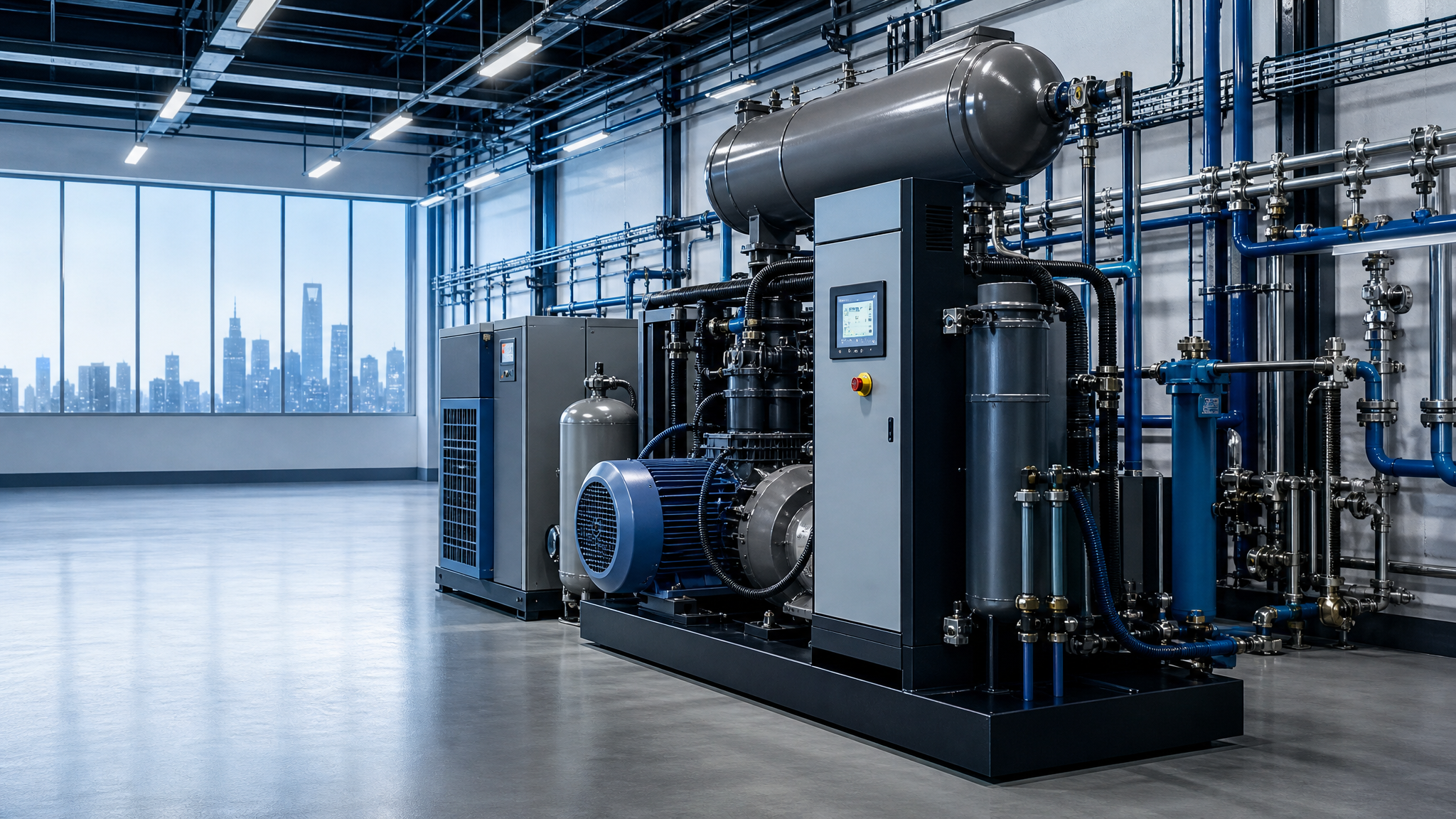
Consider this scenario: A medium-sized manufacturing facility in Guangdong was running three aging fixed-speed compressors totaling 220kW, operating 6,000 hours per year. Their annual electricity cost for compressed air alone exceeded ¥680,000. After a thorough system audit and equipment upgrade to modern Industrial Air Compressor with VFD technology, they reduced their compressed air energy consumption by 38% — saving over ¥258,000 annually with a payback period of just 14 months. Stories like this are becoming increasingly common across Guangdong’s industrial sector.
This guide examines how Guangdong manufacturers can achieve similar results through careful evaluation and selection of Industrial Air Compressor. We cover the technology options available, key specification parameters, supplier evaluation criteria, and financial analysis methods that will help you make an optimal equipment investment.
Two-Stage Compression: Maximizing Efficiency for Guangdong Industries
Two-stage compression technology represents the pinnacle of screw compressor efficiency, offering measurable advantages over single-stage designs for applications requiring consistent high-pressure output. In a two-stage compressor, air is partially compressed in the first stage to 3-4 bar, cooled in an intercooler to remove a significant portion of the heat of compression, and then further compressed in the second stage to the final discharge pressure.
The thermodynamic advantage of this approach is substantial. By cooling the air between compression stages, the system removes heat energy that would otherwise need to be overcome in a single-stage compression cycle, reducing the total work required by 15-25% depending on the discharge pressure and operating conditions. This efficiency advantage is particularly valuable for Guangdong manufacturers operating at pressures above 8 bar, where two-stage compression delivers the greatest benefit.
PRCompressor’s PRCF/PRSF two-stage permanent magnet VFD series, available throughout the Guangdong market, exemplifies the best of this technology. These units combine two-stage airends with PMSM motors and precision VFD control to achieve verified specific power values below 5.2 kW/(m³/min) — among the best available in the industrial compressor market. For a medium-sized Guangdong factory operating a 110kW compressor 6,000 hours per year, this efficiency advantage translates to annual electricity savings of ¥150,000-250,000 compared to conventional single-stage fixed-speed equipment.
Beyond energy savings, two-stage compressors offer several other advantages for industrial users. The lower compression ratio per stage reduces mechanical stress on the rotors and bearings, potentially extending the service life of the airend. The inter-stage cooling also reduces the discharge temperature, which improves oil life and reduces the load on downstream air treatment equipment. For Guangdong manufacturers with continuous or high-duty-cycle operations, these benefits add significant value over the equipment’s operating life.
Oil-Free vs Oil-Injected Industrial Air Compressor: Making the Right Choice for Guangdong
One of the most important decisions when selecting Industrial Air Compressor is whether oil-free or oil-injected technology is appropriate for your application. Each approach has distinct advantages and limitations that make it suitable for different industrial applications. Understanding these differences is essential for making an informed procurement decision that balances performance requirements with budget constraints.
Oil-injected screw compressors — the most common type in Guangdong industrial facilities — use specially formulated compressor oil injected into the compression chamber for three purposes: sealing the clearance between rotors to minimize internal leakage, lubricating the rotors and bearings, and absorbing the heat of compression. This design is simple, reliable, and cost-effective, with lower initial purchase cost and wider service network availability. Modern oil-injected compressors with high-efficiency oil separation systems achieve residual oil content below 3 ppm, which is acceptable for most general industrial applications.
Oil-free screw compressors, by contrast, achieve compression without any oil in the compression chamber through precision-engineered rotor clearances, specialized rotor coatings, and separate lubrication systems. These units deliver 100% oil-free air, making them essential for critical applications such as pharmaceutical manufacturing, food and beverage processing, electronics fabrication, and paint spraying. The trade-offs include higher initial cost and generally lower energy efficiency due to larger rotor clearances required.
For most Guangdong manufacturing applications, high-quality oil-injected Industrial Air Compressor with appropriate filtration provides adequate air quality at a significantly lower total cost of ownership. However, for facilities in the pharmaceutical, food processing, electronics, or precision coating industries, the investment in oil-free technology is justified by the quality assurance requirements and the cost of potential contamination incidents.
The Science of Air Compression: How Industrial Air Compressor Achieve Efficiency
At its core, air compression is a thermodynamic process that follows the fundamental laws of gas behavior. When air is compressed, its temperature rises significantly — a 100 kPa (1 bar) increase in pressure can raise the air temperature by approximately 80-100°C under adiabatic conditions. Managing this heat is one of the key challenges in compressor design, as excessive temperatures can degrade lubricating oil, damage components, and reduce overall system efficiency.
Modern Industrial Air Compressor address this challenge through sophisticated thermal management systems that optimize the compression process across a wide range of operating conditions. Oil-injected screw compressors use the injection of specially formulated compressor oil directly into the compression chamber to seal rotor clearances, lubricate the rotors and bearings, and absorb the heat of compression. The oil is then circulated through an oil cooler before being reinjected, maintaining optimal operating temperatures even under continuous full-load operation.
The specific power consumption of a compressor — measured in kW per m³/min of delivered air — is the most important indicator of its energy efficiency. Premium Industrial Air Compressor in the Guangdong market typically achieve specific power values ranging from 5.5 to 6.5 kW/(m³/min) at full load, with the most efficient models falling below 5.5 kW/(m³/min). By comparison, older or lower-quality units may require 7.0 kW/(m³/min) or more, representing a 20-30% efficiency penalty that translates directly to higher electricity costs over the equipment’s operating life.
Understanding these technical fundamentals is essential for making informed procurement decisions. When evaluating Industrial Air Compressor options in Guangdong, look beyond the headline specifications to examine the specific power curves at different load points, the efficiency of the drive system, and the effectiveness of the cooling and oil management systems. These factors collectively determine the real-world performance and operating cost of the equipment.
Technology Selection Matrix: Choosing the Right Industrial Air Compressor Configuration
This technology selection matrix helps Guangdong manufacturers match Industrial Air Compressor configurations to their specific operating profiles.
Demand Profile Dimension: Constant demand — fixed-speed or VFD base load. Variable demand — VFD compressor sized for variable portion. Highly variable demand — multi-compressor system with VFD trim.
Pressure Requirements Dimension: Standard pressure (7-10 bar) — most compressor types suitable. High pressure (10-15 bar) — two-stage compression recommended. Low pressure (below 7 bar) — standard units with derating.
Air Quality Requirements Dimension: General industrial (ISO Class 4-5) — oil-injected with standard filtration. Sensitive applications (ISO Class 1-3) — consider oil-free or enhanced filtration. Critical applications — oil-free compressors required.
Operating Hours Dimension: Low utilization (under 2,000 hours/year) — lower-cost fixed-speed. Medium utilization (2,000-4,000) — VFD recommended for variable demand. High utilization (4,000-8,000) — premium efficiency essential. Continuous operation (8,000+) — maximum efficiency, consider heat recovery.
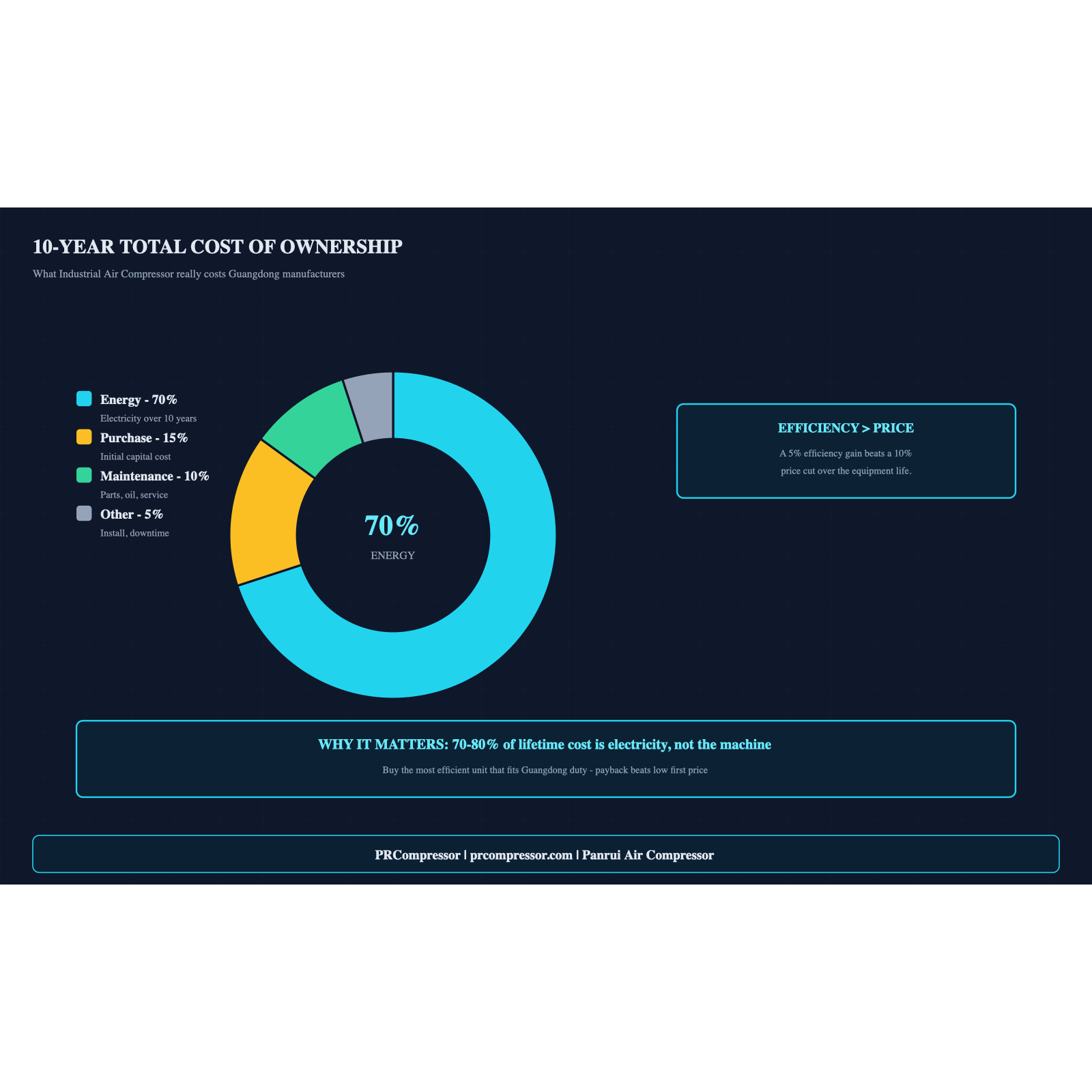
Visual: Total Cost of Ownership Breakdown
Service Contract Options for Industrial Air Compressor in Guangdong
A well-structured service contract provides peace of mind and predictable maintenance costs for Industrial Air Compressor ownership. For Guangdong manufacturers who prefer to focus on core production, a comprehensive service agreement ensures the compressor receives proper maintenance.
Basic service contracts cover scheduled preventive maintenance visits at specified intervals. The contract includes labor costs and may or may not include replacement parts. Basic contracts provide cost predictability for routine maintenance but limited protection against unexpected repairs.
Comprehensive service contracts include all preventive maintenance parts and labor plus coverage for unscheduled repairs. Full-service contracts are the most comprehensive, covering all parts, labor, and major component replacements for the contract duration.
When evaluating service contracts for Industrial Air Compressor in Guangdong, consider the contract term, scope of covered parts, response time commitment, remote monitoring availability, technician qualifications, and provisions for handling performance issues.
Financing Options for Industrial Air Compressor Investments in Guangdong
The capital investment required for Industrial Air Compressor can be substantial, particularly when premium-efficiency equipment is being considered. Fortunately, Guangdong manufacturers have access to several financing options that can make the investment more manageable and accelerate the realization of energy savings.
Traditional equipment financing — including bank loans and equipment leasing — is the most common approach. Equipment leasing offers advantages including preserving working capital and matching payments to the equipment’s useful life. Some compressor suppliers offer their own financing programs with competitive terms designed to facilitate equipment sales.
Energy performance contracting (EPC) is an increasingly popular alternative for efficiency-focused projects. Under an EPC arrangement, a third-party energy service company (ESCO) finances the equipment upgrade, and the manufacturer repays the investment from the energy savings generated by the new equipment. The ESCO guarantees the savings, making this approach attractive for facilities with limited capital budgets.
Government subsidies and incentives for energy-efficient equipment are also available in many regions of China, including Guangdong. These programs typically provide direct subsidies or tax credits for investments in equipment that exceeds minimum efficiency standards. Working with a knowledgeable Industrial Air Compressor supplier who understands the available incentives can significantly improve the financial case for premium-efficiency equipment.
Industrial Air Compressor for Construction and Mining in Guangdong
Construction and mining operations in Guangdong require robust, portable, and reliable compressed air solutions for rock drilling, pneumatic tools, concrete spraying, and dust control. Unlike factory installations, these systems must operate in harsh environments with challenging conditions.
For construction and mining applications, the selection of Industrial Air Compressor prioritizes durability, ease of maintenance, and the ability to operate in adverse conditions over efficiency optimization. While energy efficiency is still important, the primary considerations are typically reliability, serviceability, and spare parts availability in remote locations.
Portability is another key consideration. Trailer-mounted compressors, modular units, and systems designed for easy relocation are common. The ability to quickly move compressed air capacity to different locations is essential for operational flexibility.
For Guangdong construction and mining companies, the selection of Industrial Air Compressor should also consider the availability of service and support in the specific geographic areas where operations will be conducted.
Industrial Air Compressor for Packaging and Logistics in Guangdong
The packaging and logistics sector in Guangdong has grown significantly with the expansion of e-commerce and modern retail distribution. Compressed air powers a wide range of equipment including packaging machines, labeling systems, automated sorting equipment, and material handling systems.
Packaging machinery requires compressed air for pneumatic actuators, vacuum systems, and sensing equipment. These applications typically require moderate air quality at pressures of 6-8 bar. The demand is typically intermittent, with peaks during production runs and low demand during changeovers, making VFD technology particularly beneficial.
Automated storage and retrieval systems and sortation systems in logistics facilities also rely on compressed air. For large logistics hubs in Guangdong, multi-compressor systems with intelligent sequencing provide the best combination of efficiency and reliability.
For Guangdong packaging and logistics facilities, the selection of Industrial Air Compressor should prioritize efficiency across a wide operating range, reliability to avoid shipping delays, and responsive service support.
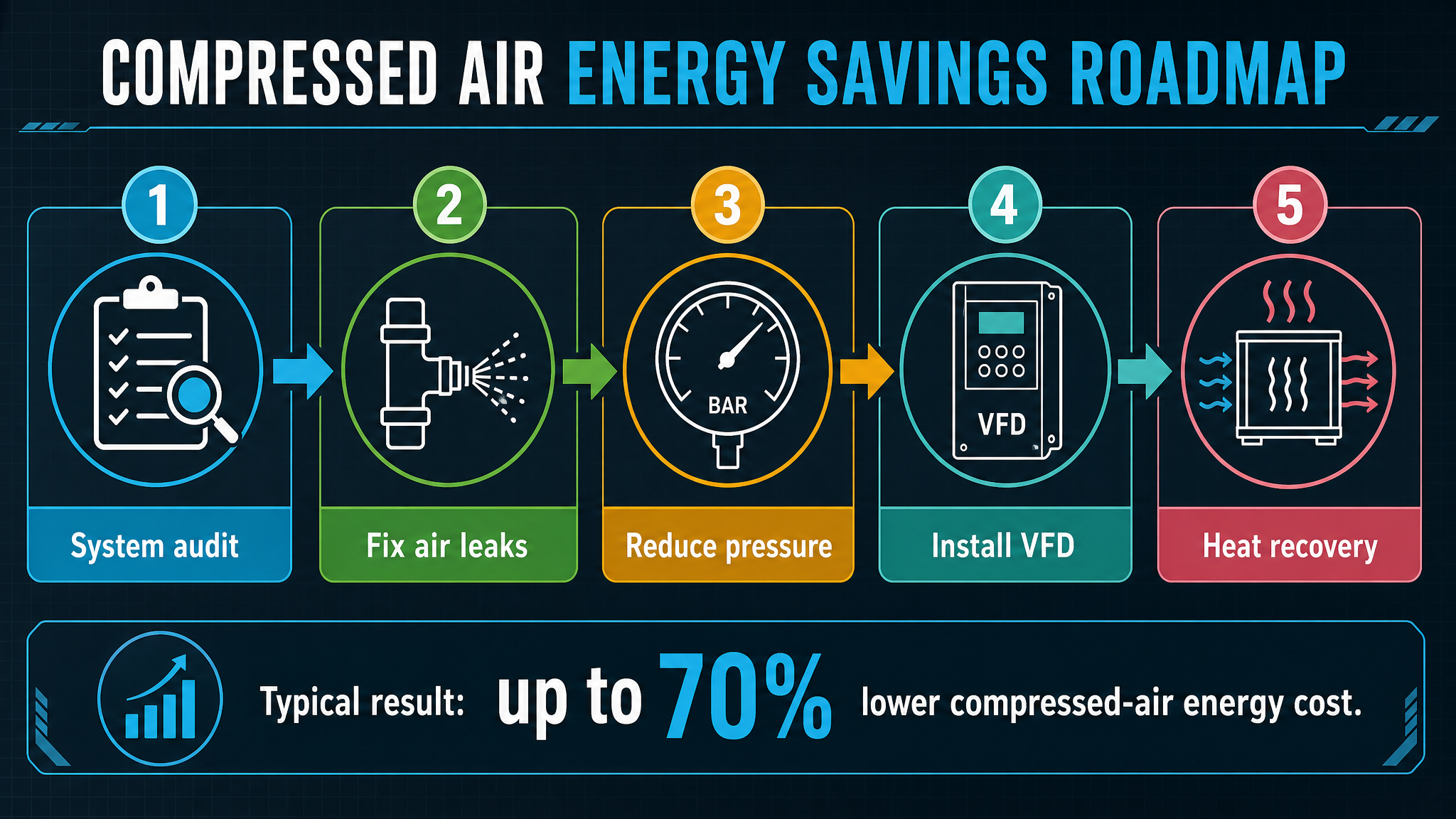
Visual: Energy Savings Roadmap
ROI Calculation: Making the Financial Case for Premium Industrial Air Compressor
Building a convincing return on investment (ROI) case for premium-efficiency Industrial Air Compressor is essential for securing internal approval and budget allocation. For Guangdong manufacturers, the financial analysis should quantify both the hard savings and the soft benefits.
The basic ROI calculation follows this formula: Total Investment = Equipment Cost + Installation Cost + Training Cost. Annual Savings = Energy Savings + Maintenance Savings + Quality Savings + Tax Benefits. Simple Payback = Total Investment ÷ Annual Savings. For well-selected compressor upgrades in Guangdong facilities, simple payback periods typically range from 12 to 30 months.
A more sophisticated analysis uses discounted cash flow (DCF) methodology to account for the time value of money. Using Net Present Value (NPV) and Internal Rate of Return (IRR) metrics, the analysis considers: the initial investment; projected annual savings over the equipment’s expected life of 10-15 years; the cost of capital; inflation in electricity costs; and the residual value at end of life.
For Guangdong manufacturers, the financial case for premium Industrial Air Compressor is typically compelling. A well-selected premium compressor with VFD technology and high-efficiency motor will almost always generate a positive NPV over its operating life, with IRR values typically exceeding 30%.
Taking Action: Your Next Steps for Industrial Air Compressor Procurement in Guangdong
Armed with the information in this guide, here is a practical action plan to move from knowledge to decision.
Week 1-2: Assessment — Measure compressed air demand. Determine air quality requirements. Document operating profile. Establish budget and timeline.
Week 3-4: Research — Identify potential suppliers. Request preliminary proposals from at least three qualified suppliers. Attend product demonstrations. Research reputations.
Week 5-6: Evaluation — Develop TCO comparison. Contact references. Conduct site visits. Evaluate service capabilities.
Week 7-8: Decision — Select preferred supplier. Negotiate commercial terms. Finalize installation plan. Place order.
For expert guidance at any stage, contact PRCompressor at 13713647073 or prcompressor.com.
Keywords: industrial air compressor, screw air compressor, guangdong manufacturer, industrial compressed air, compressor buyer’s guide, energy saving compressor, industrial air compressor, guangdong compressor, compressor energy efficiency, compressor supplier
Contact PRCompressor (Panrui) for industrial air compressor in Guangdong: Phone 13713647073 | prcompressor.com