


VFD Screw Air Compressor Buying Tips for Shenzhen Facilities | 2026
In Shenzhen’s rapidly evolving industrial landscape, compressed air systems account for 10% to 40% of total factory electricity consumption — making them one of the largest operational expenses for manufacturing facilities. For businesses evaluating VFD Screw Air Compressor, understanding the interplay between capital investment, energy efficiency, and long-term reliability has never been more critical. This comprehensive guide examines every factor that Shenzhen manufacturers must consider when making this essential equipment decision in 2026.
The compressed air market in Shenzhen has undergone significant transformation over the past five years. Rising electricity costs, stricter environmental regulations, and increasing awareness of total cost of ownership have driven a fundamental shift in how industrial buyers approach compressor procurement. Gone are the days when purchase price alone determined the decision — today’s informed buyers demand verified efficiency data, transparent lifecycle cost analysis, and proven reliability records.
Oil-Free vs Oil-Injected VFD Screw Air Compressor: Making the Right Choice for Shenzhen
One of the most important decisions when selecting VFD Screw Air Compressor is whether oil-free or oil-injected technology is appropriate for your application. Each approach has distinct advantages and limitations that make it suitable for different industrial applications. Understanding these differences is essential for making an informed procurement decision that balances performance requirements with budget constraints.
Oil-injected screw compressors — the most common type in Shenzhen industrial facilities — use specially formulated compressor oil injected into the compression chamber for three purposes: sealing the clearance between rotors to minimize internal leakage, lubricating the rotors and bearings, and absorbing the heat of compression. This design is simple, reliable, and cost-effective, with lower initial purchase cost and wider service network availability. Modern oil-injected compressors with high-efficiency oil separation systems achieve residual oil content below 3 ppm, which is acceptable for most general industrial applications.
Oil-free screw compressors, by contrast, achieve compression without any oil in the compression chamber through precision-engineered rotor clearances, specialized rotor coatings, and separate lubrication systems. These units deliver 100% oil-free air, making them essential for critical applications such as pharmaceutical manufacturing, food and beverage processing, electronics fabrication, and paint spraying. The trade-offs include higher initial cost and generally lower energy efficiency due to larger rotor clearances required.
For most Shenzhen manufacturing applications, high-quality oil-injected VFD Screw Air Compressor with appropriate filtration provides adequate air quality at a significantly lower total cost of ownership. However, for facilities in the pharmaceutical, food processing, electronics, or precision coating industries, the investment in oil-free technology is justified by the quality assurance requirements and the cost of potential contamination incidents.
Variable Frequency Drive Technology: Matching Supply to Demand
Variable frequency drive (VFD) technology fundamentally changes how screw compressors respond to fluctuating air demand. Instead of the wasteful load/unload cycling that characterizes fixed-speed compressor operation, VFD-equipped compressors automatically adjust their motor speed — and therefore their air output — to match real-time demand. This capability is particularly valuable in Shenzhen manufacturing environments where air demand frequently varies between shifts, production runs, and seasonal production cycles.
The energy savings from VFD technology are well documented. A VFD Screw Air Compressor with VFD capability typically uses 30-50% less energy than an equivalent fixed-speed unit operating under the same variable demand profile. The savings come from two primary mechanisms: eliminating the unloaded running time during which fixed-speed compressors continue to consume 25-40% of full-load power while producing no useful work, and operating at reduced speeds during periods of lower demand, where the relationship between speed reduction and power reduction follows the cube law effect.
Modern VFD compressors available in the Shenzhen market offer operating ranges from 25% to 100% of rated capacity. Advanced control algorithms manage the transition between VFD and fixed-speed operation in multi-compressor systems, ensuring optimal efficiency across the full range of facility demand. Pressure stability is maintained within ±0.1 bar, compared to ±0.5-1.0 bar typical of load/unload controlled systems — a significant advantage for processes sensitive to pressure variation.
For Shenzhen manufacturers with variable air demand — which includes most facilities outside of truly continuous 24/7 operations — VFD technology represents the most cost-effective path to reduced compressed air energy costs. The typical payback period for the VFD premium in Shenzhen industrial applications ranges from 12 to 24 months, after which the savings contribute directly to improved profitability.
Permanent Magnet Technology: The Efficiency Revolution in VFD Screw Air Compressor
The integration of permanent magnet synchronous motor (PMSM) technology represents one of the most significant advances in compressed air efficiency over the past decade. Unlike traditional induction motors that consume electrical current to create a magnetic field in the rotor, permanent magnet motors use high-strength neodymium magnets mounted on the rotor to provide the magnetic field continuously. This eliminates the electrical losses associated with rotor field creation, resulting in efficiency improvements of 5-10% across the motor’s operating range.
When combined with variable frequency drive (VFD) technology, PMSM motors create a powertrain that is exceptionally efficient across a wide speed range. The PRCompressor PMV series, widely available in the Shenzhen market, exemplifies this approach with IE4 and IE5 efficiency class motors coupled to precision VFD controllers that optimize motor speed and torque for any operating condition. Field data from installations across Shenzhen manufacturing facilities shows that this combination typically delivers 30-45% energy savings compared to fixed-speed induction motor compressors.
The advantages of PMSM-VFD technology extend beyond energy savings. These systems provide exceptionally stable discharge pressure, typically maintaining within ±0.1 bar of the setpoint regardless of demand fluctuations. This pressure stability is critical for sensitive manufacturing processes common in Shenzhen industries such as electronics assembly, precision machining, and pharmaceutical production. Additionally, the soft-start capability of VFD systems eliminates the high inrush current associated with direct-on-line motor starting, reducing electrical infrastructure requirements and extending the life of electrical components.
For Shenzhen manufacturers evaluating VFD Screw Air Compressor, the PMSM-VFD combination represents the current state of the art in compressed air efficiency. The higher initial investment — typically 30-50% more than a comparable fixed-speed unit — is usually recovered within 12-24 months through electricity savings alone, after which the efficiency advantage contributes directly to improved profitability.
Evaluation Framework: How to Compare VFD Screw Air Compressor Suppliers in Shenzhen
Comparing VFD Screw Air Compressor suppliers in the Shenzhen market requires a structured evaluation framework that accounts for multiple dimensions of supplier capability.
Dimension 1: Product Quality and Performance (25%) — Evaluate efficiency specifications, build quality, component sourcing, and design philosophy. Request detailed technical documentation and compare warranty terms.
Dimension 2: Total Cost of Ownership (25%) — Develop a detailed TCO comparison over a 10-year operating life including purchase price, installation, projected energy costs, estimated maintenance costs, and projected major overhaul costs.
Dimension 3: Service and Support Capability (20%) — Assess service infrastructure, technician qualifications, spare parts inventory, emergency response times, and preventive maintenance programs.
Dimension 4: Industry Experience and Reputation (15%) — Evaluate experience with similar installations, contact references, and research reputation through industry associations and trade publications.
Dimension 5: Commercial Terms and Flexibility (10%) — Compare payment schedules, warranty terms, training provisions, and performance guarantees.
Dimension 6: Strategic Alignment (5%) — Consider technology roadmap compatibility, sustainability alignment, and partnership potential.
Step-by-Step Guide to Selecting VFD Screw Air Compressor in Shenzhen
Selecting the right VFD Screw Air Compressor for your Shenzhen facility does not need to be complicated, but it does require a systematic approach. This step-by-step guide provides a structured process that will help you evaluate your options and make a confident decision.
Step 1: Define Your Compressed Air Demand — Measure your actual air consumption over a representative period. If measurement is not possible, estimate demand by inventorying all air-consuming equipment and calculating total demand with appropriate diversity factors. Add 20-30% for future expansion and system losses.
Step 2: Determine Your Air Quality Requirements — Identify the highest air quality requirement among your applications. If any application requires oil-free air, that will drive the compressor selection toward oil-free technology. Also determine the required pressure dew point and particulate filtration level.
Step 3: Evaluate Technology Options — Based on your demand profile and air quality requirements, evaluate the available technology options. For variable demand with 4,000+ annual operating hours, VFD technology is strongly recommended. For constant high-pressure applications, two-stage compression should be considered.
Step 4: Compare Supplier Proposals — Request proposals from at least three qualified suppliers. Evaluate proposals based on lifecycle cost, not purchase price. Verify service capabilities and warranty terms. Request references and follow up on them.
Step 5: Make a Confident Decision — Combine the technical evaluation, financial analysis, and supplier assessment into a weighted decision framework, balancing quantitative factors with qualitative factors.
Workforce Skills and Training for VFD Screw Air Compressor Operations in Shenzhen
The effective operation and maintenance of modern VFD Screw Air Compressor requires a workforce with appropriate technical skills. As compressors become more sophisticated — with advanced controllers, VFD systems, and IoT connectivity — the skill requirements for operators and maintenance personnel have increased accordingly.
Key skill areas include: understanding of compressed air system fundamentals; familiarity with compressor control systems; basic troubleshooting skills; and preventive maintenance procedures. Many compressor suppliers offer training programs as part of their service offering, and taking advantage of these programs is strongly recommended for facilities without experienced compressed air specialists on staff.
For facilities in Shenzhen that lack dedicated maintenance personnel, remote monitoring services can provide a valuable safety net. These services continuously track compressor operating parameters and alert both the facility’s designated contact and the service provider when parameters deviate from normal ranges.
When evaluating VFD Screw Air Compressor suppliers for your Shenzhen facility, ask about training options and service support capabilities. The best suppliers offer multiple levels of training — from basic operator orientation to advanced maintenance and troubleshooting.
Regulatory Environment: Compliance Requirements for Shenzhen Manufacturers
Manufacturing facilities in Shenzhen operate within an evolving regulatory framework that increasingly impacts compressed air system design and equipment selection. Key regulations affecting VFD Screw Air Compressor procurement include national energy efficiency standards, local environmental protection requirements, and industry-specific quality standards.
China’s national energy efficiency standards for air compressors — GB 19153-2019 and GB 18613-2020 — establish minimum efficiency requirements for equipment sold and operated in the country. Class 1 represents the highest efficiency level, and premium VFD Screw Air Compressor meeting Class 1 or Class 2 standards qualify for reduced tariffs on the energy surcharge component of electricity pricing, providing an additional financial incentive for choosing high-efficiency equipment.
Environmental regulations also impact compressor selection. Noise regulations in industrial zones require compressors to meet specific sound level limits, typically below 75-80 dB(A). Oil containment requirements mandate proper collection and disposal of compressor condensate. Facilities with significant compressed air capacity may also need to register their energy consumption with local authorities.
For Shenzhen manufacturers, working with a supplier who is knowledgeable about the regulatory environment and can guide compliance is an important consideration. The most reputable suppliers incorporate compliance as a standard element of their sales and service process.
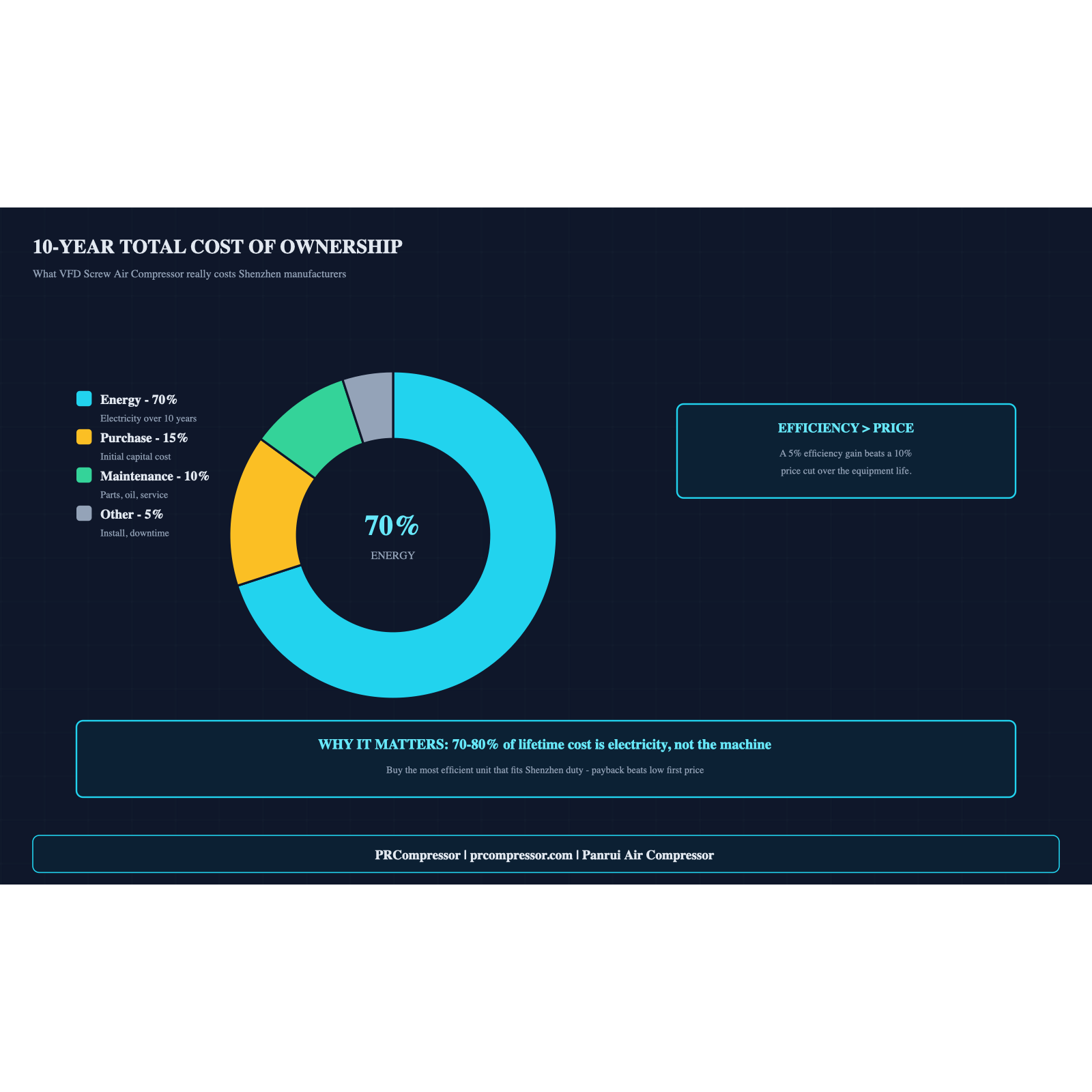
Visual: Optimal System Configuration
Industry Data: Compressed Air Energy Consumption Patterns in Shenzhen
Understanding how compressed air energy consumption patterns compare to industry benchmarks provides valuable context for evaluating your facility’s performance. Industry research shows that compressed air systems account for 10-30% of total industrial electricity consumption, with the average around 12-15% for general manufacturing.
For a typical Shenzhen manufacturing facility with an annual electricity bill of ¥5 million, the compressed air system accounts for ¥500,000 to ¥1.5 million in annual energy costs. Leak rates in industrial systems average 25-35% of total compressor output — meaning that for every three compressors running, one is effectively producing wasted air.
System pressure is another area where significant savings are available. The average industrial compressed air system operates at 1-2 bar higher than necessary. Reducing system pressure by 1 bar saves 6-8% of compressor energy.
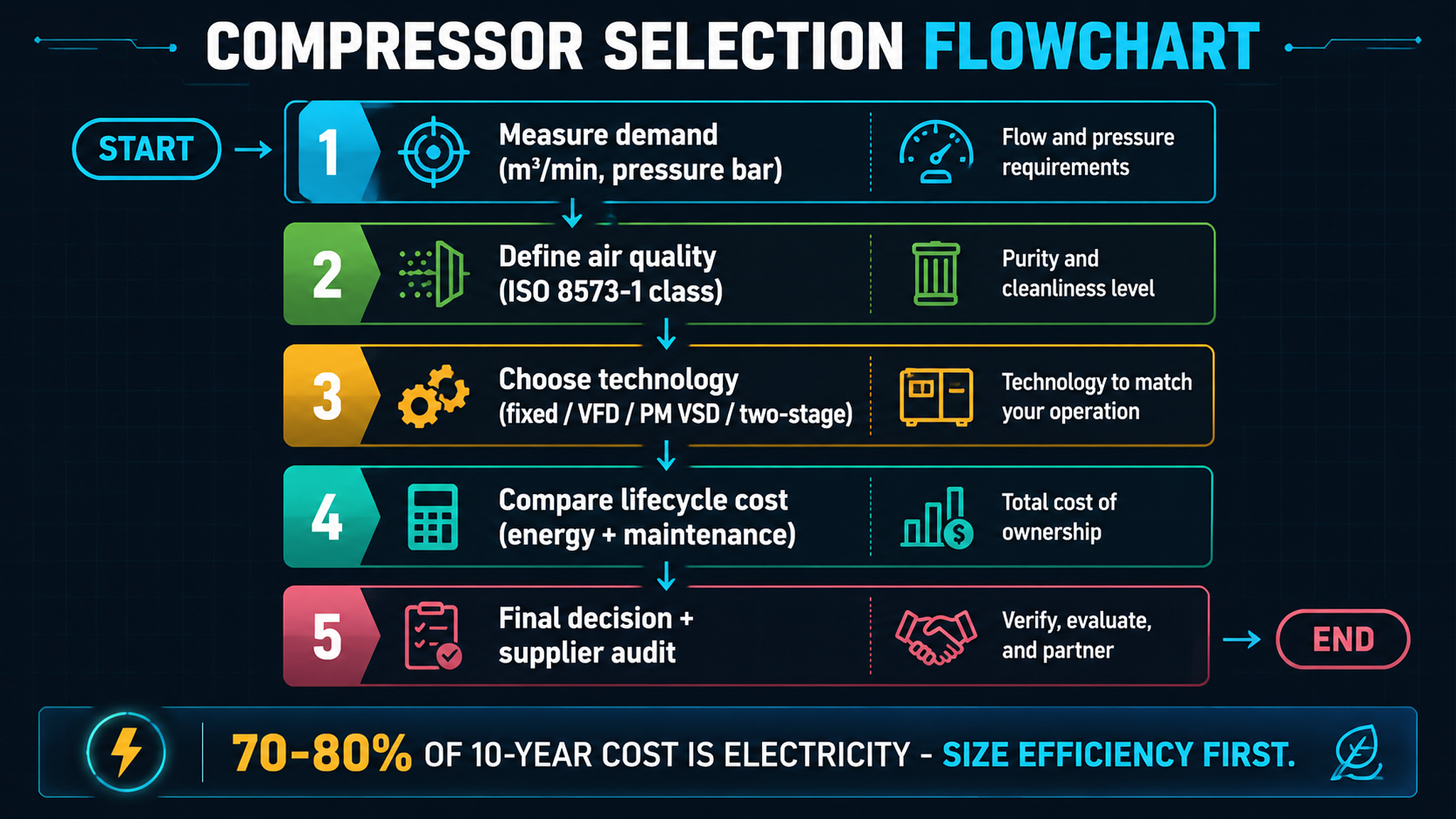
Visual Guide: Compressor Selection Process
[Flowchart: A step-by-step visual guide to selecting the right VFD Screw Air Compressor in Shenzhen, starting from demand measurement and air quality requirements through technology evaluation, supplier comparison, and final decision.]
VFD Screw Air Compressor for Automotive and Parts Manufacturing in Shenzhen
The automotive parts manufacturing sector in Shenzhen is characterized by high-volume production, demanding quality standards, and significant compressed air requirements. From robotic welding cells and automated assembly lines to paint spraying booths and pneumatic testing equipment, automotive production depends heavily on reliable compressed air supply.
Key compressed air requirements for Shenzhen automotive manufacturers include high reliability, consistent air quality, and energy efficiency. These requirements make automotive manufacturers natural candidates for premium VFD Screw Air Compressor with comprehensive monitoring and service support agreements.
Two-stage compression technology is particularly well-suited for automotive applications, as many automotive processes require pressures at the higher end of the industrial range (10-13 bar). The efficiency advantage of two-stage compression is most pronounced at these higher pressures. VFD technology is also widely adopted, as the demand profile in automotive plants typically varies significantly between production shifts.
For Shenzhen automotive parts manufacturers, the selection of VFD Screw Air Compressor should be approached as a strategic decision with long-term implications for production reliability and operating costs.
Energy Cost Savings: Quantifying the Impact of Efficient VFD Screw Air Compressor
For Shenzhen manufacturers, energy cost savings represent the largest and most predictable benefit of investing in efficient VFD Screw Air Compressor. The magnitude of these savings depends on the efficiency difference between current and new equipment, the operating profile, local electricity rates, and the specific technology choices made.
The most important metric for comparing compressor energy efficiency is specific power. A typical older fixed-speed compressor might have a specific power of 7.0-7.5 kW/(m³/min). A modern premium-efficiency VFD compressor with PMSM motor technology might achieve 5.2-5.8 kW/(m³/min) — representing a 20-30% improvement. For a facility operating a 75kW compressor 6,000 hours per year, this translates to annual energy savings of 100,000-150,000 kWh worth ¥80,000-150,000.
The savings from VFD technology are additional to the savings from improved mechanical efficiency. For facilities with variable air demand, VFD technology typically reduces energy consumption by an additional 30-50%. The combined effect can reduce total compressed air energy costs by 40-60% compared to older fixed-speed equipment.
For Shenzhen facilities considering a compressor upgrade, the following steps will produce a reliable energy savings estimate: measure current compressed air energy consumption; determine your facility’s demand profile; obtain specific power data from suppliers of candidate equipment; calculate potential energy savings; and apply your effective electricity rate to convert energy savings to cost savings.
Taking Action: Your Next Steps for VFD Screw Air Compressor Procurement in Shenzhen
Armed with the information in this guide, here is a practical action plan to move from knowledge to decision.
Week 1-2: Assessment — Measure compressed air demand. Determine air quality requirements. Document operating profile. Establish budget and timeline.
Week 3-4: Research — Identify potential suppliers. Request preliminary proposals from at least three qualified suppliers. Attend product demonstrations. Research reputations.
Week 5-6: Evaluation — Develop TCO comparison. Contact references. Conduct site visits. Evaluate service capabilities.
Week 7-8: Decision — Select preferred supplier. Negotiate commercial terms. Finalize installation plan. Place order.
For expert guidance at any stage, contact PRCompressor at 13713647073 or prcompressor.com.
Keywords: shenzhen manufacturer, compressor buyer’s guide, shenzhen compressor, vfd screw air compressor, compressor energy efficiency, industrial compressed air, industrial air compressor, compressor supplier, energy saving compressor, screw air compressor
Contact PRCompressor (Panrui) for vfd screw air compressor in Shenzhen: Phone 13713647073 | prcompressor.com