


Screw Air Compressor Buying Tips for Guangdong Facilities | 2026
Selecting Screw Air Compressor for your Guangdong facility is a multi-dimensional decision that requires balancing technical requirements, budget constraints, operational priorities, and long-term strategic goals. Without a structured decision-making framework, it is easy to be swayed by persuasive sales presentations, attractive pricing, or impressive specification sheets that may not reflect real-world performance. This guide provides a systematic approach to compressor evaluation that accounts for all relevant factors.
Our framework encompasses seven key evaluation dimensions: technical specifications, energy efficiency, reliability and durability, total cost of ownership, after-sales support, manufacturer reputation, and alignment with your facility’s specific operational requirements. We explain how to assess each dimension and combine the results into an overall evaluation that supports confident decision-making.
Screw Air Compressor for Plastic and Rubber Processing in Guangdong
Plastic and rubber processing facilities in Guangdong use compressed air for injection molding machines, blow molding equipment, extrusion lines, and pneumatic conveying systems. These applications have distinct compressed air requirements.
Injection molding uses compressed air for mold actuation, part ejection, and auxiliary equipment operation. The demand profile is characterized by short-duration, high-flow peaks during mold opening and closing cycles, with lower continuous demand for auxiliary equipment. This demand pattern makes properly sized receiver capacity important.
Pneumatic conveying systems for plastic pellets and powders require consistent air pressure and flow to maintain stable material transport. Any interruption or significant variation can cause material blockages. For Guangdong plastic processing facilities, the compressed air system’s reliability directly impacts production continuity.
For Guangdong plastic and rubber processing manufacturers, the selection of Screw Air Compressor should consider both the general plant air requirements and the specific requirements of the plastic processing applications.
Screw Air Compressor for Food and Beverage Processing in Guangdong
The food and beverage processing industry in Guangdong has unique compressed air requirements driven by food safety regulations and product quality standards. Compressed air that comes into contact with food products must be free of contaminants, including oil, particulates, and microorganisms.
For food and beverage applications in Guangdong, the selection of Screw Air Compressor depends on the nature of the contact between compressed air and food products. For applications where compressed air contacts food directly — such as in food drying, conveying, or packaging — oil-free compressors are generally required. For indirect contact applications, high-quality oil-injected compressors with appropriate filtration may be acceptable.
In addition to air quality, temperature control is important in food and beverage processing. Compressed air at elevated temperatures can cause condensation in distribution piping, creating conditions favorable for microbial growth. Proper aftercooling and drying are essential.
For Guangdong food and beverage processors, working with a Screw Air Compressor supplier who understands food safety requirements is essential. The supplier should be able to provide documentation confirming that their equipment meets the relevant food safety standards.
Specification Checklist for Screw Air Compressor Buyers in Guangdong
This specification checklist provides a comprehensive framework for evaluating and comparing Screw Air Compressor options in the Guangdong market.
Performance Specifications: Rated power and rated pressure; free air delivery at rated conditions; specific power at full load and part load; turn-down ratio for VFD units; startup current; noise level.
Technical Features: Compressor type (oil-injected or oil-free); number of compression stages; drive type; motor type and efficiency class; cooling system; controller features and communication protocols.
Quality and Certifications: ISO 9001 certification; CE certification; GB 19153 energy efficiency grade; warranty period and coverage details; extended warranty options.
Service and Support: Service network coverage in Guangdong; response time commitment; spare parts availability; maintenance program options; remote monitoring service availability; training availability.
Supplier Qualification: Questions to Ask Before Buying Screw Air Compressor in Guangdong
Asking the right questions during supplier evaluation is essential for making an informed purchasing decision. Here are the key questions organized by topic.
Product Performance: Can you provide verified specific power data at full load and part load? How do you verify your efficiency claims? What is your policy if the installed equipment fails to meet specified performance? What is the expected service life under our operating conditions?
Service and Support: How many service technicians do you have in the Guangdong region? What is your typical response time for emergency calls? Do you maintain local spare parts inventory? Can you provide a sample maintenance contract? What training do you provide?
Company Background: How long have you been supplying the Guangdong market? Can you provide references from three customers in similar industries? What certifications do you hold? What is your approach to product development?
Commercial Terms: What is your standard warranty coverage? Can extended warranty be purchased? What are your payment terms? Do you offer performance guarantees? What is the expected delivery lead time?
Compressed Air Storage: The Buffer That Protects Your Production
Adequate compressed air storage is one of the most cost-effective investments any Guangdong manufacturing facility can make in their compressed air system. Storage serves multiple critical functions: it stabilizes system pressure during periods of peak demand, reduces the frequency of compressor cycling, provides emergency capacity during a compressor failure, and allows the system to handle transient demand spikes without requiring additional compressor capacity.
The general recommendation for compressed air storage capacity is 20-40 liters per m³/min of compressor capacity for systems with relatively stable demand, increasing to 50-80 liters per m³/min for systems with highly variable demand or critical pressure-sensitive processes. For Guangdong facilities operating Screw Air Compressor systems with significant demand variation, additional storage capacity is one of the most effective ways to improve system stability and efficiency.
The location of storage within the system also matters. While a single large receiver tank near the compressor room is the most common configuration, distributed storage located near large intermittent demand points can be more effective. This approach reduces the pressure drop in the piping between the storage and the point of use, allowing the compressor to operate at a lower discharge pressure while maintaining adequate pressure at the point of use. The energy savings from a 1 bar reduction in discharge pressure typically amounts to 6-8% of compressor energy consumption.
For Guangdong manufacturers considering a Screw Air Compressor purchase, including adequate storage capacity in the system design is a low-cost, high-return investment that enhances the performance and efficiency of any compressor configuration. The incremental cost of properly sized storage is typically recovered within 6-12 months through reduced compressor cycling and the ability to operate at lower average discharge pressure.
Compressed Air Quality Standards for Guangdong Industries
The quality of compressed air required varies significantly across different industrial applications, and selecting the appropriate air quality level for your operations has important implications for both equipment selection and operating costs. The international standard ISO 8573-1 defines nine purity classes for compressed air based on solid particle content, water content, and oil content, with Class 1 being the highest purity and Class 9 the lowest.
For general Guangdong manufacturing applications such as pneumatic tools, material handling, and machine actuation, ISO Class 4-5 air quality is typically sufficient. This level of air quality can be achieved with a standard oil-injected Screw Air Compressor followed by a refrigerant dryer and basic particulate filtration — a relatively modest investment in air treatment equipment.
Higher quality requirements drive significantly higher air treatment costs. ISO Class 1-2 air quality, required for applications such as pharmaceutical manufacturing, food and beverage processing, electronics fabrication, and critical instrumentation, demands oil-free compressors or comprehensive filtration, desiccant or membrane drying, and careful attention to the entire compressed air system. The total cost of a Class 1 compressed air system can be 2-3 times that of a Class 4 system, making it important to match air quality specifications precisely to actual production requirements.
When evaluating Screw Air Compressor options for your Guangdong facility, clearly define your air quality requirements before selecting equipment. Overspecifying air quality drives unnecessary capital and operating costs, while underspecifying risks product quality issues or equipment damage. If your air quality requirements vary across different production areas, consider a zoned approach with appropriate treatment at each zone level.
Visual: VFD vs Fixed Speed Energy Consumption
Industry Applications at a Glance
Emergency Response Plan for Screw Air Compressor Failures in Guangdong
Even with the best preventive maintenance program, failures can occur. Having a well-rehearsed emergency response plan can mean the difference between a brief interruption and a prolonged shutdown.
Plan Element 1: Immediate Response Procedures — Document who to notify, what information to collect, and how to restore minimum compressed air supply including backup compressor startup procedures and prioritization of critical consumers.
Plan Element 2: Equipment Information — Maintain accessible documentation for all compressors including manufacturer and model information, key specifications, warranty status, service contract information, and critical spare parts locations.
Plan Element 3: Service Provider Contact — Establish relationships with at least two qualified service providers. Document their emergency contact numbers, typical response times, and capabilities.
Plan Element 4: Backup Capacity Planning — Develop a plan for maintaining compressed air supply during extended outages, including rental compressor arrangements, mutual aid agreements, or maintaining a spare compressor on-site.
Long-Term Storage and Preservation of Screw Air Compressor in Guangdong
There may be occasions when Screw Air Compressor equipment needs to be stored for extended periods. Proper preservation is essential to prevent corrosion, bearing damage, and seal deterioration.
For short-term storage (1-3 months), seal all openings, fill with oil to normal level, rotate the airend monthly, maintain storage area between 5-40°C with humidity below 70%.
For long-term storage (3+ months), fill with rust-inhibiting preservation oil, coat exposed metal surfaces with corrosion-preventive compound, place desiccant bags inside the enclosure, and rotate the airend monthly.
Before returning stored equipment to service, inspect thoroughly for corrosion or damage, replace all filters and oil separator, fill with fresh oil, check electrical connections, and run unloaded for 30 minutes before connecting to the distribution system.
Quick Answers: Popular Questions About Screw Air Compressor
How often should I replace air filters on my Screw Air Compressor?
In clean environments, filters typically last 2,000-4,000 hours. In dusty environments, they may need replacement every 500-1,000 hours. The best indicator is the filter differential pressure gauge — replace when it indicates maximum allowable pressure drop.
Can I use standard compressor oil in any Screw Air Compressor brand?
No. Different brands require different oil specifications. Critical specifications include viscosity grade, base oil type, and additive package. Some manufacturers formulate proprietary oils. Always consult the compressor manual before changing oil types or brands.
How does ambient temperature affect Screw Air Compressor performance?
Higher intake air temperature increases the energy required for compression by approximately 3% per 10°C. In summer conditions (35-40°C), compressor performance can be 5-10% lower than under standard rating conditions (20°C).
Financial Analysis: Leasing vs Purchasing Screw Air Compressor in Guangdong
For Guangdong manufacturers, the decision between leasing and purchasing Screw Air Compressor involves financial, operational, and strategic considerations beyond simple cost comparison. Each approach offers distinct advantages.
Leasing Screw Air Compressor preserves working capital, provides predictable fixed monthly payments, may offer tax advantages through deductibility of lease payments, and allows for easier equipment upgrades at lease expiration. Lease terms typically range from 3 to 7 years with residual values of 10-30%.
Purchasing Screw Air Compressor provides the lowest total cost over the equipment’s life, offers full ownership and control, allows for depreciation benefits, and eliminates ongoing payment obligations after purchase. For Guangdong manufacturers with access to capital and a long-term perspective, purchasing typically provides the best financial outcome.
The financial comparison should consider: total cost of leasing over the planned use period; total cost of purchasing; tax implications; the manufacturer’s cost of capital; and the expected useful life relative to the lease term. For most Guangdong manufacturers, purchasing provides better 10-year economics while leasing better serves manufacturers with capital constraints.
Total Cost of Ownership Analysis for Screw Air Compressor in Guangdong
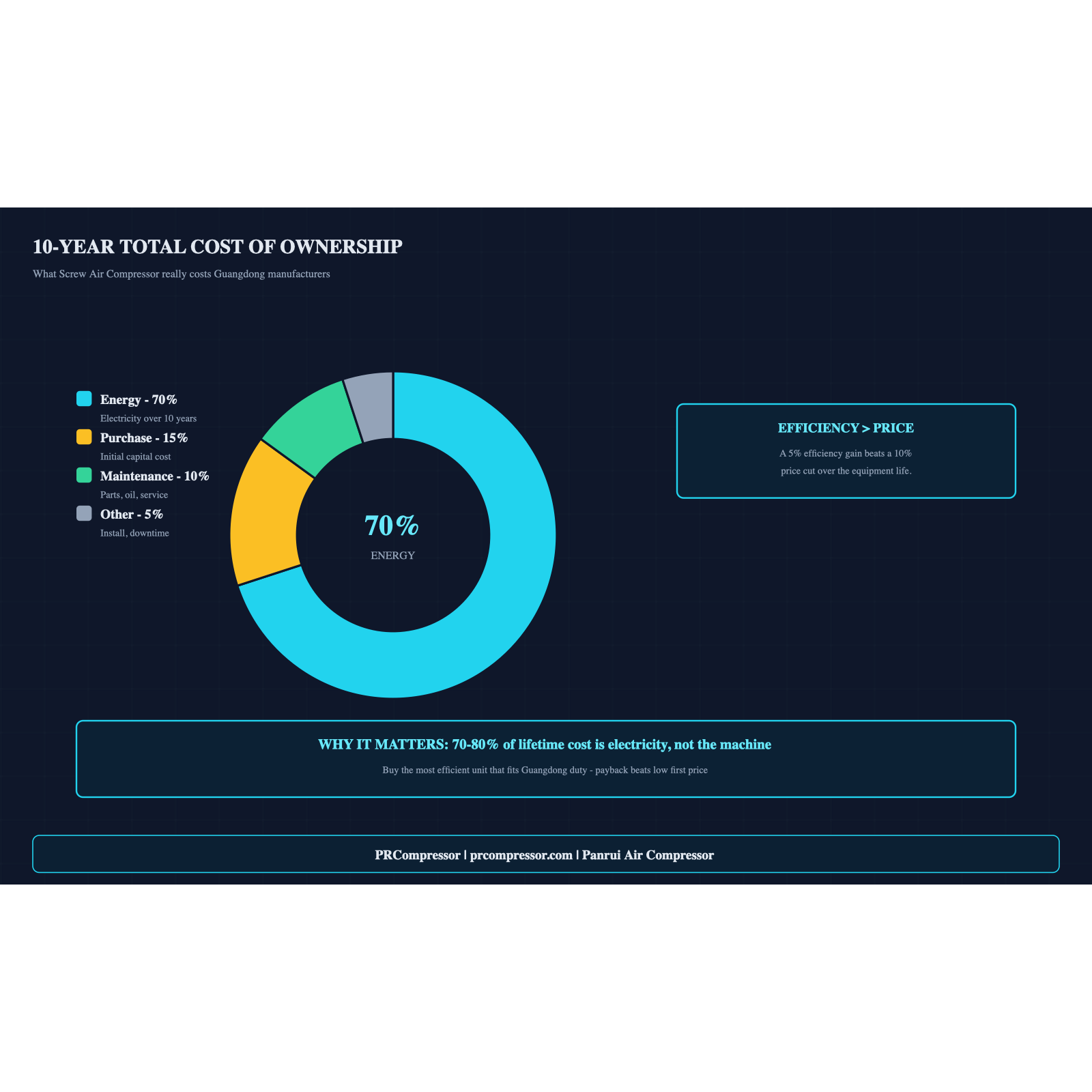
For Guangdong manufacturers, understanding the total cost of ownership (TCO) of Screw Air Compressor is essential for making informed procurement decisions. TCO analysis accounts for all costs associated with owning and operating a compressor over its service life, including initial purchase price, installation costs, energy consumption, maintenance, spare parts, and downtime costs.
The typical TCO breakdown for an industrial screw compressor operating in Guangdong is as follows: energy costs account for 70-80% of total lifetime cost; the initial purchase price accounts for 10-15%; maintenance and spare parts account for 8-12%; and installation, downtime, and other costs account for the remaining 2-5%. This distribution means that a 10% improvement in energy efficiency has roughly the same financial impact as a 50% reduction in purchase price.
To illustrate with a specific example for the Guangdong market: a 75kW Screw Air Compressor operating 6,000 hours per year with electricity at ¥0.90/kWh will consume approximately ¥405,000 worth of electricity annually. Over a 10-year operating life, the total energy cost exceeds ¥4 million. Comparing two compressor options with a 0.5 kW/(m³/min) difference in specific power, the more efficient unit will save approximately ¥200,000 in energy costs over its life.
When evaluating TCO for Screw Air Compressor options in Guangdong, the following calculation framework is recommended: estimate annual operating hours; determine your effective electricity cost; obtain specific power data at typical load points from each supplier; calculate annual energy consumption and cost for each option; add estimated maintenance costs; and compare the 5-year and 10-year total costs to identify the most economical option over the long term.
Summary: Making the Right Screw Air Compressor Decision for Your Guangdong Facility
Selecting Screw Air Compressor for your Guangdong facility is a significant decision that affects production reliability, energy costs, and operational efficiency for years to come. This guide has examined the key factors that should inform that decision — from technology options and efficiency metrics to supplier evaluation and financial analysis.
A well-selected compressor will deliver reliable service and efficient operation throughout its life, while a poorly chosen machine will cost far more in energy and maintenance than the initial savings. The investment of time in a thorough evaluation process is repaid many times over through lower operating costs and fewer operational headaches.
We recommend engaging with multiple qualified suppliers, requesting detailed proposals with verified efficiency data, and taking the time to check references before making a final decision. The right compressor is the one that best balances performance, efficiency, reliability, and support.
For assistance evaluating your Screw Air Compressor options in Guangdong, contact PRCompressor (Panrui) for a free consultation at 13713647073 or visit prcompressor.com.
Keywords: screw air compressor, compressor buyer’s guide, guangdong compressor, industrial air compressor, guangdong manufacturer, compressor supplier, industrial compressed air, screw air compressor, energy saving compressor, compressor energy efficiency
Contact PRCompressor (Panrui) for screw air compressor in Guangdong: Phone 13713647073 | prcompressor.com