


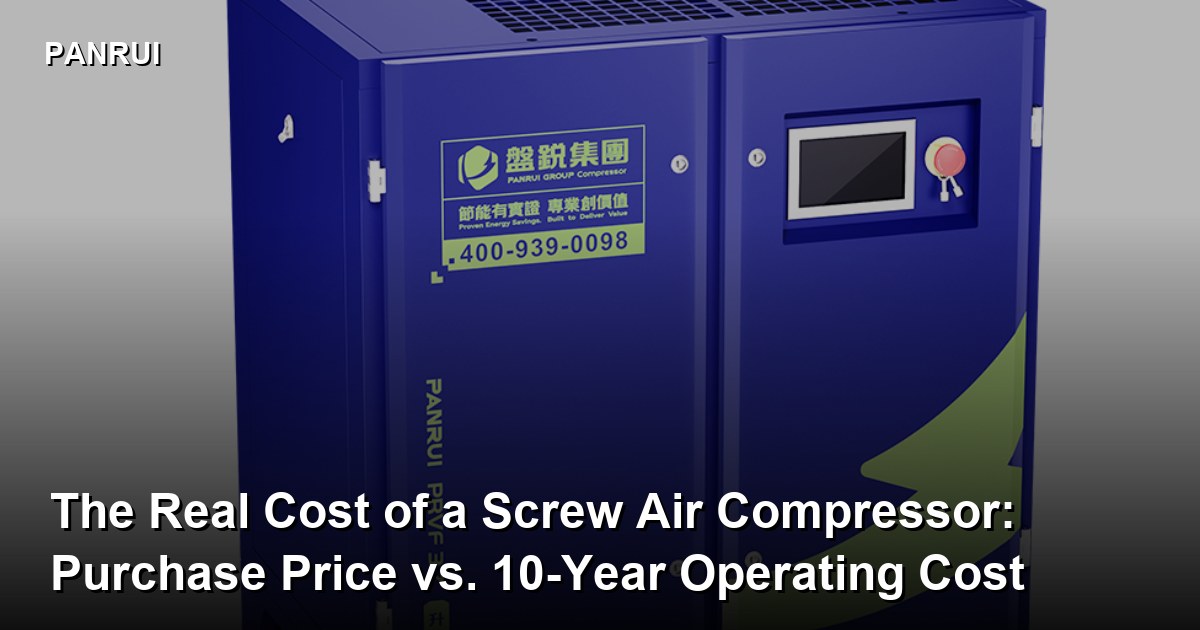
Many purchasing decisions focus on the initial price of a screw compressor. Over a ten-year life, however, electricity and maintenance usually dominate the total cost of ownership, making efficiency a far more important factor than the invoice amount.
Where the Money Goes
- Energy: often around 75% of the ten-year total cost.
- Equipment: the initial purchase may be about 15% of the total.
- Maintenance: consumables and service can account for roughly 10%.
- Downtime: unplanned production losses add cost that is not always visible on the compressor budget.
The Hidden Losses of a Low-Efficiency Machine
- It may consume more electricity for the same delivered air.
- Frequent failures interrupt production and increase repair costs.
- Poor part-load performance wastes energy when demand drops.
- Cheaper components can shorten service life and increase maintenance frequency.
For this reason, the best purchase evaluation compares a high-efficiency machine against a low-cost machine over five to ten years. A slightly higher screw compressor factory direct price may be recovered quickly if the machine uses less electricity and needs fewer repairs.
Build a Simple ROI Comparison
- Estimate annual operating hours and average load.
- Calculate the annual electricity cost for each model.
- Add expected service and replacement parts over the evaluation period.
- Compare the total cost instead of only the quotation price.
A variable speed screw air compressor can improve the ROI calculation when production demand varies during the day, because it avoids the constant load/unload losses of a fixed-speed unit.
The goal is not to find the cheapest compressor, but the one with the lowest realistic cost per cubic meter of compressed air.