


A plant running three shifts cannot stop every few hours to let a compressor cool down. That single difference is why the screw compressor vs reciprocating compressor decision matters more than brand, horsepower, or the initial price. Pick the wrong technology for continuous duty and you end up with pressure drops on the line, a backup unit you should not need, and an electricity bill that keeps climbing.
Duty Cycle: 100% Screw vs. Intermittent Reciprocating
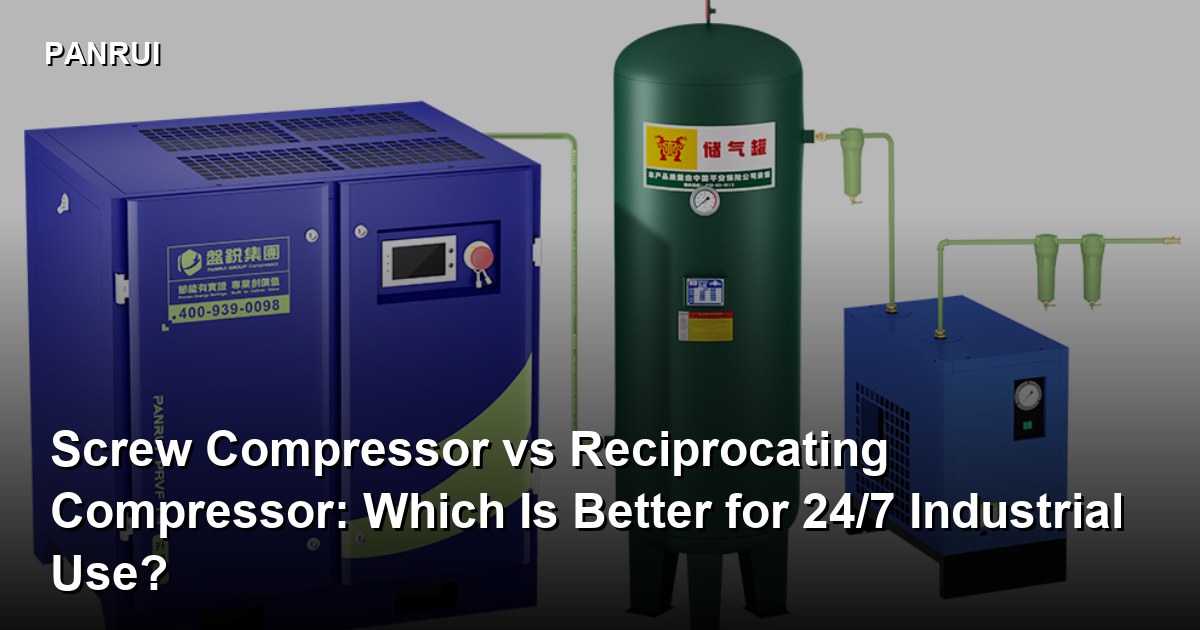
Rotary screw air compressors are engineered for a 100% duty cycle: they can load, unload, and load again around the clock without an operator-imposed rest period. Reciprocating piston compressors are different. Most industrial pistons are rated for roughly a 50–60% duty cycle, because the piston, rings, and cylinder walls need time to shed compression heat.
In a 24/7 plant, that gap becomes an operating cost. A piston unit running beyond its duty cycle wears rings and valves faster, trips on high discharge temperature, and forces you to oversize or run a second machine in rotation. For continuous production, a rotary screw air compressor is the technology designed for the job.
Energy Cost: Where Screw Machines Pull Ahead
Duty cycle is only the first cost. Over a 10-year life, electricity is roughly 70–80% of total compressor ownership cost, so small efficiency differences compound fast. Panrui twin-screw machines use near-isothermal compression, which lifts compression efficiency by 10–15% versus conventional single-stage designs. In real installations, the company documents energy savings of 20–50% against the older fixed-speed machines they replace.
The savings come from specific design choices, not marketing language:
- Two-stage compression cuts the per-stage compression ratio and saves about 8% versus a single-stage screw.
- A permanent-magnet motor with intelligent variable-speed control removes over-pressure and no-load running; a variable speed screw air compressor matches output to actual demand instead of holding excess pressure.
- Pressure customization removes wasted bar—each 1 bar of unnecessary pressure adds roughly 8% to energy use.
Heat, Noise, and Oil Carryover in Continuous Production
Continuous operation punishes any machine that was not designed for it. Panrui screw compressors are built for 52°C ambient operation, well above the 40°C design point common in the industry, with cooling systems enlarged by 20–30%. That headroom is the difference between a summer shutdown and a stable pressure supply.
Reciprocating units add two more problems in a full production hall: noise and pulsation. A piston machine’s impact loading creates vibration and pressure pulses that stress piping and tools, while the Panrui screw range measures 70±2 dB(A) at one meter—close to normal conversation. Screw machines also carry far less oil into the air stream, protecting dryers, tools, and finished-product quality downstream.
When a Reciprocating Compressor Still Makes Sense
The honest answer: pistons still win in a narrow set of jobs.
- Intermittent use in small workshops where the duty cycle stays under 50%.
- Low-flow, high-pressure niche tasks where a piston’s simple design keeps upfront cost down.
- Backup or emergency air with limited running hours.
If your demand is measured in hours per day rather than shifts, a piston unit may be fine. The moment production becomes continuous, the economics flip in favor of screw technology.
Bottom Line: Choose for the Duty Cycle You Actually Run
For a 24/7 industrial plant, the screw compressor vs reciprocating compressor comparison is not close. Screw machines run 100% duty, tolerate heat, use less energy per cubic meter, and outlast pistons—Panrui backs its machines with a 100,000-hour design life, local 24-hour service response, and customer-verified results such as a 37 kW PRSF two-stage unit that cut electricity costs while holding stable pressure, vibration, and noise.
For the purchase decision, work the numbers: duty cycle, specific power, and 10-year energy cost—not the sticker price. If continuous production is your reality, talk to a Panrui application engineer and size the right screw machine for your shift pattern.