


If a 250 kW screw compressor keeps short-cycling, the problem is usually not the airend. It is an undersized receiver. Every extra start adds motor heat and contactor wear, and a pressure band that is too wide can waste roughly 8% energy for each 1 bar of excess pressure. Getting air receiver tank sizing right is the cheapest way to stabilize plant pressure before you change the compressor itself. A receiver that is too small forces the motor to work harder and raises the cost of every cubic meter of air.
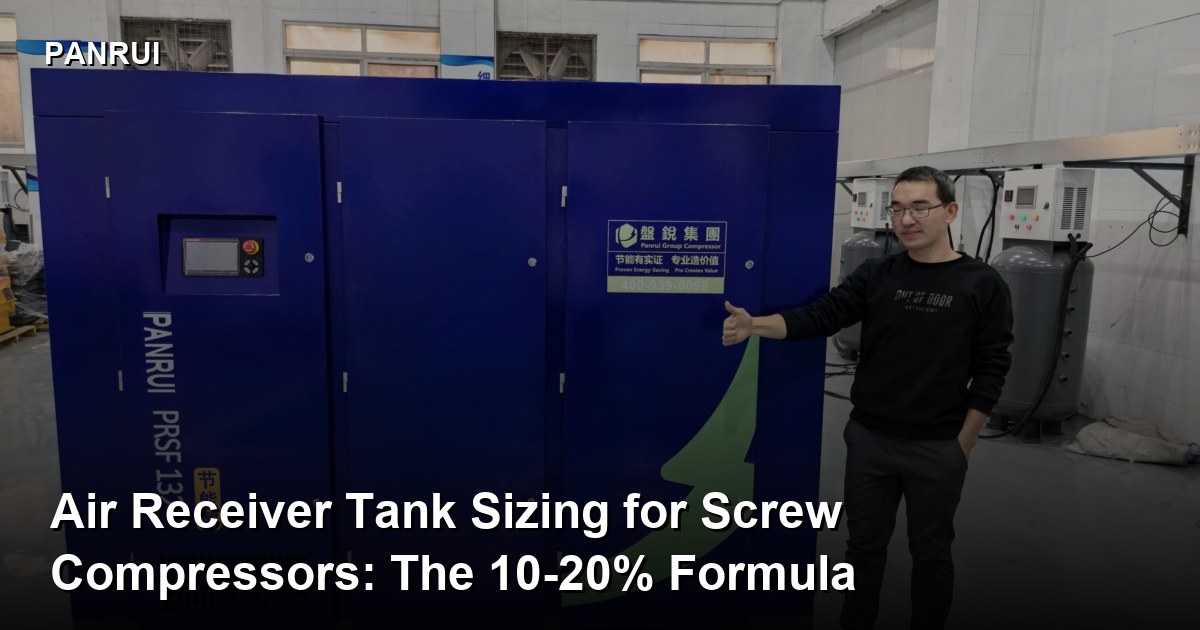
What Air Receiver Tank Sizing Should Do
A receiver stores compressed air, damps pressure pulsations, and lets the compressor unload instead of starting and stopping. It also gives the dryer and filters a steadier airflow, which improves dew point and filtration. The sizing target is simple: keep enough stored volume to cover demand swings without forcing the motor to cycle too often.
The 10-20% Rule for Air Receiver Tank Sizing
For a fixed-speed rotary screw unit, start with receiver volume equal to 10-20% of the compressor free air delivery (FAD). A machine delivering 10 m³/min needs about 1-2 m³ of storage. A large 45 m³/min two-stage unit needs 4.5-9 m³. This range is a starting point, not a final answer; the exact volume still depends on demand pattern and pressure tolerance.
Why Receiver Volume Depends on Pressure
Pressure changes the useful stored energy. At a higher system pressure, the same tank holds more standard cubic meters of air, but pushing pressure higher than the process needs is expensive. A good working rule is that every extra 1 bar costs about 8% more energy. Size the receiver for the lowest pressure that still delivers the required flow at the point of use.
Worked Example: 250 kW Two-Stage Screw Compressor
In one Panrui energy audit, a 250 kW unit running at 8.6 bar consumed 207.67 kW. Lowering the required system pressure to 4.9 bar cut demand to 154.43 kW, saving 53.24 kW/h. A correctly sized receiver supports this saving by letting the controller hold a narrow pressure band instead of chasing a wide one. Fixed-speed systems can swing around 0.2 MPa, while a VSD screw compressor holds about ±0.01 MPa.
When to Size Larger or Smaller
- Fixed-speed: use 10-20% of FAD, and go larger if the compressor cycles often.
- VSD: 6-10% of FAD is often enough because the motor speed modulates with load.
- Impact loads and short, heavy bursts: go above 20% to build a real buffer.
- Multiple compressors on a shared header: size the receiver for the trim unit, not the full plant.
Do not oversize without reason. Large tanks cost more, take floor space, and add condensate. Undersizing is still the more expensive mistake because wasted starts and unstable pressure erode production quality.
Three Checks After You Calculate Tank Volume
- Install the aftercooler and dryer upstream so the tank stores clean, dry air.
- Fit a safety relief valve, pressure gauge, and an automatic drain before start-up.
- Place the receiver close to the compressor and keep the inlet piping short to limit pressure drop.
Panrui Screw Compressors and Receivers
Panrui builds rotary screw air compressors from 5.5 kW to 315 kW with FAD from 0.8 to 55 m³/min. Units use hard-pipe connections and enlarged piping to reduce pressure loss, and each machine is tested for 12 hours before dispatch. VSD screw air compressors and two-stage models can cut energy use by 20-50% compared with older fixed-speed equipment.
Start with 10-20% of FAD for fixed-speed units and 6-10% for VSD models, then add buffer volume for impact demand. If you want the receiver, dryer, and filter sized as one system, contact Panrui for a factory quote.