


Every 1 psi (0.07 bar) of pressure drop adds roughly 0.5–1% to compressor energy use, so a plant losing 14 psi between the package and its tools is paying 7–14% more for air than it should — every month, for years. Most of that loss is a compressed air piping design problem, not a compressor problem.
The symptoms are familiar: pressure gauges that read differently across the plant, tools that starve at peak demand, and a discharge pressure raised higher and higher to compensate. You pay for the energy twice — once for the pressure you need and once for the pressure you lose on the way.
Compressed Air Piping Design Rule 1: Size for Velocity
Friction loss rises roughly with the square of air velocity, so pipe diameter is the single biggest lever in compressed air piping design. Keep main header velocity in the 20–30 ft/s (6–9 m/s) range at the compressor’s rated flow. Oversized pipe costs a little more once; undersized pipe costs energy every day for decades.
Rule 2: Build a Loop, Not a Dead-End Line
A looped header lets air reach demand from two directions, which balances pressure and cuts peak drop. Take branch lines off the top of the header so condensed water cannot drain into the drops, slope the header slightly toward a drain point, and put the receiver near the largest intermittent demand instead of beside the compressor.
Rule 3: Watch the Fittings, Not Just the Pipe
- Sharp 90° elbows and undersized quick couplers are the biggest hidden drop sources — one restrictive fitting can cost more pressure than 10 meters of straight pipe.
- Keep hose runs short and hose diameters matched to the tool’s demand.
- Install a pressure gauge at the farthest point of use — that reading, not the compressor gauge, is the number that matters.
- Repair leaks at joints and couplers; a single 3 mm leak at 7 bar can waste enough electricity to run a small compressor by itself.
Sizing shortcuts work for simple runs, but the safest check is a pressure-drop calculation at your real flow and worst-case temperature. If the plant grows, velocity climbs with flow — a 50 mm header sized for today’s compressor can become a serious pressure loser after you add a second unit.
Proof: What Good Piping Delivers
Improve a poorly designed line and the compressor can often run at a lower discharge pressure. With every 1 psi of drop removed saving roughly 0.5–1% of compressor energy, a plant recovering 8 psi across the system cuts 4–8% of the air compressor’s electricity bill before touching the compressor. Pair that with a variable-speed drive and the savings compound.
FAQ: Is the Loop Worth the Extra Pipe?
Yes — the extra meters of pipe usually pay for themselves in lower pressure drop and fewer dead zones. If the plant grows, the loop also makes future take-offs simple, so you avoid re-running a main line at peak demand. For new builds, design the loop first and let the compressor room layout follow it.
Design It Once, Pay Less Every Month
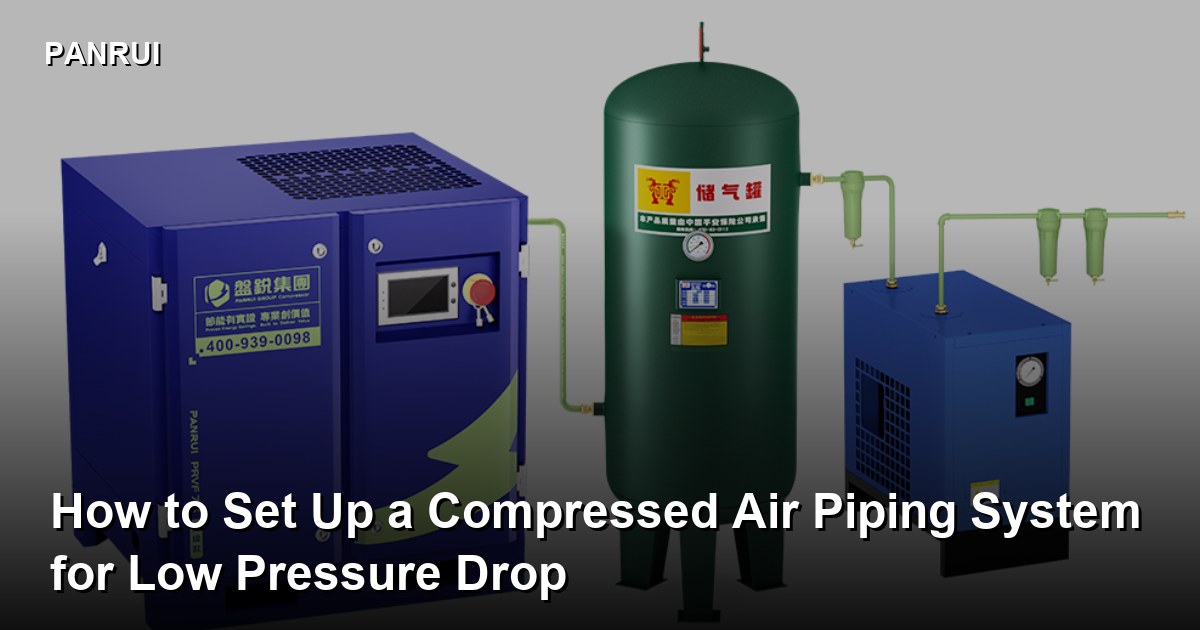
Compressed air piping design is a one-time decision with a 20-year energy bill attached. Check your own line sizes, velocities, and farthest-point gauge readings against the rules above, then review the compressor side too — duty cycle, receiver, and dryer sizing all interact with the piping. Start with our rotary screw air compressor range, and send your pipe sizes and farthest-point pressure to a Panrui engineer for a free piping audit. A compressed air piping design that keeps velocity low, pressure balanced, and drop measured is the cheapest energy saving you will ever install.