


Energy Saving Air Compressor Technology Guide for South China Industries (2026)
The industrial compressed air landscape in South China is experiencing unprecedented change in 2026. With energy costs rising by approximately 8-15% annually across most Chinese industrial regions, manufacturing facilities are under intensifying pressure to optimize their air compression systems. This detailed analysis explores how South China businesses can navigate the complex market for Energy Saving Air Compressor and make procurement decisions that will serve them well for the next decade.
Industry data from recent surveys indicates that over 60% of industrial facilities in South China are operating compressed air systems that are either outdated or improperly sized for their current production needs. This inefficiency represents both a significant cost burden and a substantial opportunity for improvement. The manufacturers who act decisively to upgrade their compressed air infrastructure stand to gain a meaningful competitive advantage through lower operating costs and improved production reliability.
Common Mistakes to Avoid When Buying Energy Saving Air Compressor in South China
Experience shows that South China manufacturers often make predictable mistakes when purchasing Energy Saving Air Compressor. Being aware of these common errors will help you avoid them and make a better procurement decision.
Mistake 1: Buying on Price Alone — The most common and most costly mistake. The compressor with the lowest purchase price is almost never the most economical choice over its operating life. Evaluate proposals based on 5-year or 10-year total cost of ownership, not purchase price.
Mistake 2: Oversizing the Compressor — Many facilities purchase compressors significantly larger than actual needs, causing inefficient part-load operation and wasted energy. Conduct a proper demand assessment and size the compressor to match actual requirements.
Mistake 3: Neglecting System Design — Focusing exclusively on the compressor while neglecting piping, storage, air treatment, and condensate management can negate the benefits of even the best compressor. Evaluate the complete system.
Mistake 4: Ignoring Service Capability — Choosing a compressor without verifying the supplier’s service capabilities in your area is a recipe for future frustration. Verify service network coverage and response time commitments.
Mistake 5: Skipping the Audit — Investing in new equipment without first understanding your current system’s performance is like treating symptoms without a diagnosis. Invest in a professional audit before making procurement decisions.
Future-Proofing Your Energy Saving Air Compressor Investment in South China
Investing in Energy Saving Air Compressor is a long-term commitment that will affect your facility’s operations, energy costs, and environmental performance for a decade or more. Protecting that investment against future changes is an important consideration.
Technology compatibility is key. Choose equipment that supports open communication protocols rather than proprietary systems. Select controllers with upgradeable firmware. If considering IoT capabilities, ensure the platform supports common connectivity standards that will remain relevant.
Regulatory preparedness is another consideration. China’s energy efficiency standards are expected to continue tightening. Choosing equipment that meets anticipated future standards provides a compliance buffer. Selecting equipment with lower environmental impact positions your facility favorably for future regulations.
Flexibility in equipment configuration also supports future-proofing. Modular compressor designs that allow capacity additions or technology upgrades without replacing the entire system provide valuable adaptability.
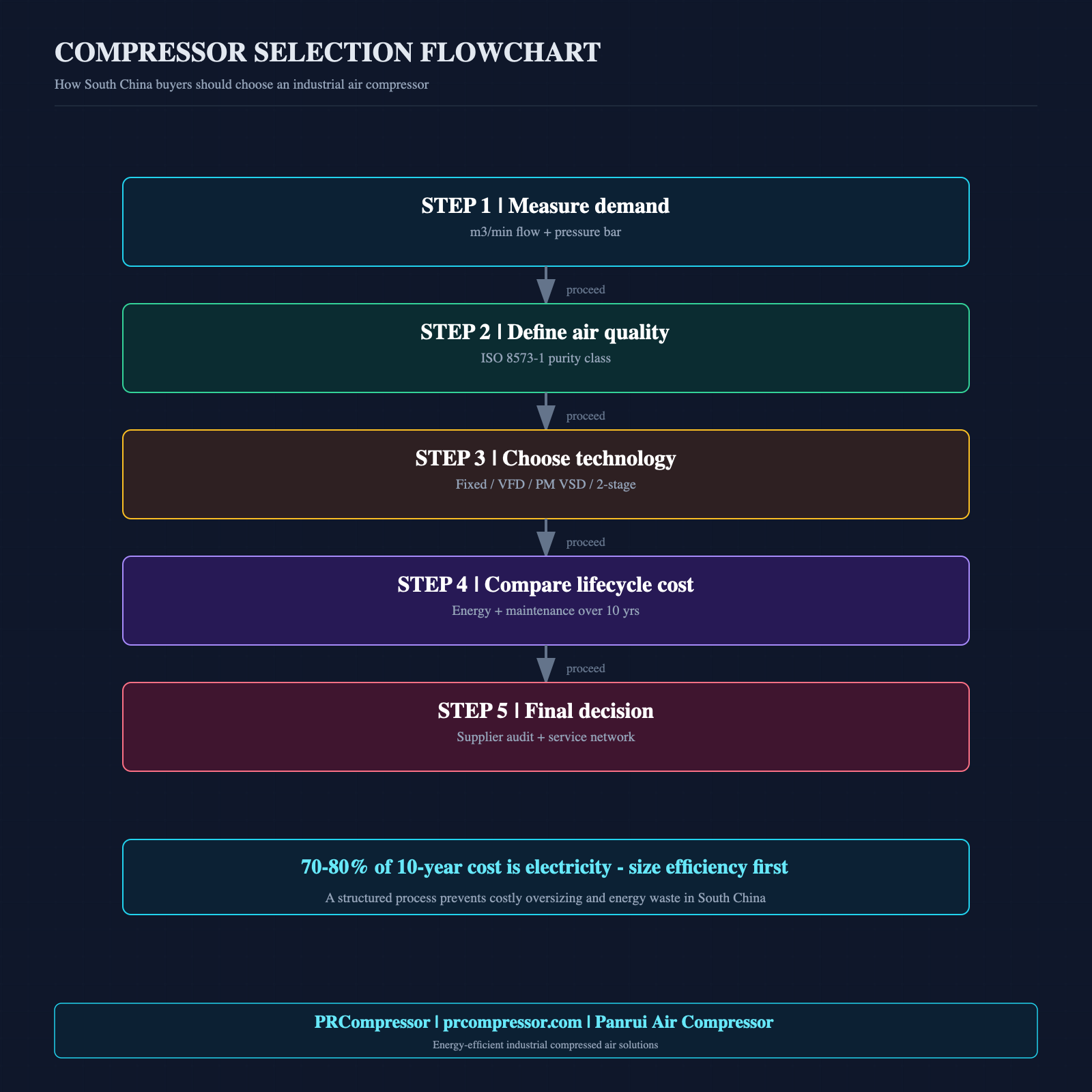
Visual Guide: Compressor Selection Process
[Flowchart: A step-by-step visual guide to selecting the right Energy Saving Air Compressor in South China, starting from demand measurement and air quality requirements through technology evaluation, supplier comparison, and final decision.]
Compressed Air Storage: The Buffer That Protects Your Production
Adequate compressed air storage is one of the most cost-effective investments any South China manufacturing facility can make in their compressed air system. Storage serves multiple critical functions: it stabilizes system pressure during periods of peak demand, reduces the frequency of compressor cycling, provides emergency capacity during a compressor failure, and allows the system to handle transient demand spikes without requiring additional compressor capacity.
The general recommendation for compressed air storage capacity is 20-40 liters per m³/min of compressor capacity for systems with relatively stable demand, increasing to 50-80 liters per m³/min for systems with highly variable demand or critical pressure-sensitive processes. For South China facilities operating Energy Saving Air Compressor systems with significant demand variation, additional storage capacity is one of the most effective ways to improve system stability and efficiency.
The location of storage within the system also matters. While a single large receiver tank near the compressor room is the most common configuration, distributed storage located near large intermittent demand points can be more effective. This approach reduces the pressure drop in the piping between the storage and the point of use, allowing the compressor to operate at a lower discharge pressure while maintaining adequate pressure at the point of use. The energy savings from a 1 bar reduction in discharge pressure typically amounts to 6-8% of compressor energy consumption.
For South China manufacturers considering a Energy Saving Air Compressor purchase, including adequate storage capacity in the system design is a low-cost, high-return investment that enhances the performance and efficiency of any compressor configuration. The incremental cost of properly sized storage is typically recovered within 6-12 months through reduced compressor cycling and the ability to operate at lower average discharge pressure.
Multi-Compressor System Design: Rightsizing for Variable Demand
For larger South China manufacturing facilities with varying compressed air demand, a single compressor — even a highly efficient VFD model — may not be the optimal solution. Multi-compressor systems, properly designed with a mix of base load and trim compressors, can achieve significantly better part-load efficiency than any single compressor operating alone. The key is to select and configure the compressors so that each unit operates in its most efficient range as the total system demand varies.
The standard configuration for efficient multi-compressor systems pairs one or more VFD compressors serving as trim units with fixed-speed base load compressors. The VFD unit modulates to match the difference between base load output and total system demand, while the base load units operate at their most efficient full-load condition. Modern sequencers optimize the startup and shutdown of base load units based on system pressure and demand trends, minimizing the number of starts and ensuring each unit operates in its optimal efficiency range.
For South China facilities with demand profiles that vary significantly between production shifts or seasons, this approach can deliver system-level efficiencies that approach 90% or more of individual compressor full-load efficiency — far better than the 60-70% system efficiency typical of uncontrolled multi-compressor installations. The additional investment in a sequencer and the incremental cost of multiple smaller compressors versus one large unit is typically recovered within 12-18 months through energy savings.
When planning a multi-compressor system, consider the following design principles: limit the number of compressor sizes to 2-3 for simplicity; ensure total installed capacity covers peak demand plus 20-30% redundancy; select compressors with complementary efficiency characteristics; and include adequate receiver capacity to stabilize pressure during transient demand changes.
Environmental Data: Carbon Emissions and Sustainability
In the South China power grid, the average carbon emission factor is approximately 0.8-0.9 kg CO₂ per kWh. For a 75kW compressor operating 6,000 hours per year, annual carbon emissions are approximately 325 metric tons of CO₂. A 30% reduction in energy consumption would reduce emissions by approximately 98 metric tons annually.
Beyond energy-related emissions, other environmental considerations include oil management, noise emissions, and end-of-life recyclability. These factors contribute to a comprehensive sustainability profile for South China manufacturers committed to environmental responsibility.
Regulatory Environment: Compliance Requirements for South China Manufacturers
Manufacturing facilities in South China operate within an evolving regulatory framework that increasingly impacts compressed air system design and equipment selection. Key regulations affecting Energy Saving Air Compressor procurement include national energy efficiency standards, local environmental protection requirements, and industry-specific quality standards.
China’s national energy efficiency standards for air compressors — GB 19153-2019 and GB 18613-2020 — establish minimum efficiency requirements for equipment sold and operated in the country. Class 1 represents the highest efficiency level, and premium Energy Saving Air Compressor meeting Class 1 or Class 2 standards qualify for reduced tariffs on the energy surcharge component of electricity pricing, providing an additional financial incentive for choosing high-efficiency equipment.
Environmental regulations also impact compressor selection. Noise regulations in industrial zones require compressors to meet specific sound level limits, typically below 75-80 dB(A). Oil containment requirements mandate proper collection and disposal of compressor condensate. Facilities with significant compressed air capacity may also need to register their energy consumption with local authorities.
For South China manufacturers, working with a supplier who is knowledgeable about the regulatory environment and can guide compliance is an important consideration. The most reputable suppliers incorporate compliance as a standard element of their sales and service process.
Maintenance Cost Analysis for Energy Saving Air Compressor in South China
Maintenance costs represent a significant component of the total cost of ownership for Energy Saving Air Compressor, typically accounting for 8-12% of lifetime costs. Understanding the maintenance requirements and costs of different compressor types and brands is essential for accurate TCO analysis.
Routine maintenance for oil-injected Energy Saving Air Compressor includes oil and oil filter changes at 2,000-4,000 hour intervals; air filter replacement at similar intervals; oil separator replacement at 4,000-8,000 hour intervals; and annual inspection of safety devices and control system. The annual maintenance cost for a typical mid-range installation in the 37-75 kW range is approximately ¥8,000-15,000 for routine parts and labor.
Major maintenance events, including bearing replacement and airend overhaul, occur at 20,000-40,000 hour intervals with costs ranging from ¥15,000 to ¥80,000 or more depending on unit size. The timing and cost of major maintenance varies significantly between brands and models.
For South China manufacturers, selecting Energy Saving Air Compressor with accessible service points, readily available spare parts, and a competent local service network is essential for controlling maintenance costs. Asking suppliers for detailed maintenance schedules, parts pricing, and service labor rates during the evaluation process will provide the data needed for accurate comparison.
Energy Saving Air Compressor for Automotive and Parts Manufacturing in South China
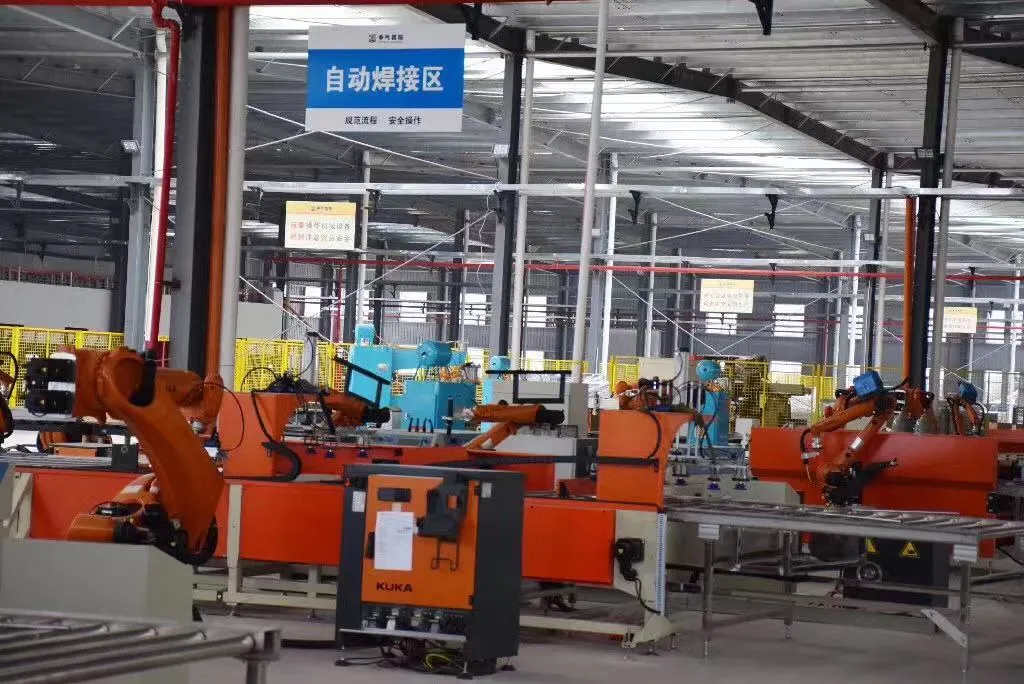
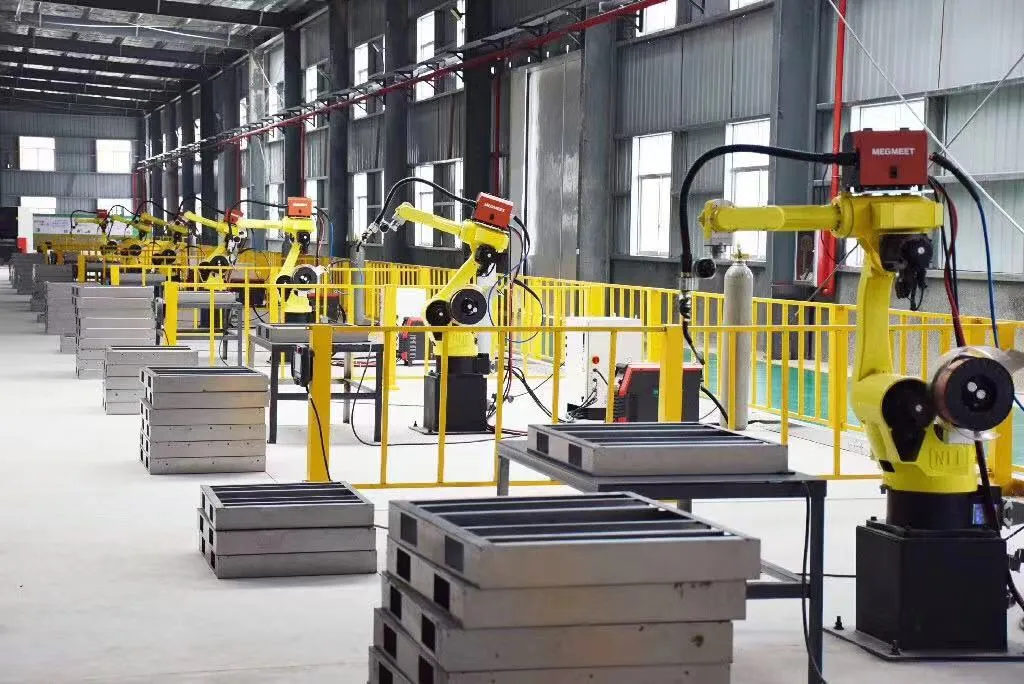
The automotive parts manufacturing sector in South China is characterized by high-volume production, demanding quality standards, and significant compressed air requirements. From robotic welding cells and automated assembly lines to paint spraying booths and pneumatic testing equipment, automotive production depends heavily on reliable compressed air supply.
Key compressed air requirements for South China automotive manufacturers include high reliability, consistent air quality, and energy efficiency. These requirements make automotive manufacturers natural candidates for premium Energy Saving Air Compressor with comprehensive monitoring and service support agreements.
Two-stage compression technology is particularly well-suited for automotive applications, as many automotive processes require pressures at the higher end of the industrial range (10-13 bar). The efficiency advantage of two-stage compression is most pronounced at these higher pressures. VFD technology is also widely adopted, as the demand profile in automotive plants typically varies significantly between production shifts.
For South China automotive parts manufacturers, the selection of Energy Saving Air Compressor should be approached as a strategic decision with long-term implications for production reliability and operating costs.
Energy Saving Air Compressor for Textile Manufacturing in South China
Textile manufacturing is a traditional and still-important industry in South China, with substantial compressed air requirements for weaving machines, knitting equipment, air-jet looms, and finishing processes. The compressed air demand in textile facilities is typically continuous and relatively stable.
Air-jet looms — a staple of modern textile production — are particularly sensitive to compressed air quality and stability. These machines use precisely controlled jets of compressed air to insert weft yarns during the weaving process, and any variation in pressure or air quality can cause weaving defects.
The efficiency of compressed air systems is a significant cost factor in textile manufacturing, where energy costs represent a substantial portion of total production costs. For South China textile mills operating multiple air-jet looms, the compressed air system’s energy consumption can account for 20-30% of total facility electricity usage.
For South China textile manufacturers, the selection of Energy Saving Air Compressor should balance efficiency, reliability, and service support. Textile production is typically continuous, so compressor reliability and service responsiveness are particularly important.
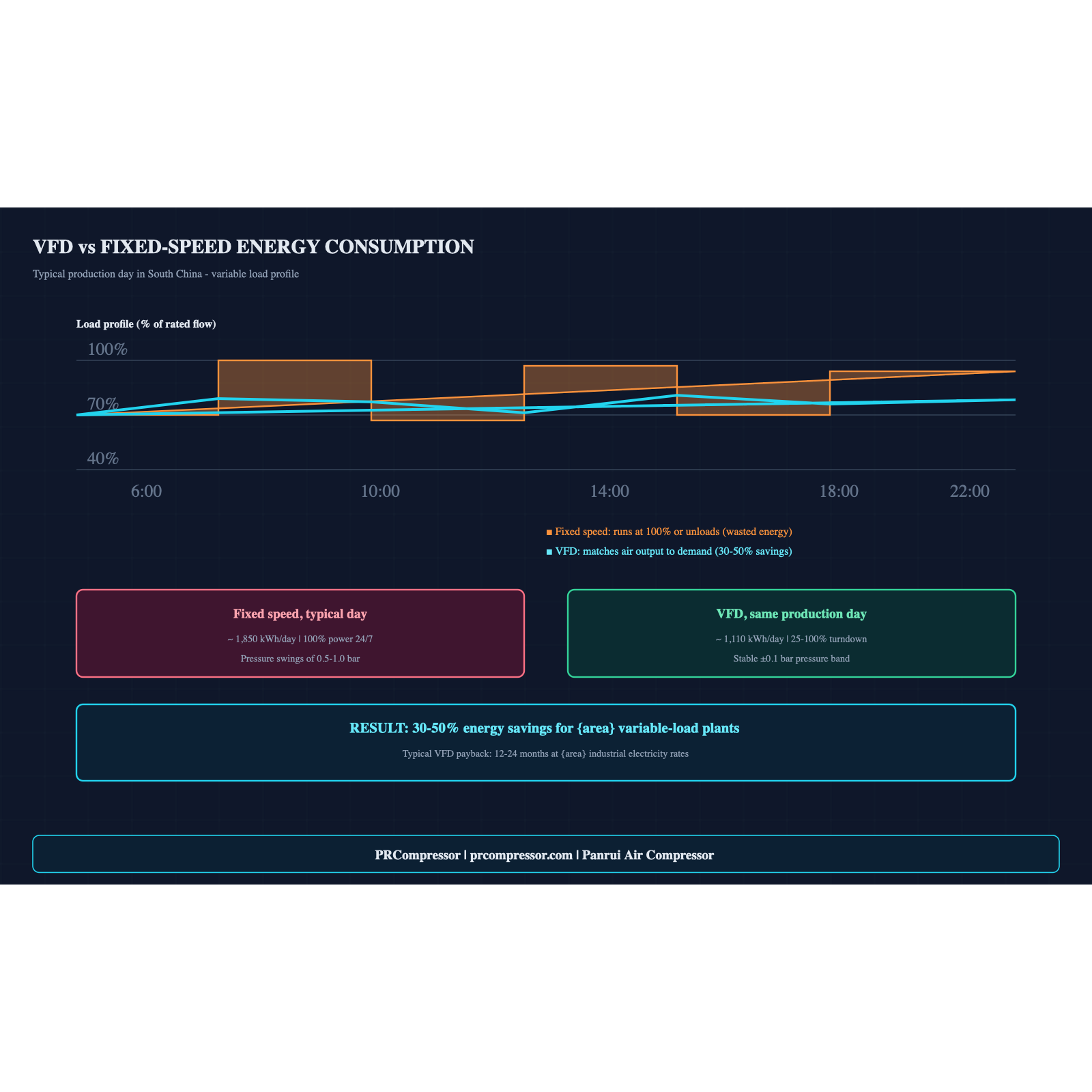
Visual: VFD vs Fixed Speed Energy Consumption
Call to Action: Start Your Energy Saving Air Compressor Evaluation Today
The information in this guide provides a comprehensive foundation for evaluating Energy Saving Air Compressor options in South China. Now the most important step is to take action — every month of delay is a month of unnecessarily high energy costs and missed opportunity.
The first step is simple: contact PRCompressor (Panrui) for a free, no-obligation consultation. Our experienced team will help you assess your current system, identify improvement opportunities, and develop a recommendation tailored to your needs.
Don’t let another day of inefficient compressed air operation erode your profitability. Contact us today.
Phone: 13713647073 | Email: info@panrui.com | Web: prcompressor.com
Keywords: industrial air compressor, compressor energy efficiency, energy saving compressor, industrial compressed air, compressor buyer’s guide, energy saving air compressor, compressor supplier, south china manufacturer, south china compressor, screw air compressor
Contact PRCompressor (Panrui) for energy saving air compressor in South China: Phone 13713647073 | prcompressor.com