


A screw compressor alone does not make a complete compressed air system. The receiver tank, dryer, and filters work together to stabilize pressure, remove moisture, and protect downstream equipment from contamination.
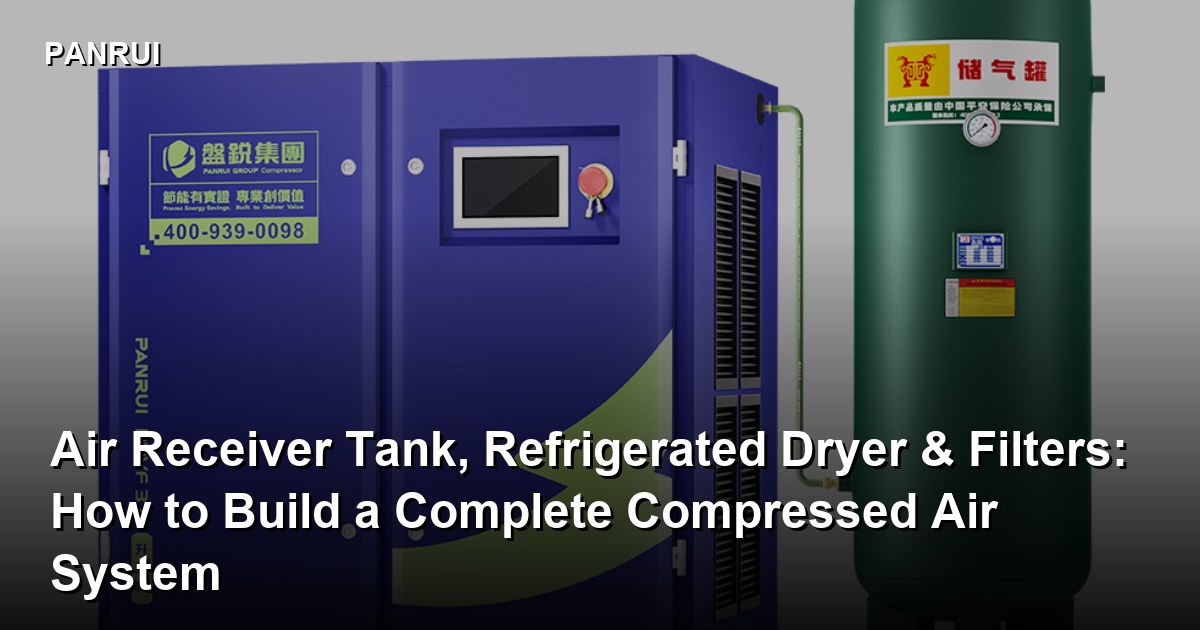
Air Receiver Tank Sizing
- The receiver tank stores air and buffers short-term demand peaks.
- A common rule is to size the tank at around 30% of the compressor’s rated flow per minute.
- Larger storage can help when production uses air in short, heavy bursts.
- Proper drainage prevents water from accumulating inside the tank.
Refrigerated Dryer vs. Desiccant Dryer
- A refrigerated dryer is suitable for most general manufacturing and provides a stable pressure dew point of about 3°C.
- A desiccant dryer is required when the process needs a much lower dew point, such as -40°C for critical applications.
- The dryer should be selected based on the compressor flow, inlet temperature, and required dew point.
Filter Order and Purpose
Filters are installed in sequence: a general-purpose filter for particles, a coalescing filter for water and oil aerosols, and sometimes an activated carbon filter for odor or oil vapor. Correct installation order protects each downstream component and extends filter life.
Building a complete screw compressor system means matching all components to the actual flow, pressure, and air quality requirements. A well-designed package reduces moisture problems and helps the compressor run at its most efficient point.
For plants with variable production, adding a VSD screw compressor to the system helps stabilize pressure and reduce energy consumption as demand changes throughout the shift.