


Complete Guide to Industrial Air Compressor in Zhuhai | 2026 Edition
What should you look for when purchasing Industrial Air Compressor in Zhuhai? It is a question that facility managers and procurement professionals grapple with regularly, and for good reason. A compressor purchase represents a significant capital investment that directly impacts production efficiency, energy costs, and maintenance budgets for years to come. Making the wrong choice can cost a factory hundreds of thousands of yuan in unnecessary electricity bills and lost productivity over the equipment’s lifespan.
This guide provides a structured framework for evaluating Industrial Air Compressor options in the Zhuhai market. We cover specification analysis, manufacturer evaluation, cost modeling, and implementation planning — everything you need to make a confident, well-informed purchasing decision that aligns with your facility’s specific requirements and operational goals.
Total Cost of Ownership Analysis for Industrial Air Compressor in Zhuhai
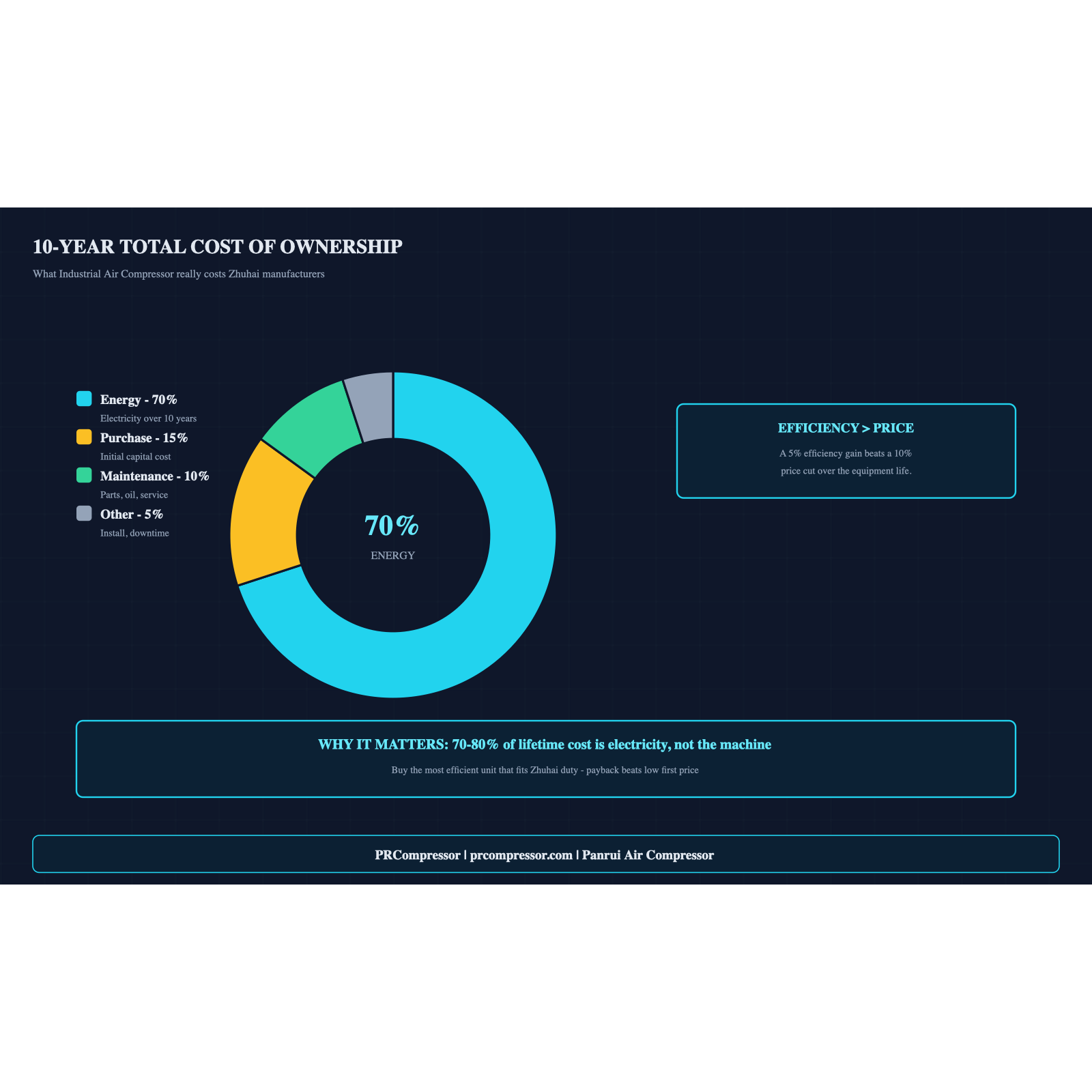
For Zhuhai manufacturers, understanding the total cost of ownership (TCO) of Industrial Air Compressor is essential for making informed procurement decisions. TCO analysis accounts for all costs associated with owning and operating a compressor over its service life, including initial purchase price, installation costs, energy consumption, maintenance, spare parts, and downtime costs.
The typical TCO breakdown for an industrial screw compressor operating in Zhuhai is as follows: energy costs account for 70-80% of total lifetime cost; the initial purchase price accounts for 10-15%; maintenance and spare parts account for 8-12%; and installation, downtime, and other costs account for the remaining 2-5%. This distribution means that a 10% improvement in energy efficiency has roughly the same financial impact as a 50% reduction in purchase price.
To illustrate with a specific example for the Zhuhai market: a 75kW Industrial Air Compressor operating 6,000 hours per year with electricity at ¥0.90/kWh will consume approximately ¥405,000 worth of electricity annually. Over a 10-year operating life, the total energy cost exceeds ¥4 million. Comparing two compressor options with a 0.5 kW/(m³/min) difference in specific power, the more efficient unit will save approximately ¥200,000 in energy costs over its life.
When evaluating TCO for Industrial Air Compressor options in Zhuhai, the following calculation framework is recommended: estimate annual operating hours; determine your effective electricity cost; obtain specific power data at typical load points from each supplier; calculate annual energy consumption and cost for each option; add estimated maintenance costs; and compare the 5-year and 10-year total costs to identify the most economical option over the long term.
Industrial Air Compressor for Food and Beverage Processing in Zhuhai
The food and beverage processing industry in Zhuhai has unique compressed air requirements driven by food safety regulations and product quality standards. Compressed air that comes into contact with food products must be free of contaminants, including oil, particulates, and microorganisms.
For food and beverage applications in Zhuhai, the selection of Industrial Air Compressor depends on the nature of the contact between compressed air and food products. For applications where compressed air contacts food directly — such as in food drying, conveying, or packaging — oil-free compressors are generally required. For indirect contact applications, high-quality oil-injected compressors with appropriate filtration may be acceptable.
In addition to air quality, temperature control is important in food and beverage processing. Compressed air at elevated temperatures can cause condensation in distribution piping, creating conditions favorable for microbial growth. Proper aftercooling and drying are essential.
For Zhuhai food and beverage processors, working with a Industrial Air Compressor supplier who understands food safety requirements is essential. The supplier should be able to provide documentation confirming that their equipment meets the relevant food safety standards.
Visual: VFD vs Fixed Speed Energy Consumption
Future-Proofing Your Industrial Air Compressor Investment in Zhuhai
Investing in Industrial Air Compressor is a long-term commitment that will affect your facility’s operations, energy costs, and environmental performance for a decade or more. Protecting that investment against future changes is an important consideration.
Technology compatibility is key. Choose equipment that supports open communication protocols rather than proprietary systems. Select controllers with upgradeable firmware. If considering IoT capabilities, ensure the platform supports common connectivity standards that will remain relevant.
Regulatory preparedness is another consideration. China’s energy efficiency standards are expected to continue tightening. Choosing equipment that meets anticipated future standards provides a compliance buffer. Selecting equipment with lower environmental impact positions your facility favorably for future regulations.
Flexibility in equipment configuration also supports future-proofing. Modular compressor designs that allow capacity additions or technology upgrades without replacing the entire system provide valuable adaptability.
Emergency Response Plan for Industrial Air Compressor Failures in Zhuhai
Even with the best preventive maintenance program, failures can occur. Having a well-rehearsed emergency response plan can mean the difference between a brief interruption and a prolonged shutdown.
Plan Element 1: Immediate Response Procedures — Document who to notify, what information to collect, and how to restore minimum compressed air supply including backup compressor startup procedures and prioritization of critical consumers.
Plan Element 2: Equipment Information — Maintain accessible documentation for all compressors including manufacturer and model information, key specifications, warranty status, service contract information, and critical spare parts locations.
Plan Element 3: Service Provider Contact — Establish relationships with at least two qualified service providers. Document their emergency contact numbers, typical response times, and capabilities.
Plan Element 4: Backup Capacity Planning — Develop a plan for maintaining compressed air supply during extended outages, including rental compressor arrangements, mutual aid agreements, or maintaining a spare compressor on-site.
Long-Term Storage and Preservation of Industrial Air Compressor in Zhuhai
There may be occasions when Industrial Air Compressor equipment needs to be stored for extended periods. Proper preservation is essential to prevent corrosion, bearing damage, and seal deterioration.
For short-term storage (1-3 months), seal all openings, fill with oil to normal level, rotate the airend monthly, maintain storage area between 5-40°C with humidity below 70%.
For long-term storage (3+ months), fill with rust-inhibiting preservation oil, coat exposed metal surfaces with corrosion-preventive compound, place desiccant bags inside the enclosure, and rotate the airend monthly.
Before returning stored equipment to service, inspect thoroughly for corrosion or damage, replace all filters and oil separator, fill with fresh oil, check electrical connections, and run unloaded for 30 minutes before connecting to the distribution system.
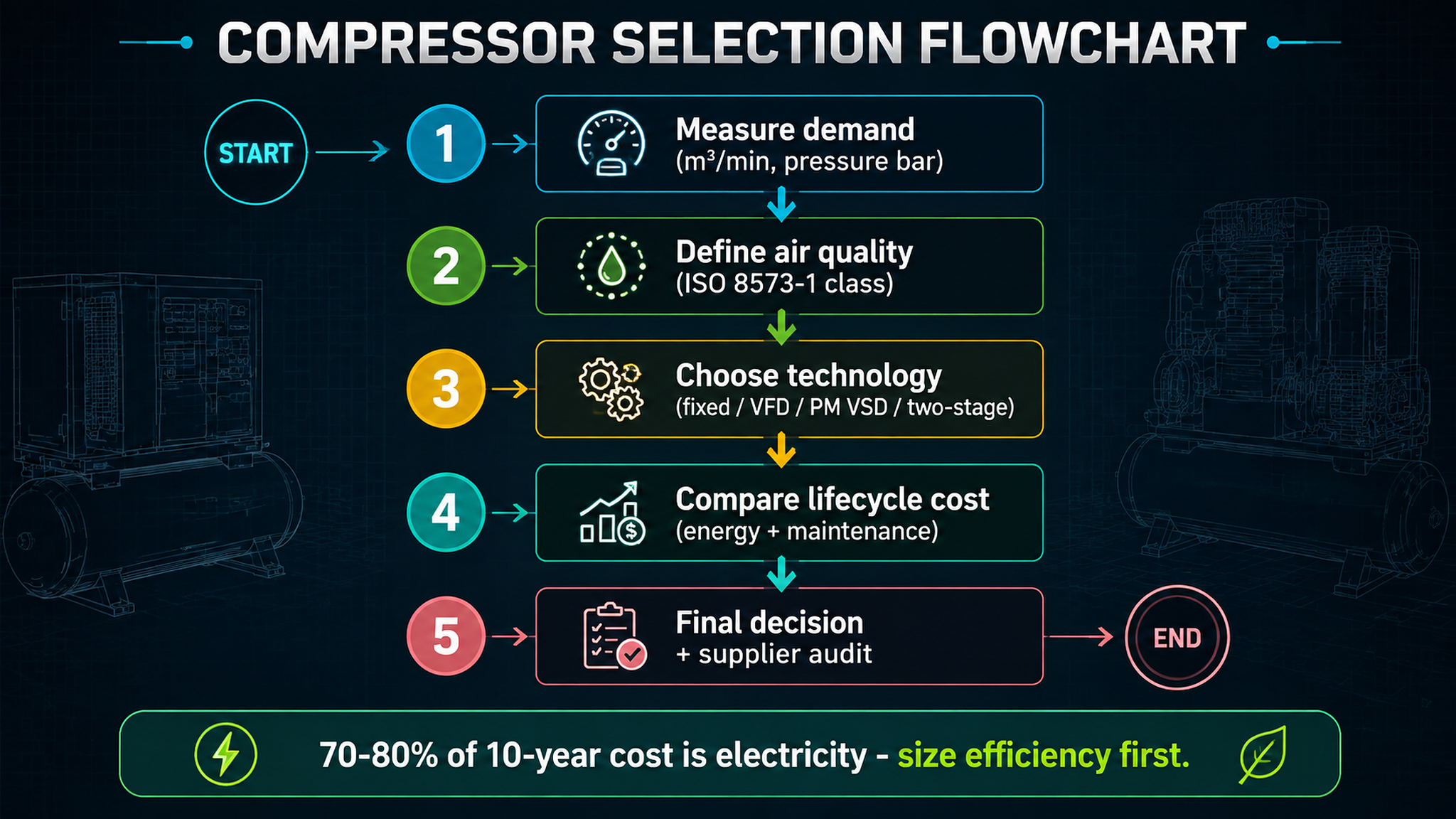
Visual Guide: Compressor Selection Process
[Flowchart: A step-by-step visual guide to selecting the right Industrial Air Compressor in Zhuhai, starting from demand measurement and air quality requirements through technology evaluation, supplier comparison, and final decision.]
Expert Answers: Common Questions About Industrial Air Compressor
What is the difference between single-stage and two-stage Industrial Air Compressor?
Single-stage compressors compress air from atmospheric to final pressure in one step. Two-stage compressors divide this process with inter-stage cooling, reducing energy required by 15-25% depending on discharge pressure. Two-stage units are particularly well-suited for applications requiring 10 bar or higher.
How often should I change the oil in my Industrial Air Compressor?
Standard interval is 2,000-4,000 operating hours or annually. However, the optimal interval depends on operating conditions and oil type. The most reliable method is regular oil analysis to determine when oil properties degrade beyond acceptable limits.
Can I install a Industrial Air Compressor outdoors in Zhuhai’s climate?
Outdoor installation is possible but requires a weatherproof enclosure. Additional considerations include low-temperature operation below 5°C, adequate ventilation, and security. Indoor installation is strongly recommended for most applications.
How do I choose between domestic and international Industrial Air Compressor brands?
International premium brands offer the highest efficiency and most comprehensive service networks at a 30-60% price premium. Domestic brands offer competitive efficiency and reliability at lower prices with shorter lead times and potentially more responsive local service. The choice depends on your specific priorities.
Multi-Compressor System Design: Rightsizing for Variable Demand
For larger Zhuhai manufacturing facilities with varying compressed air demand, a single compressor — even a highly efficient VFD model — may not be the optimal solution. Multi-compressor systems, properly designed with a mix of base load and trim compressors, can achieve significantly better part-load efficiency than any single compressor operating alone. The key is to select and configure the compressors so that each unit operates in its most efficient range as the total system demand varies.
The standard configuration for efficient multi-compressor systems pairs one or more VFD compressors serving as trim units with fixed-speed base load compressors. The VFD unit modulates to match the difference between base load output and total system demand, while the base load units operate at their most efficient full-load condition. Modern sequencers optimize the startup and shutdown of base load units based on system pressure and demand trends, minimizing the number of starts and ensuring each unit operates in its optimal efficiency range.
For Zhuhai facilities with demand profiles that vary significantly between production shifts or seasons, this approach can deliver system-level efficiencies that approach 90% or more of individual compressor full-load efficiency — far better than the 60-70% system efficiency typical of uncontrolled multi-compressor installations. The additional investment in a sequencer and the incremental cost of multiple smaller compressors versus one large unit is typically recovered within 12-18 months through energy savings.
When planning a multi-compressor system, consider the following design principles: limit the number of compressor sizes to 2-3 for simplicity; ensure total installed capacity covers peak demand plus 20-30% redundancy; select compressors with complementary efficiency characteristics; and include adequate receiver capacity to stabilize pressure during transient demand changes.
Air Leak Management: The Hidden Opportunity in Every Industrial Air Compressor Installation
Compressed air leaks are the single largest source of energy waste in industrial compressed air systems, and they are far more costly than most facility managers realize. Industry studies consistently show that the average industrial compressed air system loses 25-35% of its output through leaks. For a Zhuhai factory operating a 75kW Industrial Air Compressor 6,000 hours per year at ¥0.80/kWh, this means ¥90,000-126,000 worth of compressed air is escaping into the atmosphere every year — money that could be saved through a systematic leak management program.
The sources of compressed air leaks are varied and often numerous. Common leak points include pipe joints and fittings, quick-connect couplings, pneumatic tool connections, condensate drains, pressure regulators, and the connections to end-use equipment. A single 3mm leak at 8 bar pressure wastes approximately 560 m³ of compressed air per year — equivalent to the full output of a 15kW compressor running continuously for over 1,000 hours.
Effective leak management follows a structured approach: identification, quantification, repair, and ongoing monitoring. Ultrasonic leak detectors enable rapid identification of even small leaks during normal operating hours. Once identified, leaks should be tagged, logged, and assigned for repair based on their severity. Regular leak surveys should be part of every facility’s maintenance program.
For Zhuhai facilities investing in new Industrial Air Compressor, establishing a leak management program at the same time ensures that the efficiency benefits of the new equipment are not undermined by system losses. The cost of a leak management program is typically recovered within 3-6 months through reduced compressor energy consumption and extended equipment life from reduced runtime.
Conclusion: Why Industrial Air Compressor Quality Matters for Zhuhai Manufacturers
The quality of your compressed air system directly impacts your production quality, operational efficiency, and profitability. Manufacturers who consistently achieve the best results are those who recognize that quality — in equipment, installation, maintenance, and supplier partnership — determines long-term satisfaction.
A quality Industrial Air Compressor investment delivers reliable production that is never interrupted by unexpected failures, energy efficiency that minimizes operating costs, consistent air quality that supports product quality, and a long service life that maximizes return on investment.
PRCompressor (Panrui) has served Zhuhai manufacturers for over 14 years, delivering quality Industrial Air Compressor solutions backed by comprehensive service support. Our product line spans from 5.5kW to 500kW, covering every configuration to suit your application.
Contact us at 13713647073 or visit prcompressor.com for a free consultation.
Keywords: zhuhai compressor, energy saving compressor, industrial air compressor, compressor energy efficiency, compressor buyer’s guide, compressor supplier, screw air compressor, zhuhai manufacturer, industrial compressed air, industrial air compressor
Contact PRCompressor (Panrui) for industrial air compressor in Zhuhai: Phone 13713647073 | prcompressor.com