


Complete Guide to Two-Stage Screw Air Compressor in Shenzhen | 2026 Edition
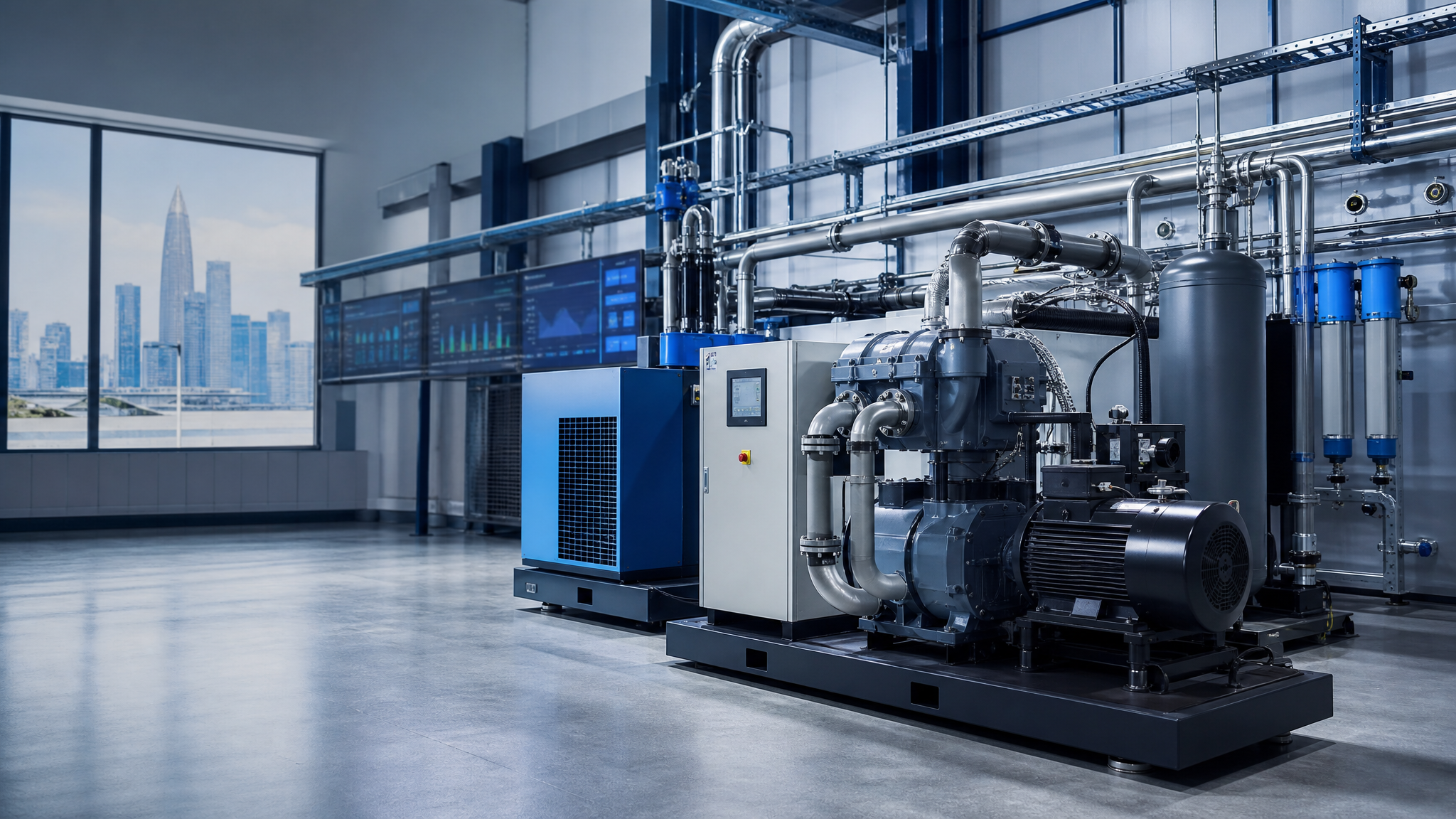
In Shenzhen’s rapidly evolving industrial landscape, compressed air systems account for 10% to 40% of total factory electricity consumption — making them one of the largest operational expenses for manufacturing facilities. For businesses evaluating Two-Stage Screw Air Compressor, understanding the interplay between capital investment, energy efficiency, and long-term reliability has never been more critical. This comprehensive guide examines every factor that Shenzhen manufacturers must consider when making this essential equipment decision in 2026.
The compressed air market in Shenzhen has undergone significant transformation over the past five years. Rising electricity costs, stricter environmental regulations, and increasing awareness of total cost of ownership have driven a fundamental shift in how industrial buyers approach compressor procurement. Gone are the days when purchase price alone determined the decision — today’s informed buyers demand verified efficiency data, transparent lifecycle cost analysis, and proven reliability records.
Supplier Qualification: Questions to Ask Before Buying Two-Stage Screw Air Compressor in Shenzhen
Asking the right questions during supplier evaluation is essential for making an informed purchasing decision. Here are the key questions organized by topic.
Product Performance: Can you provide verified specific power data at full load and part load? How do you verify your efficiency claims? What is your policy if the installed equipment fails to meet specified performance? What is the expected service life under our operating conditions?
Service and Support: How many service technicians do you have in the Shenzhen region? What is your typical response time for emergency calls? Do you maintain local spare parts inventory? Can you provide a sample maintenance contract? What training do you provide?
Company Background: How long have you been supplying the Shenzhen market? Can you provide references from three customers in similar industries? What certifications do you hold? What is your approach to product development?
Commercial Terms: What is your standard warranty coverage? Can extended warranty be purchased? What are your payment terms? Do you offer performance guarantees? What is the expected delivery lead time?
Rightsizing: Determining the Optimal Capacity for Two-Stage Screw Air Compressor in Shenzhen
Determining the optimal capacity for Two-Stage Screw Air Compressor is one of the most critical decisions in the compressor selection process. An undersized compressor cannot meet production demand, while an oversized compressor operates inefficiently.
The first step in rightsizing is accurate demand measurement. Install a flow meter and log demand data for at least one full production week. The data should capture both average demand and peak demand events. For facilities with relatively constant demand, select a compressor with output matching measured average demand plus 20-30% margin.
For facilities with variable demand, a single VFD compressor sized to handle 70-100% of peak demand, or a multi-compressor system with a VFD trim unit, typically provides the best combination of efficiency and capacity. Storage capacity should also be factored in — typically 20-40 liters per m³/min of compressor capacity.
In facilities with significant short-duration peak demand events, additional storage capacity can allow the compressor system to be sized for average demand rather than peak demand, yielding substantial capital and energy savings.
Emergency Response Plan for Two-Stage Screw Air Compressor Failures in Shenzhen
Even with the best preventive maintenance program, failures can occur. Having a well-rehearsed emergency response plan can mean the difference between a brief interruption and a prolonged shutdown.
Plan Element 1: Immediate Response Procedures — Document who to notify, what information to collect, and how to restore minimum compressed air supply including backup compressor startup procedures and prioritization of critical consumers.
Plan Element 2: Equipment Information — Maintain accessible documentation for all compressors including manufacturer and model information, key specifications, warranty status, service contract information, and critical spare parts locations.
Plan Element 3: Service Provider Contact — Establish relationships with at least two qualified service providers. Document their emergency contact numbers, typical response times, and capabilities.
Plan Element 4: Backup Capacity Planning — Develop a plan for maintaining compressed air supply during extended outages, including rental compressor arrangements, mutual aid agreements, or maintaining a spare compressor on-site.
Industry Data: Compressed Air Energy Consumption Patterns in Shenzhen
Understanding how compressed air energy consumption patterns compare to industry benchmarks provides valuable context for evaluating your facility’s performance. Industry research shows that compressed air systems account for 10-30% of total industrial electricity consumption, with the average around 12-15% for general manufacturing.
For a typical Shenzhen manufacturing facility with an annual electricity bill of ¥5 million, the compressed air system accounts for ¥500,000 to ¥1.5 million in annual energy costs. Leak rates in industrial systems average 25-35% of total compressor output — meaning that for every three compressors running, one is effectively producing wasted air.
System pressure is another area where significant savings are available. The average industrial compressed air system operates at 1-2 bar higher than necessary. Reducing system pressure by 1 bar saves 6-8% of compressor energy.
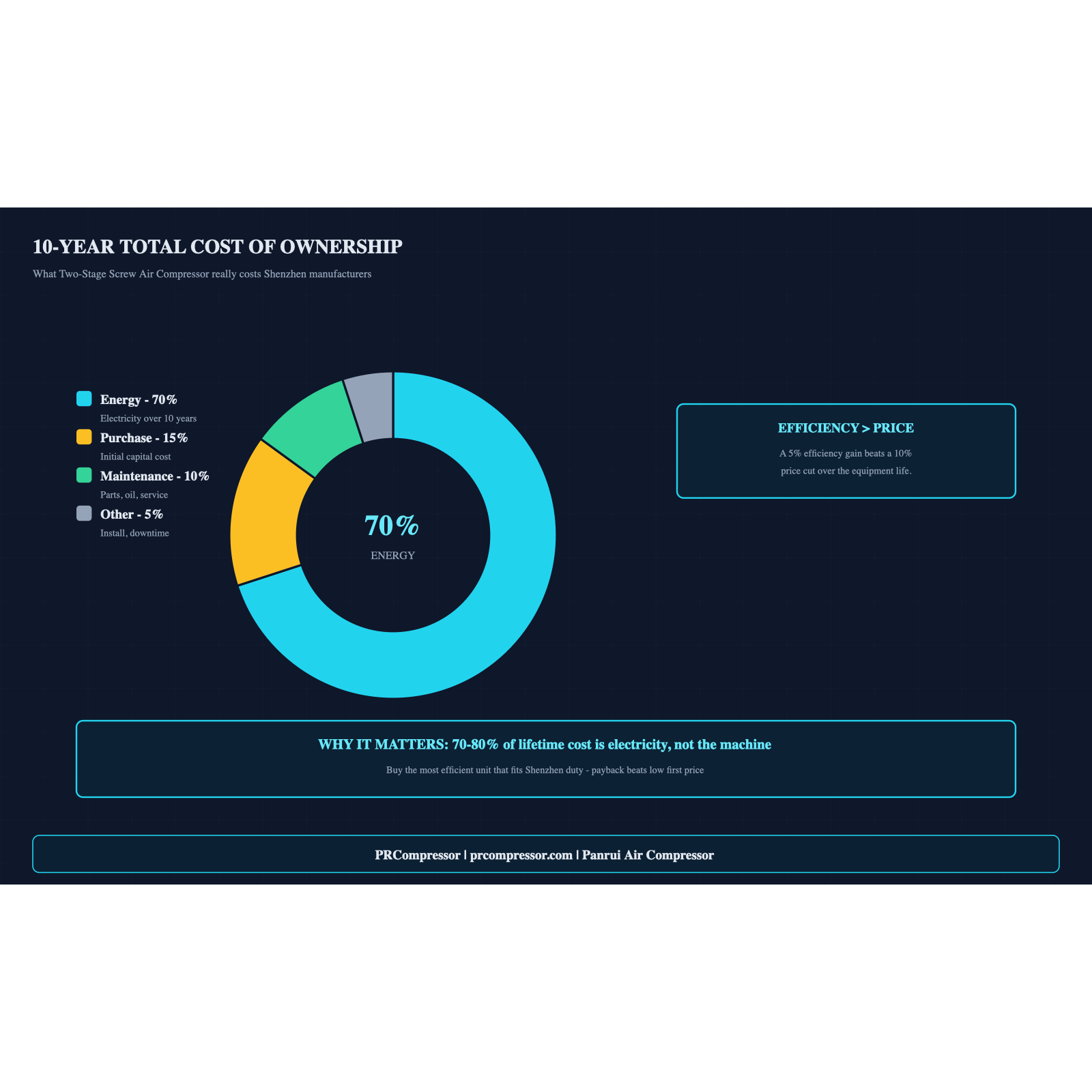
Visual: Total Cost of Ownership Breakdown
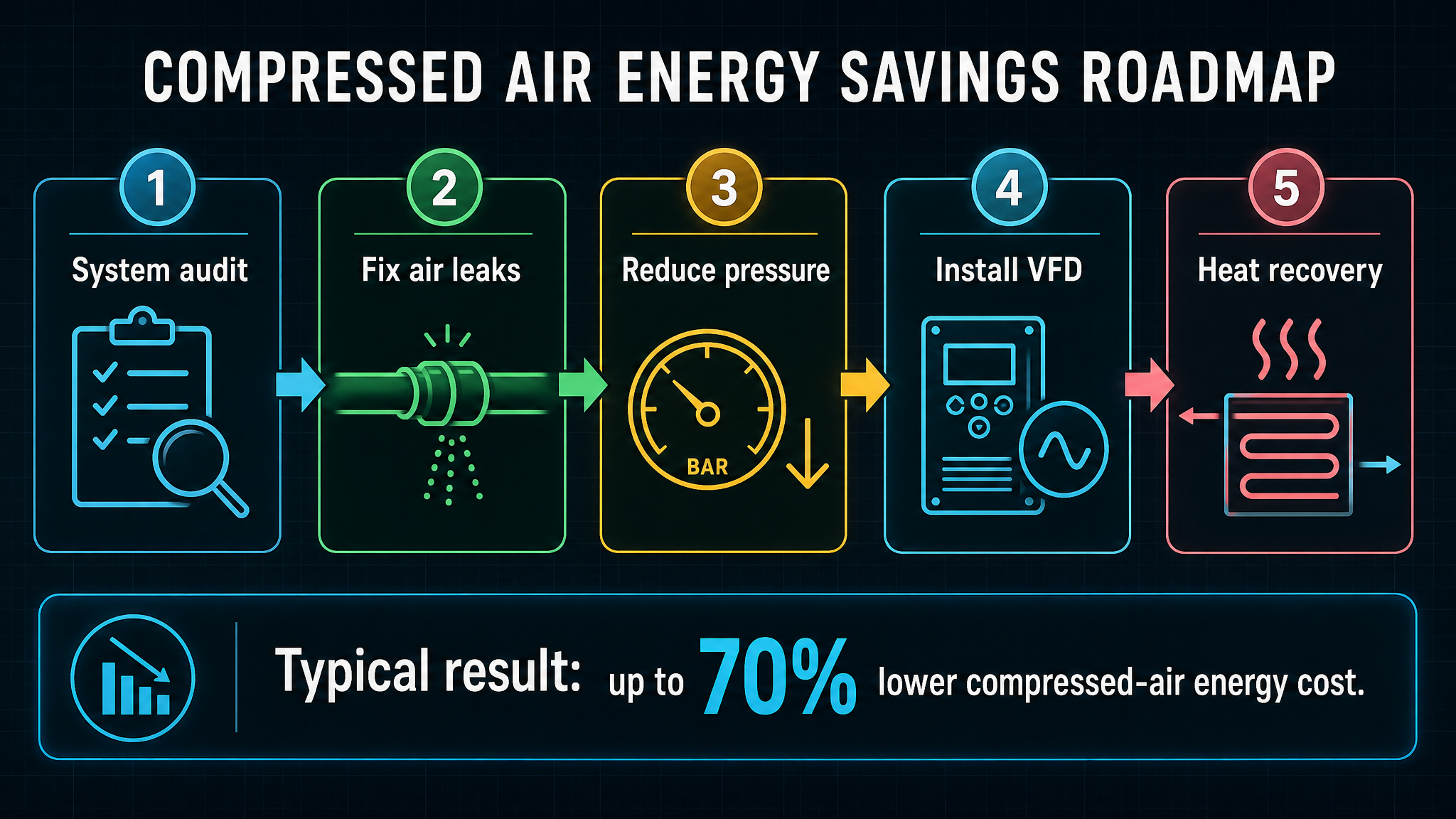
Visual: Energy Savings Roadmap
Two-Stage Screw Air Compressor for Construction and Mining in Shenzhen
Construction and mining operations in Shenzhen require robust, portable, and reliable compressed air solutions for rock drilling, pneumatic tools, concrete spraying, and dust control. Unlike factory installations, these systems must operate in harsh environments with challenging conditions.
For construction and mining applications, the selection of Two-Stage Screw Air Compressor prioritizes durability, ease of maintenance, and the ability to operate in adverse conditions over efficiency optimization. While energy efficiency is still important, the primary considerations are typically reliability, serviceability, and spare parts availability in remote locations.
Portability is another key consideration. Trailer-mounted compressors, modular units, and systems designed for easy relocation are common. The ability to quickly move compressed air capacity to different locations is essential for operational flexibility.
For Shenzhen construction and mining companies, the selection of Two-Stage Screw Air Compressor should also consider the availability of service and support in the specific geographic areas where operations will be conducted.
Two-Stage Screw Air Compressor for Textile Manufacturing in Shenzhen
Textile manufacturing is a traditional and still-important industry in Shenzhen, with substantial compressed air requirements for weaving machines, knitting equipment, air-jet looms, and finishing processes. The compressed air demand in textile facilities is typically continuous and relatively stable.
Air-jet looms — a staple of modern textile production — are particularly sensitive to compressed air quality and stability. These machines use precisely controlled jets of compressed air to insert weft yarns during the weaving process, and any variation in pressure or air quality can cause weaving defects.
The efficiency of compressed air systems is a significant cost factor in textile manufacturing, where energy costs represent a substantial portion of total production costs. For Shenzhen textile mills operating multiple air-jet looms, the compressed air system’s energy consumption can account for 20-30% of total facility electricity usage.
For Shenzhen textile manufacturers, the selection of Two-Stage Screw Air Compressor should balance efficiency, reliability, and service support. Textile production is typically continuous, so compressor reliability and service responsiveness are particularly important.
Multi-Compressor System Design: Rightsizing for Variable Demand
For larger Shenzhen manufacturing facilities with varying compressed air demand, a single compressor — even a highly efficient VFD model — may not be the optimal solution. Multi-compressor systems, properly designed with a mix of base load and trim compressors, can achieve significantly better part-load efficiency than any single compressor operating alone. The key is to select and configure the compressors so that each unit operates in its most efficient range as the total system demand varies.
The standard configuration for efficient multi-compressor systems pairs one or more VFD compressors serving as trim units with fixed-speed base load compressors. The VFD unit modulates to match the difference between base load output and total system demand, while the base load units operate at their most efficient full-load condition. Modern sequencers optimize the startup and shutdown of base load units based on system pressure and demand trends, minimizing the number of starts and ensuring each unit operates in its optimal efficiency range.
For Shenzhen facilities with demand profiles that vary significantly between production shifts or seasons, this approach can deliver system-level efficiencies that approach 90% or more of individual compressor full-load efficiency — far better than the 60-70% system efficiency typical of uncontrolled multi-compressor installations. The additional investment in a sequencer and the incremental cost of multiple smaller compressors versus one large unit is typically recovered within 12-18 months through energy savings.
When planning a multi-compressor system, consider the following design principles: limit the number of compressor sizes to 2-3 for simplicity; ensure total installed capacity covers peak demand plus 20-30% redundancy; select compressors with complementary efficiency characteristics; and include adequate receiver capacity to stabilize pressure during transient demand changes.
Variable Frequency Drive Technology: Matching Supply to Demand
Variable frequency drive (VFD) technology fundamentally changes how screw compressors respond to fluctuating air demand. Instead of the wasteful load/unload cycling that characterizes fixed-speed compressor operation, VFD-equipped compressors automatically adjust their motor speed — and therefore their air output — to match real-time demand. This capability is particularly valuable in Shenzhen manufacturing environments where air demand frequently varies between shifts, production runs, and seasonal production cycles.
The energy savings from VFD technology are well documented. A Two-Stage Screw Air Compressor with VFD capability typically uses 30-50% less energy than an equivalent fixed-speed unit operating under the same variable demand profile. The savings come from two primary mechanisms: eliminating the unloaded running time during which fixed-speed compressors continue to consume 25-40% of full-load power while producing no useful work, and operating at reduced speeds during periods of lower demand, where the relationship between speed reduction and power reduction follows the cube law effect.
Modern VFD compressors available in the Shenzhen market offer operating ranges from 25% to 100% of rated capacity. Advanced control algorithms manage the transition between VFD and fixed-speed operation in multi-compressor systems, ensuring optimal efficiency across the full range of facility demand. Pressure stability is maintained within ±0.1 bar, compared to ±0.5-1.0 bar typical of load/unload controlled systems — a significant advantage for processes sensitive to pressure variation.
For Shenzhen manufacturers with variable air demand — which includes most facilities outside of truly continuous 24/7 operations — VFD technology represents the most cost-effective path to reduced compressed air energy costs. The typical payback period for the VFD premium in Shenzhen industrial applications ranges from 12 to 24 months, after which the savings contribute directly to improved profitability.
Payback Period Analysis for Two-Stage Screw Air Compressor Investments in Shenzhen
Payback period is the most commonly used metric for evaluating compressor upgrade projects in Shenzhen manufacturing facilities. Replacing an older fixed-speed compressor with a modern premium VFD model typically achieves payback in 12-24 months. Upgrading from standard-efficiency to premium-efficiency typically achieves payback in 18-36 months.
System-level improvement projects often achieve the shortest payback periods. Fixing compressed air leaks can reduce total system energy consumption by 20-30% at costs recovered within 3-6 months. Reducing system pressure by 1 bar saves 6-8% of compressor energy at essentially no cost. These quick-payback projects should be implemented alongside major equipment investments.
For Shenzhen manufacturers developing a compressed air system investment plan, a phased approach that prioritizes quick-payback system improvements while also planning for longer-payback equipment upgrades typically provides the best overall financial outcome.
Financial Analysis: Leasing vs Purchasing Two-Stage Screw Air Compressor in Shenzhen
For Shenzhen manufacturers, the decision between leasing and purchasing Two-Stage Screw Air Compressor involves financial, operational, and strategic considerations beyond simple cost comparison. Each approach offers distinct advantages.
Leasing Two-Stage Screw Air Compressor preserves working capital, provides predictable fixed monthly payments, may offer tax advantages through deductibility of lease payments, and allows for easier equipment upgrades at lease expiration. Lease terms typically range from 3 to 7 years with residual values of 10-30%.
Purchasing Two-Stage Screw Air Compressor provides the lowest total cost over the equipment’s life, offers full ownership and control, allows for depreciation benefits, and eliminates ongoing payment obligations after purchase. For Shenzhen manufacturers with access to capital and a long-term perspective, purchasing typically provides the best financial outcome.
The financial comparison should consider: total cost of leasing over the planned use period; total cost of purchasing; tax implications; the manufacturer’s cost of capital; and the expected useful life relative to the lease term. For most Shenzhen manufacturers, purchasing provides better 10-year economics while leasing better serves manufacturers with capital constraints.
Final Recommendations for Shenzhen Two-Stage Screw Air Compressor Buyers
After examining the full landscape of Two-Stage Screw Air Compressor options in Shenzhen, several clear recommendations emerge:
Know Your Numbers — Invest in understanding your compressed air demand, air quality requirements, and operating profile before talking to suppliers. A professional audit is a worthwhile investment.
Compare on Lifecycle Cost — Evaluate proposals based on 5-year TCO, considering purchase price, energy costs, maintenance, and expected service life. Energy costs will dominate the total.
Evaluate Service Capability Thoroughly — The best compressor is worthless if it cannot be serviced promptly. Verify service network coverage in Shenzhen and check references.
Plan for the Complete System — The compressor is the centerpiece, but the complete system includes piping, storage, air treatment, controls, and monitoring. Invest in system design commensurate with your equipment investment.
For personalized assistance, contact PRCompressor at 13713647073 or visit prcompressor.com.
Keywords: industrial compressed air, compressor energy efficiency, shenzhen manufacturer, industrial air compressor, compressor buyer’s guide, screw air compressor, two-stage screw air compressor, shenzhen compressor, energy saving compressor, compressor supplier
Contact PRCompressor (Panrui) for two-stage screw air compressor in Shenzhen: Phone 13713647073 | prcompressor.com