


Energy Saving Air Compressor in South China: 2026 Manufacturer Selection Guide
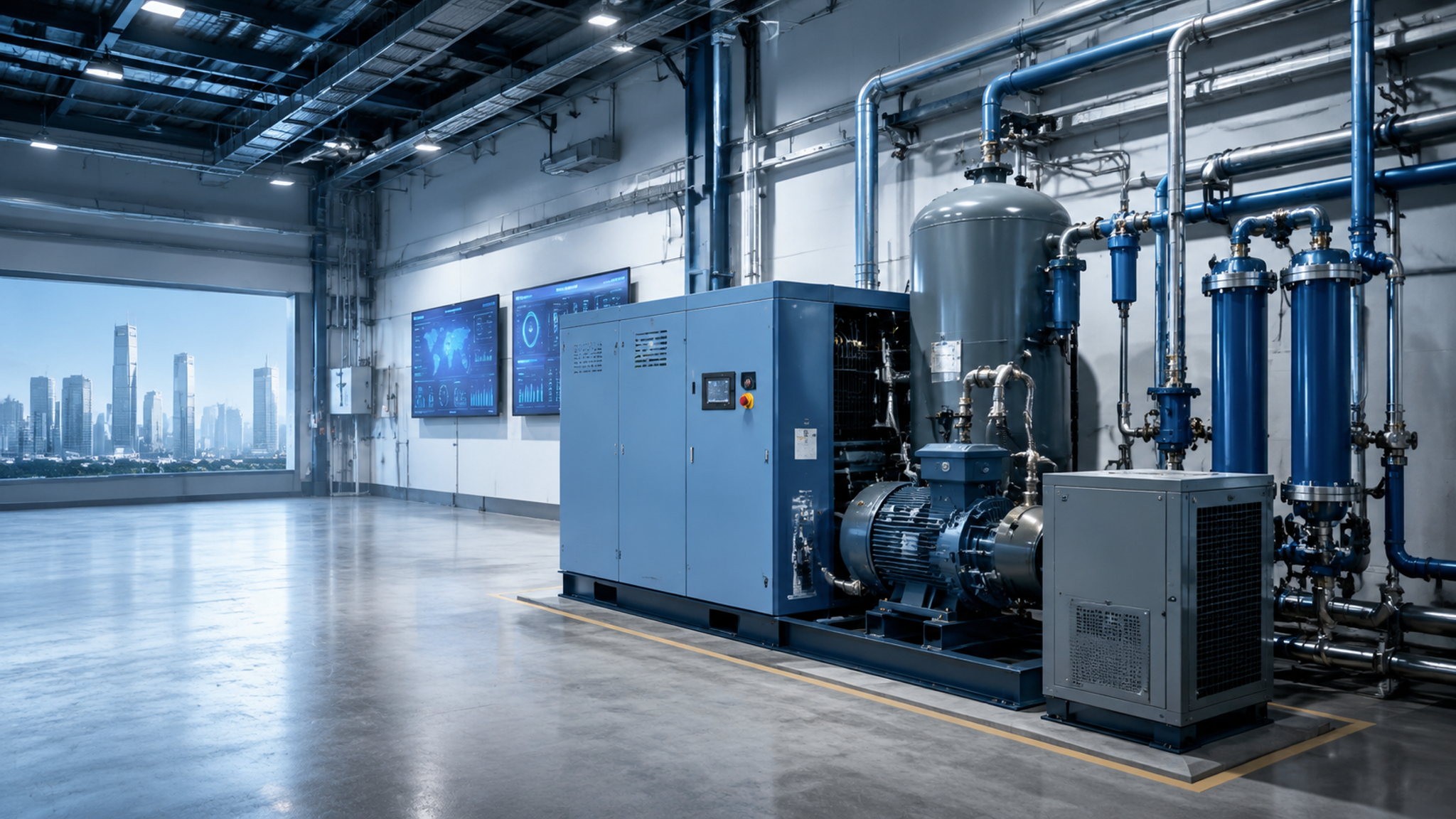
China’s carbon neutrality goals and increasingly stringent energy efficiency regulations are reshaping industrial equipment procurement across the country, and South China is no exception. Manufacturing facilities are now required to meet higher energy efficiency standards than ever before, making the selection of Energy Saving Air Compressor a decision with significant regulatory compliance implications alongside operational and financial considerations.
This guide provides a comprehensive overview of the Energy Saving Air Compressor market in South China, covering technology trends, regulatory requirements, supplier evaluation criteria, and financial analysis. Whether you are equipping a new facility or upgrading an existing system, this resource will help you navigate the decision-making process with confidence.
The Science of Air Compression: How Energy Saving Air Compressor Achieve Efficiency
At its core, air compression is a thermodynamic process that follows the fundamental laws of gas behavior. When air is compressed, its temperature rises significantly — a 100 kPa (1 bar) increase in pressure can raise the air temperature by approximately 80-100°C under adiabatic conditions. Managing this heat is one of the key challenges in compressor design, as excessive temperatures can degrade lubricating oil, damage components, and reduce overall system efficiency.
Modern Energy Saving Air Compressor address this challenge through sophisticated thermal management systems that optimize the compression process across a wide range of operating conditions. Oil-injected screw compressors use the injection of specially formulated compressor oil directly into the compression chamber to seal rotor clearances, lubricate the rotors and bearings, and absorb the heat of compression. The oil is then circulated through an oil cooler before being reinjected, maintaining optimal operating temperatures even under continuous full-load operation.
The specific power consumption of a compressor — measured in kW per m³/min of delivered air — is the most important indicator of its energy efficiency. Premium Energy Saving Air Compressor in the South China market typically achieve specific power values ranging from 5.5 to 6.5 kW/(m³/min) at full load, with the most efficient models falling below 5.5 kW/(m³/min). By comparison, older or lower-quality units may require 7.0 kW/(m³/min) or more, representing a 20-30% efficiency penalty that translates directly to higher electricity costs over the equipment’s operating life.
Understanding these technical fundamentals is essential for making informed procurement decisions. When evaluating Energy Saving Air Compressor options in South China, look beyond the headline specifications to examine the specific power curves at different load points, the efficiency of the drive system, and the effectiveness of the cooling and oil management systems. These factors collectively determine the real-world performance and operating cost of the equipment.
Compressed Air System Design: Beyond the Compressor Itself
The compressor is only one component of a complete compressed air system, and optimizing the system as a whole is essential for achieving the best possible performance and efficiency. For South China manufacturers investing in Energy Saving Air Compressor, attention to system design — including intake air quality, piping configuration, air treatment, and condensate management — can significantly impact both the efficiency of the compressor itself and the quality of the compressed air delivered to production equipment.
The quality of intake air is a frequently overlooked factor in compressor performance. Every 10°C reduction in intake air temperature reduces the energy required for compression by approximately 3%. For South China facilities in hot climates, locating the compressor intake on the north side of the building or drawing air from a cooler area can yield meaningful energy savings. Similarly, keeping intake air filters clean is essential — a dirty intake filter can increase pressure drop across the filter housing, effectively reducing the compressor’s capacity and increasing its specific power consumption.
Proper piping design is equally important. Undersized piping creates excessive pressure drop, forcing the compressor to operate at a higher discharge pressure to compensate. The rule of thumb is to design piping for a maximum pressure drop of 3-5% of the system pressure — for an 8 bar system, this means keeping total piping pressure drop below 0.4 bar. Loop-configuration piping rather than dead-end branches improves pressure stability and allows maintenance on sections without disrupting the entire system.
Air treatment is the final critical element of system design. The appropriate combination of aftercooler, dryer, and filters depends on the air quality requirements of your specific applications. For most South China general manufacturing applications, a refrigerant dryer and particulate filter provide adequate air quality at moderate cost. For facilities requiring higher air quality, additional treatment including desiccant dryers and coalescing filters may be necessary.
Common Energy Saving Air Compressor Problems and Troubleshooting Guide for South China Users
Even the best-maintained Energy Saving Air Compressor can experience operational issues. This troubleshooting guide covers the most common problems and provides a systematic approach to resolving them.
Problem: Compressor fails to start — Check power supply and electrical connections. Verify safety interlocks are satisfied. Check controller display for error codes. For VFD units, verify the VFD is powered and not reporting a fault.
Problem: Low discharge pressure — Check for excessive air demand. Inspect air filter for clogging. Check for leaks in the distribution system. Verify pressure control settings and sensor function.
Problem: High discharge temperature — Check oil level. Inspect oil cooler for dirt or debris. Verify ambient temperature is within design range. Check oil filter for clogging.
Problem: Excessive oil consumption — Check oil separator element for saturation. Inspect oil return line and check valve. Verify correct oil level. Check for air filter restrictions.
Problem: Unusual noise or vibration — Check for loose mounting bolts. Inspect coupling alignment (direct-drive) or belt condition (belt-driven). Listen for bearing noise. For persistent issues, conduct vibration analysis.
Long-Term Storage and Preservation of Energy Saving Air Compressor in South China
There may be occasions when Energy Saving Air Compressor equipment needs to be stored for extended periods. Proper preservation is essential to prevent corrosion, bearing damage, and seal deterioration.
For short-term storage (1-3 months), seal all openings, fill with oil to normal level, rotate the airend monthly, maintain storage area between 5-40°C with humidity below 70%.
For long-term storage (3+ months), fill with rust-inhibiting preservation oil, coat exposed metal surfaces with corrosion-preventive compound, place desiccant bags inside the enclosure, and rotate the airend monthly.
Before returning stored equipment to service, inspect thoroughly for corrosion or damage, replace all filters and oil separator, fill with fresh oil, check electrical connections, and run unloaded for 30 minutes before connecting to the distribution system.
Buyer’s FAQ: Making Sense of Energy Saving Air Compressor Specifications
What does specific power mean and why does it matter?
Specific power is the most important efficiency metric, measuring kW required per m³/min of delivered air. Premium compressors achieve 5.2-6.0 kW/(m³/min), while less efficient units may require 6.5-7.5 kW/(m³/min). Each 0.5 kW/(m³/min) improvement saves approximately ¥50,000-80,000 annually for a mid-size unit.
Why is my new Energy Saving Air Compressor using more energy than expected?
Common causes include: compressor oversized for actual demand, system pressure set too high, air treatment with high pressure drop, or air leaks in the distribution system. A systematic audit will typically identify the cause.
What is the warranty coverage for Energy Saving Air Compressor?
Standard warranty is typically 2 years. The airend is often covered by a separate longer warranty, typically 3-5 years. Some premium brands offer extended options up to 10 years for major components.
Future-Proofing Your Energy Saving Air Compressor Investment in South China
Investing in Energy Saving Air Compressor is a long-term commitment that will affect your facility’s operations, energy costs, and environmental performance for a decade or more. Protecting that investment against future changes is an important consideration.
Technology compatibility is key. Choose equipment that supports open communication protocols rather than proprietary systems. Select controllers with upgradeable firmware. If considering IoT capabilities, ensure the platform supports common connectivity standards that will remain relevant.
Regulatory preparedness is another consideration. China’s energy efficiency standards are expected to continue tightening. Choosing equipment that meets anticipated future standards provides a compliance buffer. Selecting equipment with lower environmental impact positions your facility favorably for future regulations.
Flexibility in equipment configuration also supports future-proofing. Modular compressor designs that allow capacity additions or technology upgrades without replacing the entire system provide valuable adaptability.
Specification Checklist for Energy Saving Air Compressor Buyers in South China
This specification checklist provides a comprehensive framework for evaluating and comparing Energy Saving Air Compressor options in the South China market.
Performance Specifications: Rated power and rated pressure; free air delivery at rated conditions; specific power at full load and part load; turn-down ratio for VFD units; startup current; noise level.
Technical Features: Compressor type (oil-injected or oil-free); number of compression stages; drive type; motor type and efficiency class; cooling system; controller features and communication protocols.
Quality and Certifications: ISO 9001 certification; CE certification; GB 19153 energy efficiency grade; warranty period and coverage details; extended warranty options.
Service and Support: Service network coverage in South China; response time commitment; spare parts availability; maintenance program options; remote monitoring service availability; training availability.
Visual: Total Cost of Ownership Breakdown
Energy Saving Air Compressor for Automotive and Parts Manufacturing in South China
The automotive parts manufacturing sector in South China is characterized by high-volume production, demanding quality standards, and significant compressed air requirements. From robotic welding cells and automated assembly lines to paint spraying booths and pneumatic testing equipment, automotive production depends heavily on reliable compressed air supply.
Key compressed air requirements for South China automotive manufacturers include high reliability, consistent air quality, and energy efficiency. These requirements make automotive manufacturers natural candidates for premium Energy Saving Air Compressor with comprehensive monitoring and service support agreements.
Two-stage compression technology is particularly well-suited for automotive applications, as many automotive processes require pressures at the higher end of the industrial range (10-13 bar). The efficiency advantage of two-stage compression is most pronounced at these higher pressures. VFD technology is also widely adopted, as the demand profile in automotive plants typically varies significantly between production shifts.
For South China automotive parts manufacturers, the selection of Energy Saving Air Compressor should be approached as a strategic decision with long-term implications for production reliability and operating costs.
Payback Period Analysis for Energy Saving Air Compressor Investments in South China
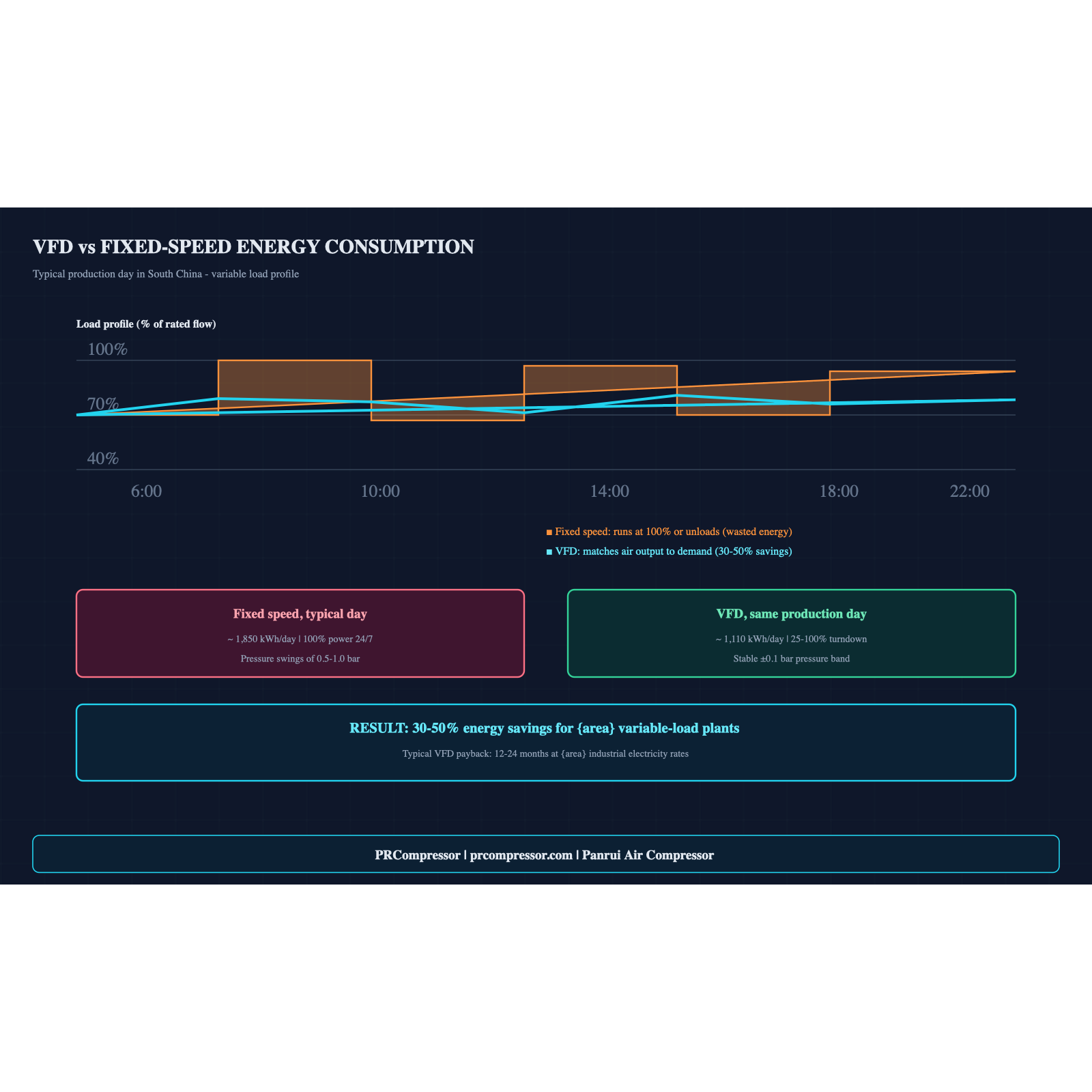
Payback period is the most commonly used metric for evaluating compressor upgrade projects in South China manufacturing facilities. Replacing an older fixed-speed compressor with a modern premium VFD model typically achieves payback in 12-24 months. Upgrading from standard-efficiency to premium-efficiency typically achieves payback in 18-36 months.
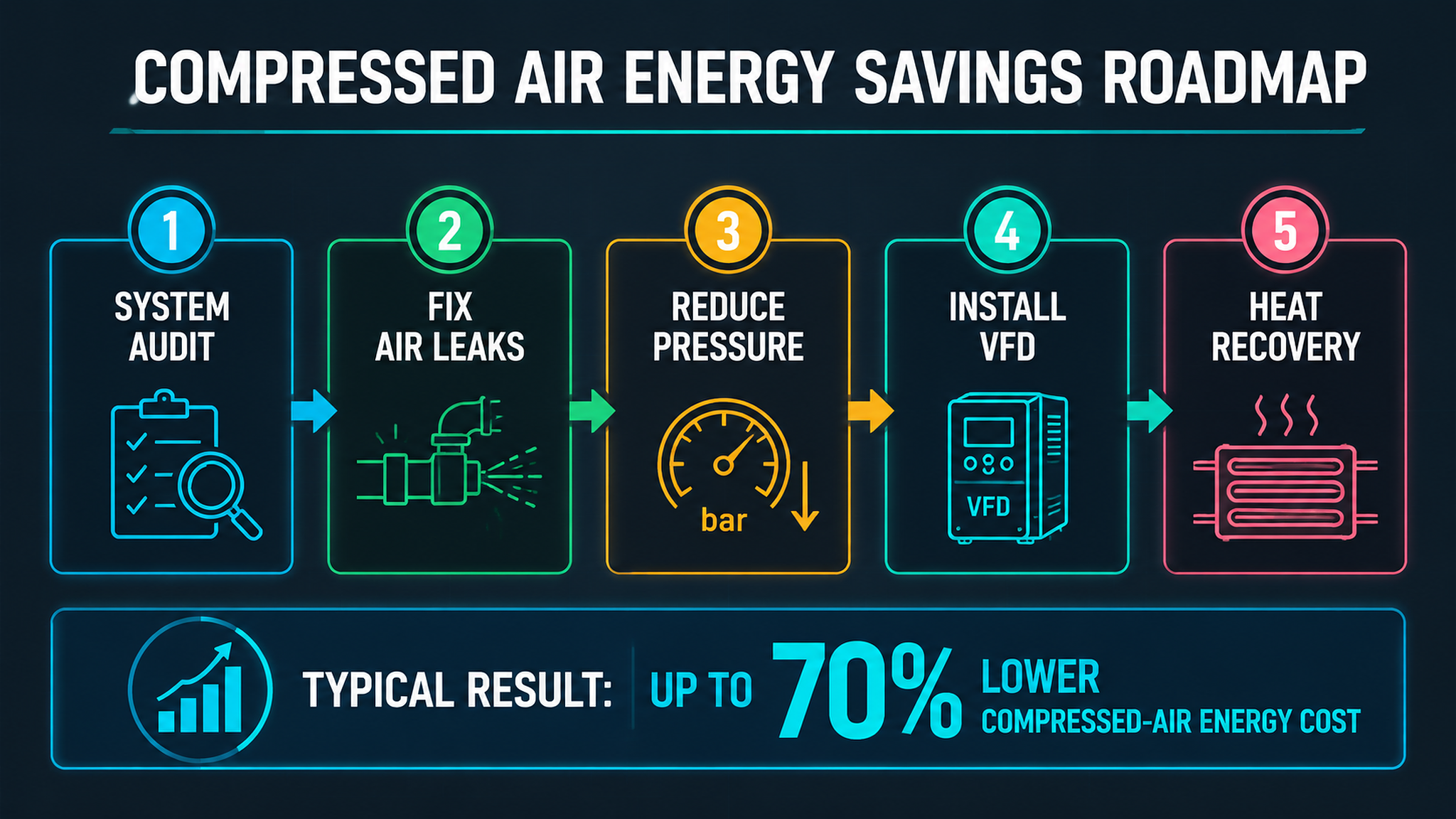
System-level improvement projects often achieve the shortest payback periods. Fixing compressed air leaks can reduce total system energy consumption by 20-30% at costs recovered within 3-6 months. Reducing system pressure by 1 bar saves 6-8% of compressor energy at essentially no cost. These quick-payback projects should be implemented alongside major equipment investments.
For South China manufacturers developing a compressed air system investment plan, a phased approach that prioritizes quick-payback system improvements while also planning for longer-payback equipment upgrades typically provides the best overall financial outcome.
ROI Calculation: Making the Financial Case for Premium Energy Saving Air Compressor
Building a convincing return on investment (ROI) case for premium-efficiency Energy Saving Air Compressor is essential for securing internal approval and budget allocation. For South China manufacturers, the financial analysis should quantify both the hard savings and the soft benefits.
The basic ROI calculation follows this formula: Total Investment = Equipment Cost + Installation Cost + Training Cost. Annual Savings = Energy Savings + Maintenance Savings + Quality Savings + Tax Benefits. Simple Payback = Total Investment ÷ Annual Savings. For well-selected compressor upgrades in South China facilities, simple payback periods typically range from 12 to 30 months.
A more sophisticated analysis uses discounted cash flow (DCF) methodology to account for the time value of money. Using Net Present Value (NPV) and Internal Rate of Return (IRR) metrics, the analysis considers: the initial investment; projected annual savings over the equipment’s expected life of 10-15 years; the cost of capital; inflation in electricity costs; and the residual value at end of life.
For South China manufacturers, the financial case for premium Energy Saving Air Compressor is typically compelling. A well-selected premium compressor with VFD technology and high-efficiency motor will almost always generate a positive NPV over its operating life, with IRR values typically exceeding 30%.
Visual: Energy Savings Roadmap
Checklist: Your Complete Energy Saving Air Compressor Buying Guide for South China
This comprehensive checklist summarizes the key considerations for your Energy Saving Air Compressor purchase. Use it throughout your procurement process.
Technical Requirements: ☐ Measured compressed air demand; ☐ Required discharge pressure; ☐ Required air quality level; ☐ Operating profile; ☐ Available utilities; ☐ Space for installation.
Equipment Selection: ☐ Compressor type (oil-injected or oil-free); ☐ Drive configuration (fixed speed or VFD); ☐ Compression stages; ☐ Motor efficiency class; ☐ Cooling system; ☐ Control system features.
Supplier Evaluation: ☐ Comparable proposals from 3+ suppliers; ☐ Verified efficiency data; ☐ Warranty terms; ☐ Service network coverage; ☐ References contacted; ☐ Service contract options.
Financial: ☐ TCO analysis completed; ☐ Financing options evaluated; ☐ Government incentives identified; ☐ Installation cost estimated; ☐ Performance guarantees documented.
For assistance, contact PRCompressor at 13713647073 or prcompressor.com.
Keywords: energy saving air compressor, energy saving compressor, industrial compressed air, compressor supplier, south china compressor, compressor energy efficiency, screw air compressor, compressor buyer’s guide, industrial air compressor, south china manufacturer
Contact PRCompressor (Panrui) for energy saving air compressor in South China: Phone 13713647073 | prcompressor.com