


High Efficiency Screw Compressor Buying Tips for Guangdong Facilities | 2026
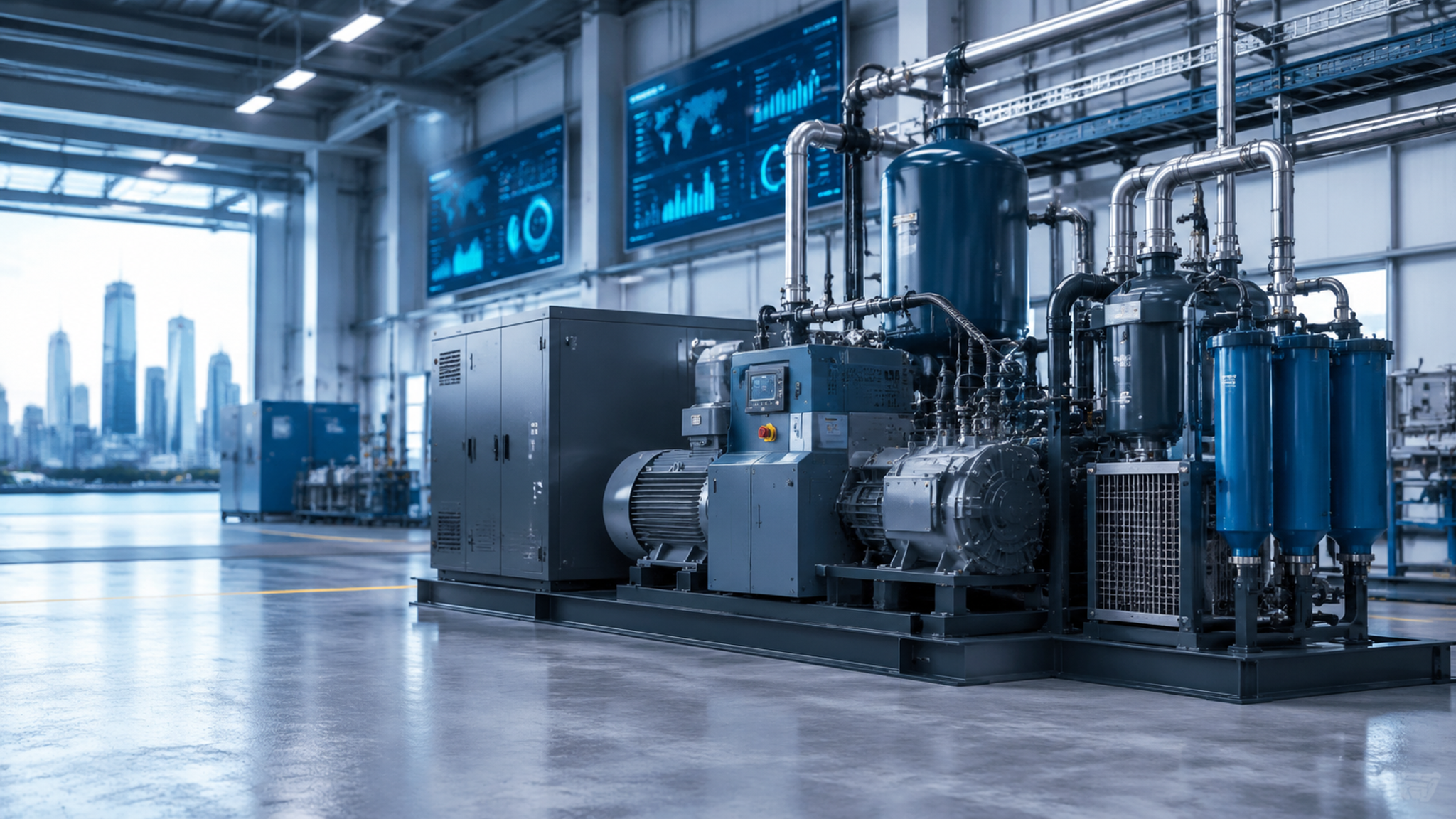
Consider this scenario: A medium-sized manufacturing facility in Guangdong was running three aging fixed-speed compressors totaling 220kW, operating 6,000 hours per year. Their annual electricity cost for compressed air alone exceeded ¥680,000. After a thorough system audit and equipment upgrade to modern High Efficiency Screw Compressor with VFD technology, they reduced their compressed air energy consumption by 38% — saving over ¥258,000 annually with a payback period of just 14 months. Stories like this are becoming increasingly common across Guangdong’s industrial sector.
This guide examines how Guangdong manufacturers can achieve similar results through careful evaluation and selection of High Efficiency Screw Compressor. We cover the technology options available, key specification parameters, supplier evaluation criteria, and financial analysis methods that will help you make an optimal equipment investment.
The Science of Air Compression: How High Efficiency Screw Compressor Achieve Efficiency
At its core, air compression is a thermodynamic process that follows the fundamental laws of gas behavior. When air is compressed, its temperature rises significantly — a 100 kPa (1 bar) increase in pressure can raise the air temperature by approximately 80-100°C under adiabatic conditions. Managing this heat is one of the key challenges in compressor design, as excessive temperatures can degrade lubricating oil, damage components, and reduce overall system efficiency.
Modern High Efficiency Screw Compressor address this challenge through sophisticated thermal management systems that optimize the compression process across a wide range of operating conditions. Oil-injected screw compressors use the injection of specially formulated compressor oil directly into the compression chamber to seal rotor clearances, lubricate the rotors and bearings, and absorb the heat of compression. The oil is then circulated through an oil cooler before being reinjected, maintaining optimal operating temperatures even under continuous full-load operation.
The specific power consumption of a compressor — measured in kW per m³/min of delivered air — is the most important indicator of its energy efficiency. Premium High Efficiency Screw Compressor in the Guangdong market typically achieve specific power values ranging from 5.5 to 6.5 kW/(m³/min) at full load, with the most efficient models falling below 5.5 kW/(m³/min). By comparison, older or lower-quality units may require 7.0 kW/(m³/min) or more, representing a 20-30% efficiency penalty that translates directly to higher electricity costs over the equipment’s operating life.
Understanding these technical fundamentals is essential for making informed procurement decisions. When evaluating High Efficiency Screw Compressor options in Guangdong, look beyond the headline specifications to examine the specific power curves at different load points, the efficiency of the drive system, and the effectiveness of the cooling and oil management systems. These factors collectively determine the real-world performance and operating cost of the equipment.
Compressed Air Storage: The Buffer That Protects Your Production
Adequate compressed air storage is one of the most cost-effective investments any Guangdong manufacturing facility can make in their compressed air system. Storage serves multiple critical functions: it stabilizes system pressure during periods of peak demand, reduces the frequency of compressor cycling, provides emergency capacity during a compressor failure, and allows the system to handle transient demand spikes without requiring additional compressor capacity.
The general recommendation for compressed air storage capacity is 20-40 liters per m³/min of compressor capacity for systems with relatively stable demand, increasing to 50-80 liters per m³/min for systems with highly variable demand or critical pressure-sensitive processes. For Guangdong facilities operating High Efficiency Screw Compressor systems with significant demand variation, additional storage capacity is one of the most effective ways to improve system stability and efficiency.
The location of storage within the system also matters. While a single large receiver tank near the compressor room is the most common configuration, distributed storage located near large intermittent demand points can be more effective. This approach reduces the pressure drop in the piping between the storage and the point of use, allowing the compressor to operate at a lower discharge pressure while maintaining adequate pressure at the point of use. The energy savings from a 1 bar reduction in discharge pressure typically amounts to 6-8% of compressor energy consumption.
For Guangdong manufacturers considering a High Efficiency Screw Compressor purchase, including adequate storage capacity in the system design is a low-cost, high-return investment that enhances the performance and efficiency of any compressor configuration. The incremental cost of properly sized storage is typically recovered within 6-12 months through reduced compressor cycling and the ability to operate at lower average discharge pressure.
Step-by-Step Guide to Selecting High Efficiency Screw Compressor in Guangdong
Selecting the right High Efficiency Screw Compressor for your Guangdong facility does not need to be complicated, but it does require a systematic approach. This step-by-step guide provides a structured process that will help you evaluate your options and make a confident decision.
Step 1: Define Your Compressed Air Demand — Measure your actual air consumption over a representative period. If measurement is not possible, estimate demand by inventorying all air-consuming equipment and calculating total demand with appropriate diversity factors. Add 20-30% for future expansion and system losses.
Step 2: Determine Your Air Quality Requirements — Identify the highest air quality requirement among your applications. If any application requires oil-free air, that will drive the compressor selection toward oil-free technology. Also determine the required pressure dew point and particulate filtration level.
Step 3: Evaluate Technology Options — Based on your demand profile and air quality requirements, evaluate the available technology options. For variable demand with 4,000+ annual operating hours, VFD technology is strongly recommended. For constant high-pressure applications, two-stage compression should be considered.
Step 4: Compare Supplier Proposals — Request proposals from at least three qualified suppliers. Evaluate proposals based on lifecycle cost, not purchase price. Verify service capabilities and warranty terms. Request references and follow up on them.
Step 5: Make a Confident Decision — Combine the technical evaluation, financial analysis, and supplier assessment into a weighted decision framework, balancing quantitative factors with qualitative factors.
Future-Proofing Your High Efficiency Screw Compressor Investment in Guangdong
Investing in High Efficiency Screw Compressor is a long-term commitment that will affect your facility’s operations, energy costs, and environmental performance for a decade or more. Protecting that investment against future changes is an important consideration.
Technology compatibility is key. Choose equipment that supports open communication protocols rather than proprietary systems. Select controllers with upgradeable firmware. If considering IoT capabilities, ensure the platform supports common connectivity standards that will remain relevant.
Regulatory preparedness is another consideration. China’s energy efficiency standards are expected to continue tightening. Choosing equipment that meets anticipated future standards provides a compliance buffer. Selecting equipment with lower environmental impact positions your facility favorably for future regulations.
Flexibility in equipment configuration also supports future-proofing. Modular compressor designs that allow capacity additions or technology upgrades without replacing the entire system provide valuable adaptability.
Financial Analysis: Leasing vs Purchasing High Efficiency Screw Compressor in Guangdong
For Guangdong manufacturers, the decision between leasing and purchasing High Efficiency Screw Compressor involves financial, operational, and strategic considerations beyond simple cost comparison. Each approach offers distinct advantages.
Leasing High Efficiency Screw Compressor preserves working capital, provides predictable fixed monthly payments, may offer tax advantages through deductibility of lease payments, and allows for easier equipment upgrades at lease expiration. Lease terms typically range from 3 to 7 years with residual values of 10-30%.
Purchasing High Efficiency Screw Compressor provides the lowest total cost over the equipment’s life, offers full ownership and control, allows for depreciation benefits, and eliminates ongoing payment obligations after purchase. For Guangdong manufacturers with access to capital and a long-term perspective, purchasing typically provides the best financial outcome.
The financial comparison should consider: total cost of leasing over the planned use period; total cost of purchasing; tax implications; the manufacturer’s cost of capital; and the expected useful life relative to the lease term. For most Guangdong manufacturers, purchasing provides better 10-year economics while leasing better serves manufacturers with capital constraints.
Total Cost of Ownership Analysis for High Efficiency Screw Compressor in Guangdong
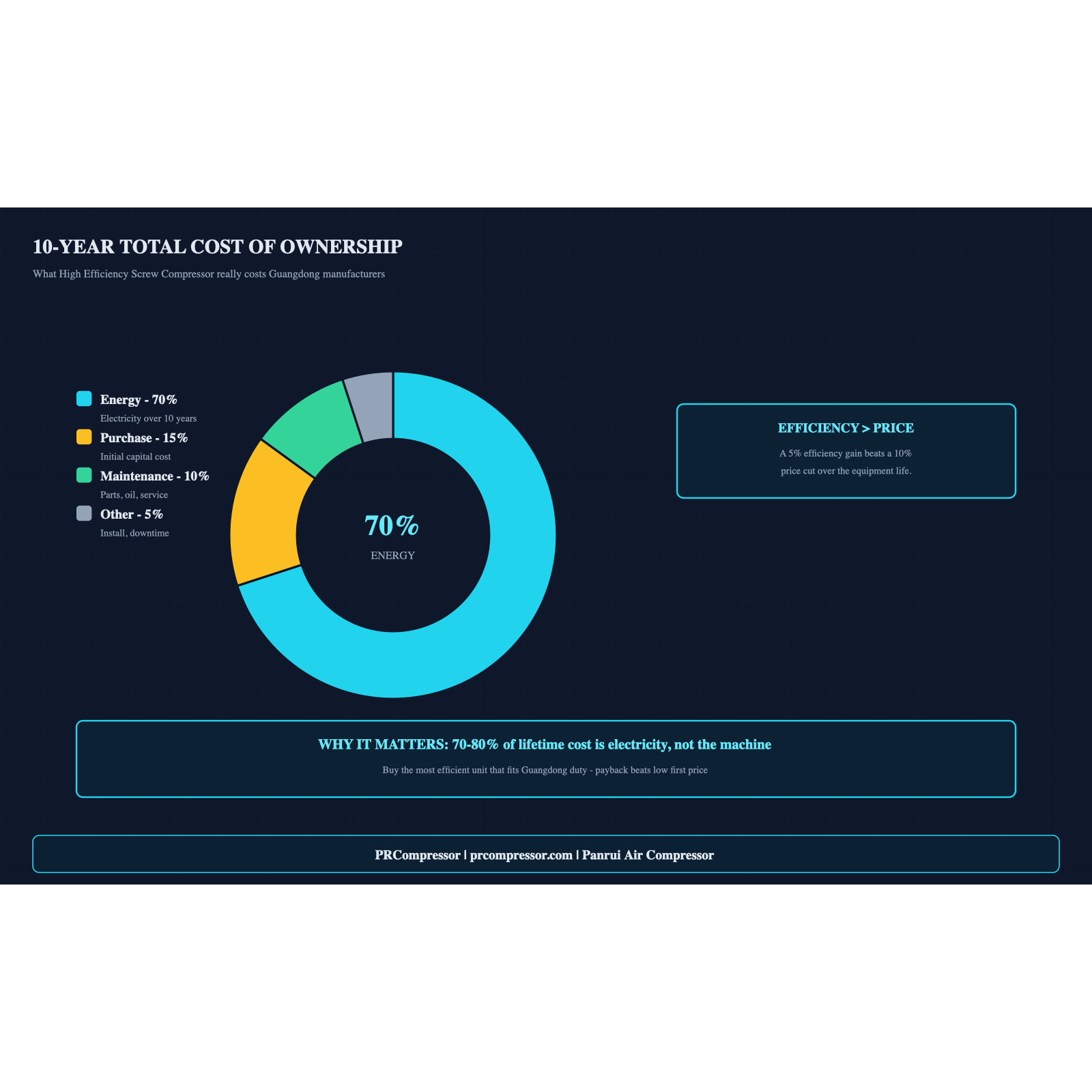
For Guangdong manufacturers, understanding the total cost of ownership (TCO) of High Efficiency Screw Compressor is essential for making informed procurement decisions. TCO analysis accounts for all costs associated with owning and operating a compressor over its service life, including initial purchase price, installation costs, energy consumption, maintenance, spare parts, and downtime costs.
The typical TCO breakdown for an industrial screw compressor operating in Guangdong is as follows: energy costs account for 70-80% of total lifetime cost; the initial purchase price accounts for 10-15%; maintenance and spare parts account for 8-12%; and installation, downtime, and other costs account for the remaining 2-5%. This distribution means that a 10% improvement in energy efficiency has roughly the same financial impact as a 50% reduction in purchase price.
To illustrate with a specific example for the Guangdong market: a 75kW High Efficiency Screw Compressor operating 6,000 hours per year with electricity at ¥0.90/kWh will consume approximately ¥405,000 worth of electricity annually. Over a 10-year operating life, the total energy cost exceeds ¥4 million. Comparing two compressor options with a 0.5 kW/(m³/min) difference in specific power, the more efficient unit will save approximately ¥200,000 in energy costs over its life.
When evaluating TCO for High Efficiency Screw Compressor options in Guangdong, the following calculation framework is recommended: estimate annual operating hours; determine your effective electricity cost; obtain specific power data at typical load points from each supplier; calculate annual energy consumption and cost for each option; add estimated maintenance costs; and compare the 5-year and 10-year total costs to identify the most economical option over the long term.
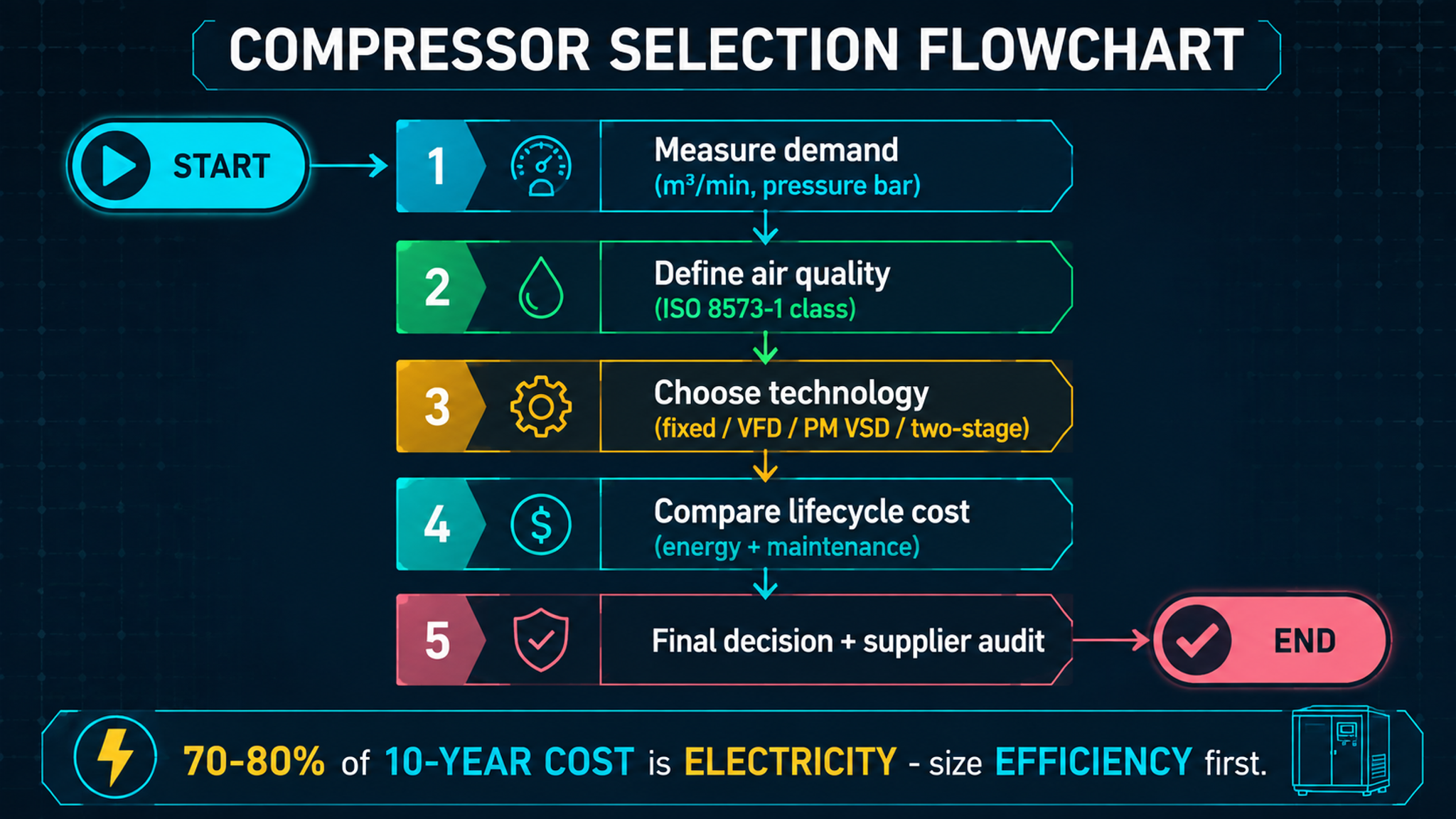
Visual Guide: Compressor Selection Process
[Flowchart: A step-by-step visual guide to selecting the right High Efficiency Screw Compressor in Guangdong, starting from demand measurement and air quality requirements through technology evaluation, supplier comparison, and final decision.]
Visual Guide: How High Efficiency Screw Compressor Compares
Buyer’s FAQ: Making Sense of High Efficiency Screw Compressor Specifications
What does specific power mean and why does it matter?
Specific power is the most important efficiency metric, measuring kW required per m³/min of delivered air. Premium compressors achieve 5.2-6.0 kW/(m³/min), while less efficient units may require 6.5-7.5 kW/(m³/min). Each 0.5 kW/(m³/min) improvement saves approximately ¥50,000-80,000 annually for a mid-size unit.
Why is my new High Efficiency Screw Compressor using more energy than expected?
Common causes include: compressor oversized for actual demand, system pressure set too high, air treatment with high pressure drop, or air leaks in the distribution system. A systematic audit will typically identify the cause.
What is the warranty coverage for High Efficiency Screw Compressor?
Standard warranty is typically 2 years. The airend is often covered by a separate longer warranty, typically 3-5 years. Some premium brands offer extended options up to 10 years for major components.
High Efficiency Screw Compressor for Automotive and Parts Manufacturing in Guangdong
The automotive parts manufacturing sector in Guangdong is characterized by high-volume production, demanding quality standards, and significant compressed air requirements. From robotic welding cells and automated assembly lines to paint spraying booths and pneumatic testing equipment, automotive production depends heavily on reliable compressed air supply.
Key compressed air requirements for Guangdong automotive manufacturers include high reliability, consistent air quality, and energy efficiency. These requirements make automotive manufacturers natural candidates for premium High Efficiency Screw Compressor with comprehensive monitoring and service support agreements.
Two-stage compression technology is particularly well-suited for automotive applications, as many automotive processes require pressures at the higher end of the industrial range (10-13 bar). The efficiency advantage of two-stage compression is most pronounced at these higher pressures. VFD technology is also widely adopted, as the demand profile in automotive plants typically varies significantly between production shifts.
For Guangdong automotive parts manufacturers, the selection of High Efficiency Screw Compressor should be approached as a strategic decision with long-term implications for production reliability and operating costs.
Preventive Maintenance Schedule for High Efficiency Screw Compressor in Guangdong
A well-planned preventive maintenance (PM) program is essential for maximizing the life and efficiency of your High Efficiency Screw Compressor investment. Studies show that a properly maintained compressor consumes 5-10% less energy than one receiving only reactive maintenance, and its service life can be extended by 30-50%.
Daily tasks: Check oil level; inspect for oil leaks; monitor discharge temperature; check operating pressure and temperature readings; listen for unusual noises; drain condensate from the receiver tank.
Weekly and monthly tasks: Inspect and clean air filter elements; check belt tension; verify safety valve operation; inspect electrical connections; check VFD cooling fan; review operating data for trends.
Quarterly and annual tasks: Perform oil analysis; replace oil and oil filter; replace air filter and oil separator; inspect and clean cooling system; check sensor calibration; conduct full system performance test.
For Guangdong manufacturers, maintaining a detailed maintenance log that records all inspections, measurements, and component replacements is essential for tracking the compressor’s condition over time.
Taking Action: Your Next Steps for High Efficiency Screw Compressor Procurement in Guangdong
Armed with the information in this guide, here is a practical action plan to move from knowledge to decision.
Week 1-2: Assessment — Measure compressed air demand. Determine air quality requirements. Document operating profile. Establish budget and timeline.
Week 3-4: Research — Identify potential suppliers. Request preliminary proposals from at least three qualified suppliers. Attend product demonstrations. Research reputations.
Week 5-6: Evaluation — Develop TCO comparison. Contact references. Conduct site visits. Evaluate service capabilities.
Week 7-8: Decision — Select preferred supplier. Negotiate commercial terms. Finalize installation plan. Place order.
For expert guidance at any stage, contact PRCompressor at 13713647073 or prcompressor.com.
Keywords: guangdong manufacturer, industrial compressed air, compressor energy efficiency, compressor supplier, high efficiency screw compressor, energy saving compressor, compressor buyer’s guide, industrial air compressor, guangdong compressor, screw air compressor
Contact PRCompressor (Panrui) for high efficiency screw compressor in Guangdong: Phone 13713647073 | prcompressor.com