


A plant that needs 6.5 bar at the tool but keeps the compressor discharge at 8 bar is paying for pressure nobody uses. In a compressed air pressure drop calculation, every extra 1 bar (0.1 MPa) of system pressure adds roughly 7% to compressor electricity consumption. That is why a pressure-drop audit usually pays for itself faster than a new air end.
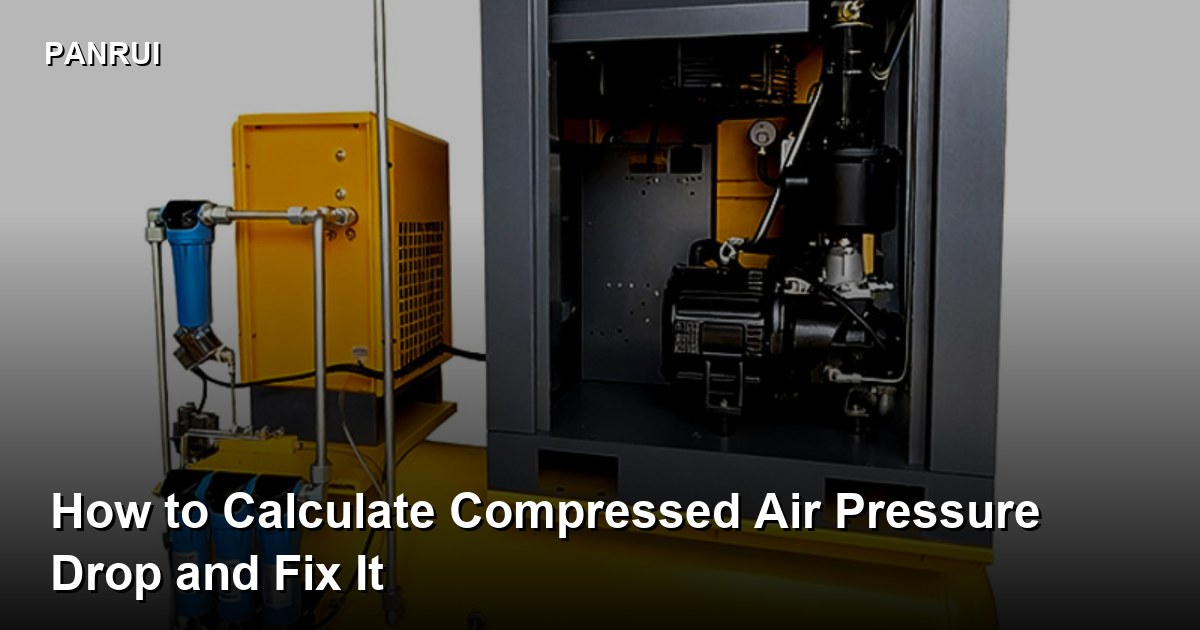
How to calculate the pressure drop in your system
You do not need a laboratory. Measure pressure at the rotary screw air compressor outlet and again at the furthest point of use while the plant is running at full load. The gap between the two readings is your total system pressure drop. If that gap keeps creeping up, the problem is usually piping, filtration, or drying — not the compressor itself.
Convert the gap into money. The Panrui energy model applies a pressure correction factor of 1 − (excess bar × 7%). A 75 kW machine delivering 8 bar when 6.5 bar would do means 1.5 extra bar, or 1 − (1.5 × 0.07) = 0.895. That is 10.5% of motor power spent on pressure nobody uses — about 7.9 kW on a 75 kW unit.
Where the pressure disappears
- Undersized pipe diameter and long straight runs
- Too many elbows, tees, and threaded couplings
- Saturated filters and undersized dryers
- A receiver located far from the point of use
- Leaks that force the compressor to hold a higher pressure band
Fix the drop before adding another compressor
Most plants answer low pressure with a bigger machine. The cheaper fix is to remove the loss. Panrui screw units ship with enlarged internal piping and hard-pipe connections specifically to cut pressure loss between the air end and the outlet, and the same logic applies to your distribution line.
- Upsize the header and drop lines so velocity falls as diameter increases.
- Replace tight elbows with swept bends and loop the header so air reaches each point from two directions.
- Track filter differential pressure and replace elements before they become restrictive.
- Move or add a receiver near the point of use to smooth demand spikes.
- Find and seal leaks, then lower the discharge setpoint to match.
Tighten pressure control to keep the savings
Fixed-speed machines run inside a wide band, often 0.2 MPa between load and unload, which forces you to set discharge higher than the process needs. A variable speed screw compressor holds supply within about ±0.01 MPa, so you can lower the target pressure instead of overshooting it. On the Panrui audit model, removing 0.1 MPa of that band alone is worth roughly 7% of power.
What a full correction looks like
In one Panrui replacement calculation, a 250 kW machine rated at 8.6 bar was actually supplying a 4.9 bar load. The 3.7 bar of excess pressure cut its pressure factor to 0.741 — more than a quarter of its power was pressure overhead. Replacing it with a right-sized two-stage VSD unit cut hourly consumption from 207.67 kW to 154.43 kW, saving 53.24 kW every hour. That is the difference between measuring a problem and fixing it.
“A little extra pressure is safe” — no, it is overhead
Extra pressure is insurance you pay for in real time. Every 1 bar above the true requirement costs about 7% more electricity, and a fixed-speed unit adds another 0.1–0.2 MPa on top through its load/unload band. Keeping pressure only as high as the tools require — and removing the drop that forced it higher — is the fastest energy win in a compressed air room.
Next step
Audit the gap between discharge pressure and point-of-use pressure, then fix piping, filtration, and control before sizing a new machine. For a right-sized two-stage screw compressor or a VSD unit that holds a tight, low band, talk to the Panrui team.
Request a compressed air pressure drop calculation and get a before-and-after energy comparison for your plant.