


How to Choose Industrial Air Compressor in South China | 2026 Expert Guide
Consider this scenario: A medium-sized manufacturing facility in South China was running three aging fixed-speed compressors totaling 220kW, operating 6,000 hours per year. Their annual electricity cost for compressed air alone exceeded ¥680,000. After a thorough system audit and equipment upgrade to modern Industrial Air Compressor with VFD technology, they reduced their compressed air energy consumption by 38% — saving over ¥258,000 annually with a payback period of just 14 months. Stories like this are becoming increasingly common across South China’s industrial sector.
This guide examines how South China manufacturers can achieve similar results through careful evaluation and selection of Industrial Air Compressor. We cover the technology options available, key specification parameters, supplier evaluation criteria, and financial analysis methods that will help you make an optimal equipment investment.
Compressed Air System Design: Beyond the Compressor Itself
The compressor is only one component of a complete compressed air system, and optimizing the system as a whole is essential for achieving the best possible performance and efficiency. For South China manufacturers investing in Industrial Air Compressor, attention to system design — including intake air quality, piping configuration, air treatment, and condensate management — can significantly impact both the efficiency of the compressor itself and the quality of the compressed air delivered to production equipment.
The quality of intake air is a frequently overlooked factor in compressor performance. Every 10°C reduction in intake air temperature reduces the energy required for compression by approximately 3%. For South China facilities in hot climates, locating the compressor intake on the north side of the building or drawing air from a cooler area can yield meaningful energy savings. Similarly, keeping intake air filters clean is essential — a dirty intake filter can increase pressure drop across the filter housing, effectively reducing the compressor’s capacity and increasing its specific power consumption.
Proper piping design is equally important. Undersized piping creates excessive pressure drop, forcing the compressor to operate at a higher discharge pressure to compensate. The rule of thumb is to design piping for a maximum pressure drop of 3-5% of the system pressure — for an 8 bar system, this means keeping total piping pressure drop below 0.4 bar. Loop-configuration piping rather than dead-end branches improves pressure stability and allows maintenance on sections without disrupting the entire system.
Air treatment is the final critical element of system design. The appropriate combination of aftercooler, dryer, and filters depends on the air quality requirements of your specific applications. For most South China general manufacturing applications, a refrigerant dryer and particulate filter provide adequate air quality at moderate cost. For facilities requiring higher air quality, additional treatment including desiccant dryers and coalescing filters may be necessary.
Compressed Air Quality Standards for South China Industries
The quality of compressed air required varies significantly across different industrial applications, and selecting the appropriate air quality level for your operations has important implications for both equipment selection and operating costs. The international standard ISO 8573-1 defines nine purity classes for compressed air based on solid particle content, water content, and oil content, with Class 1 being the highest purity and Class 9 the lowest.
For general South China manufacturing applications such as pneumatic tools, material handling, and machine actuation, ISO Class 4-5 air quality is typically sufficient. This level of air quality can be achieved with a standard oil-injected Industrial Air Compressor followed by a refrigerant dryer and basic particulate filtration — a relatively modest investment in air treatment equipment.
Higher quality requirements drive significantly higher air treatment costs. ISO Class 1-2 air quality, required for applications such as pharmaceutical manufacturing, food and beverage processing, electronics fabrication, and critical instrumentation, demands oil-free compressors or comprehensive filtration, desiccant or membrane drying, and careful attention to the entire compressed air system. The total cost of a Class 1 compressed air system can be 2-3 times that of a Class 4 system, making it important to match air quality specifications precisely to actual production requirements.
When evaluating Industrial Air Compressor options for your South China facility, clearly define your air quality requirements before selecting equipment. Overspecifying air quality drives unnecessary capital and operating costs, while underspecifying risks product quality issues or equipment damage. If your air quality requirements vary across different production areas, consider a zoned approach with appropriate treatment at each zone level.
Rightsizing: Determining the Optimal Capacity for Industrial Air Compressor in South China
Determining the optimal capacity for Industrial Air Compressor is one of the most critical decisions in the compressor selection process. An undersized compressor cannot meet production demand, while an oversized compressor operates inefficiently.
The first step in rightsizing is accurate demand measurement. Install a flow meter and log demand data for at least one full production week. The data should capture both average demand and peak demand events. For facilities with relatively constant demand, select a compressor with output matching measured average demand plus 20-30% margin.
For facilities with variable demand, a single VFD compressor sized to handle 70-100% of peak demand, or a multi-compressor system with a VFD trim unit, typically provides the best combination of efficiency and capacity. Storage capacity should also be factored in — typically 20-40 liters per m³/min of compressor capacity.
In facilities with significant short-duration peak demand events, additional storage capacity can allow the compressor system to be sized for average demand rather than peak demand, yielding substantial capital and energy savings.
Supplier Qualification: Questions to Ask Before Buying Industrial Air Compressor in South China
Asking the right questions during supplier evaluation is essential for making an informed purchasing decision. Here are the key questions organized by topic.
Product Performance: Can you provide verified specific power data at full load and part load? How do you verify your efficiency claims? What is your policy if the installed equipment fails to meet specified performance? What is the expected service life under our operating conditions?
Service and Support: How many service technicians do you have in the South China region? What is your typical response time for emergency calls? Do you maintain local spare parts inventory? Can you provide a sample maintenance contract? What training do you provide?
Company Background: How long have you been supplying the South China market? Can you provide references from three customers in similar industries? What certifications do you hold? What is your approach to product development?
Commercial Terms: What is your standard warranty coverage? Can extended warranty be purchased? What are your payment terms? Do you offer performance guarantees? What is the expected delivery lead time?
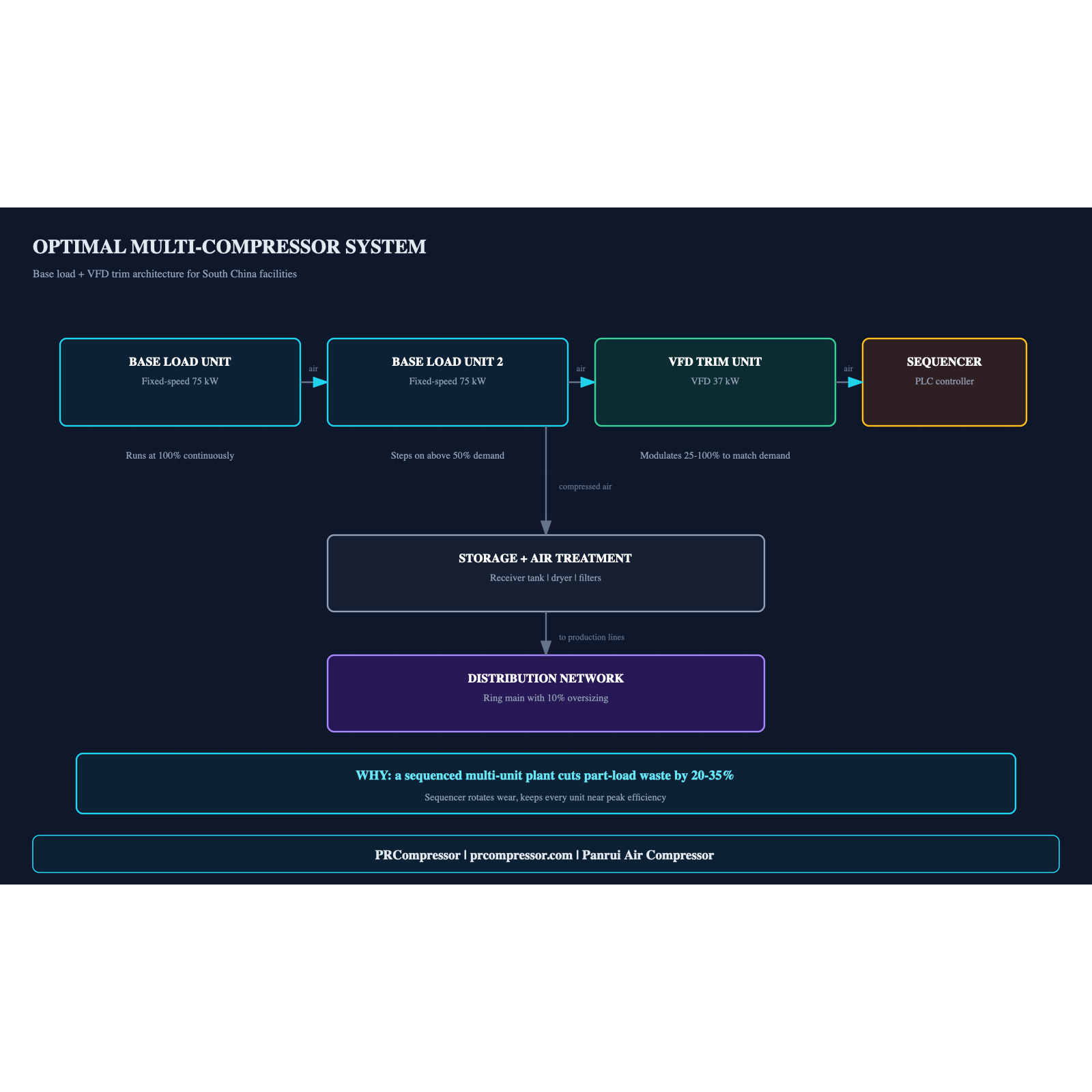
Visual: Optimal System Configuration
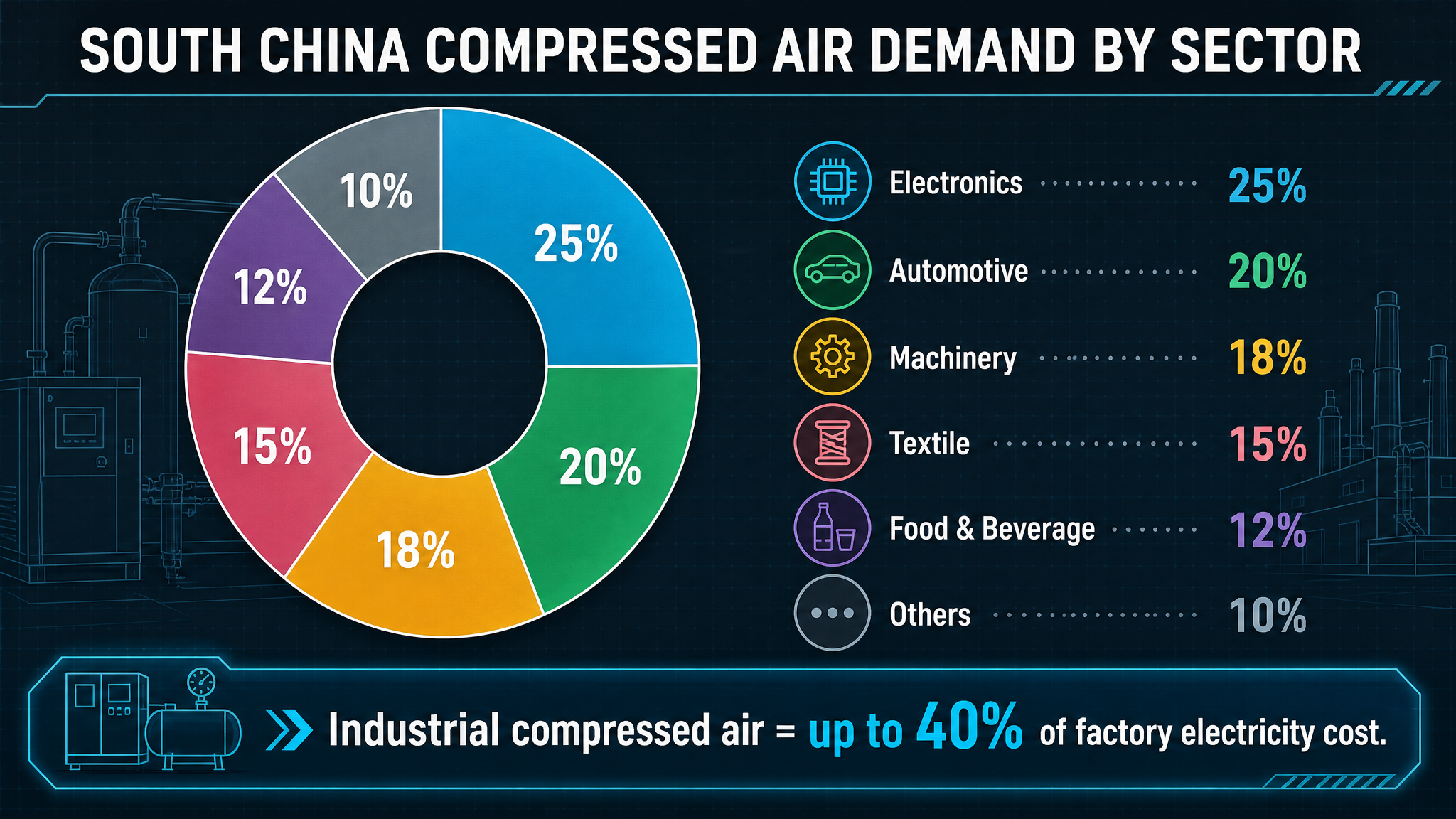
Industry Applications at a Glance
Total Cost of Ownership Analysis for Industrial Air Compressor in South China
For South China manufacturers, understanding the total cost of ownership (TCO) of Industrial Air Compressor is essential for making informed procurement decisions. TCO analysis accounts for all costs associated with owning and operating a compressor over its service life, including initial purchase price, installation costs, energy consumption, maintenance, spare parts, and downtime costs.
The typical TCO breakdown for an industrial screw compressor operating in South China is as follows: energy costs account for 70-80% of total lifetime cost; the initial purchase price accounts for 10-15%; maintenance and spare parts account for 8-12%; and installation, downtime, and other costs account for the remaining 2-5%. This distribution means that a 10% improvement in energy efficiency has roughly the same financial impact as a 50% reduction in purchase price.
To illustrate with a specific example for the South China market: a 75kW Industrial Air Compressor operating 6,000 hours per year with electricity at ¥0.90/kWh will consume approximately ¥405,000 worth of electricity annually. Over a 10-year operating life, the total energy cost exceeds ¥4 million. Comparing two compressor options with a 0.5 kW/(m³/min) difference in specific power, the more efficient unit will save approximately ¥200,000 in energy costs over its life.
When evaluating TCO for Industrial Air Compressor options in South China, the following calculation framework is recommended: estimate annual operating hours; determine your effective electricity cost; obtain specific power data at typical load points from each supplier; calculate annual energy consumption and cost for each option; add estimated maintenance costs; and compare the 5-year and 10-year total costs to identify the most economical option over the long term.
Troubleshooting FAQ: Common Industrial Air Compressor Issues
Why does my Industrial Air Compressor keep tripping the overload relay?
Most common cause is low supply voltage. Check voltage at compressor terminals during operation. Other causes include mechanical binding, incorrect relay setting, failing motor, or excessive ambient temperature.
What causes oil in the compressed air lines?
Most common is a saturated or damaged oil separator element. Other causes include restricted oil return line, overfilling with oil, high system back pressure, or using wrong oil type.
Why is my compressor running continuously without unloading?
Most likely cause is an air leak in the distribution system. Other possibilities include faulty pressure switch/transducer or restricted intake filter. Check for leaks first using ultrasonic detection or by checking pressure drop when the compressor is stopped.
Industry Data: Compressed Air Energy Consumption Patterns in South China
Understanding how compressed air energy consumption patterns compare to industry benchmarks provides valuable context for evaluating your facility’s performance. Industry research shows that compressed air systems account for 10-30% of total industrial electricity consumption, with the average around 12-15% for general manufacturing.
For a typical South China manufacturing facility with an annual electricity bill of ¥5 million, the compressed air system accounts for ¥500,000 to ¥1.5 million in annual energy costs. Leak rates in industrial systems average 25-35% of total compressor output — meaning that for every three compressors running, one is effectively producing wasted air.
System pressure is another area where significant savings are available. The average industrial compressed air system operates at 1-2 bar higher than necessary. Reducing system pressure by 1 bar saves 6-8% of compressor energy.
Industrial Air Compressor for Chemical and Petrochemical Processing in South China
Chemical and petrochemical processing facilities in South China have some of the most demanding compressed air requirements, driven by the need for absolute reliability, strict air quality standards, and the hazards associated with compressed air in potentially explosive atmospheres.
Safety is the primary consideration in chemical processing compressed air systems. Facilities handling flammable materials or operating in hazardous areas must comply with strict safety standards. Compressors used in or near hazardous areas require appropriate ATEX or equivalent certification. Oil-free compressors are often specified to eliminate the risk of oil contamination reacting with process chemicals.
Reliability is equally critical, as compressed air failure in chemical processing can cause process interruptions that are both costly and potentially dangerous. Redundant compressor configurations, emergency backup systems, and comprehensive monitoring are standard in this industry.
For South China chemical and petrochemical facilities, working with a Industrial Air Compressor supplier who has experience in the chemical industry is essential. The supplier should understand the safety requirements and reliability standards that apply to chemical processing applications.
Industrial Air Compressor for Pharmaceutical and Medical Device Manufacturing in South China
Pharmaceutical and medical device manufacturing in South China represents the most demanding compressed air applications in the industrial sector. Good Manufacturing Practice (GMP) regulations require that compressed air used in pharmaceutical production be of defined quality with documented verification.
For pharmaceutical applications, 100% oil-free Industrial Air Compressor is the standard specification, backed by continuous monitoring and comprehensive documentation. The compressor system must include redundant capacity to ensure uninterrupted operation during maintenance, and all components that contact the compressed air must be constructed of materials suitable for cleanroom environments.
Validation and documentation are critical elements of pharmaceutical compressed air systems. Installation Qualification (IQ), Operational Qualification (OQ), and Performance Qualification (PQ) protocols must be executed and documented for all critical compressed air equipment.
For South China pharmaceutical and medical device manufacturers, selecting Industrial Air Compressor from suppliers with experience in the regulated pharmaceutical market is strongly recommended. These suppliers understand the documentation requirements and validation protocols that apply to pharmaceutical compressed air systems.
Investment Perspective: Industrial Air Compressor as a Strategic Asset
Viewing Industrial Air Compressor through the lens of strategic asset management can transform how South China manufacturers approach their compressed air investments. A compressor is not merely a utility — it is a production-critical asset whose performance directly impacts competitiveness, efficiency, and environmental performance.
Strategic metrics include: energy cost per unit of production output; compressed air availability as a percentage of production time; and compressed air cost as a percentage of total facility operating costs. Manufacturers who adopt this strategic approach achieve measurably better outcomes.
For South China manufacturers ready to take this strategic approach, PRCompressor (Panrui) offers the expertise, product range, and support infrastructure needed to succeed. Contact us at 13713647073 or prcompressor.com.
Keywords: industrial compressed air, compressor supplier, industrial air compressor, south china compressor, energy saving compressor, compressor buyer’s guide, industrial air compressor, screw air compressor, compressor energy efficiency, south china manufacturer
Contact PRCompressor (Panrui) for industrial air compressor in South China: Phone 13713647073 | prcompressor.com