


Industrial Air Compressor Buying Tips for Guangdong Facilities | 2026
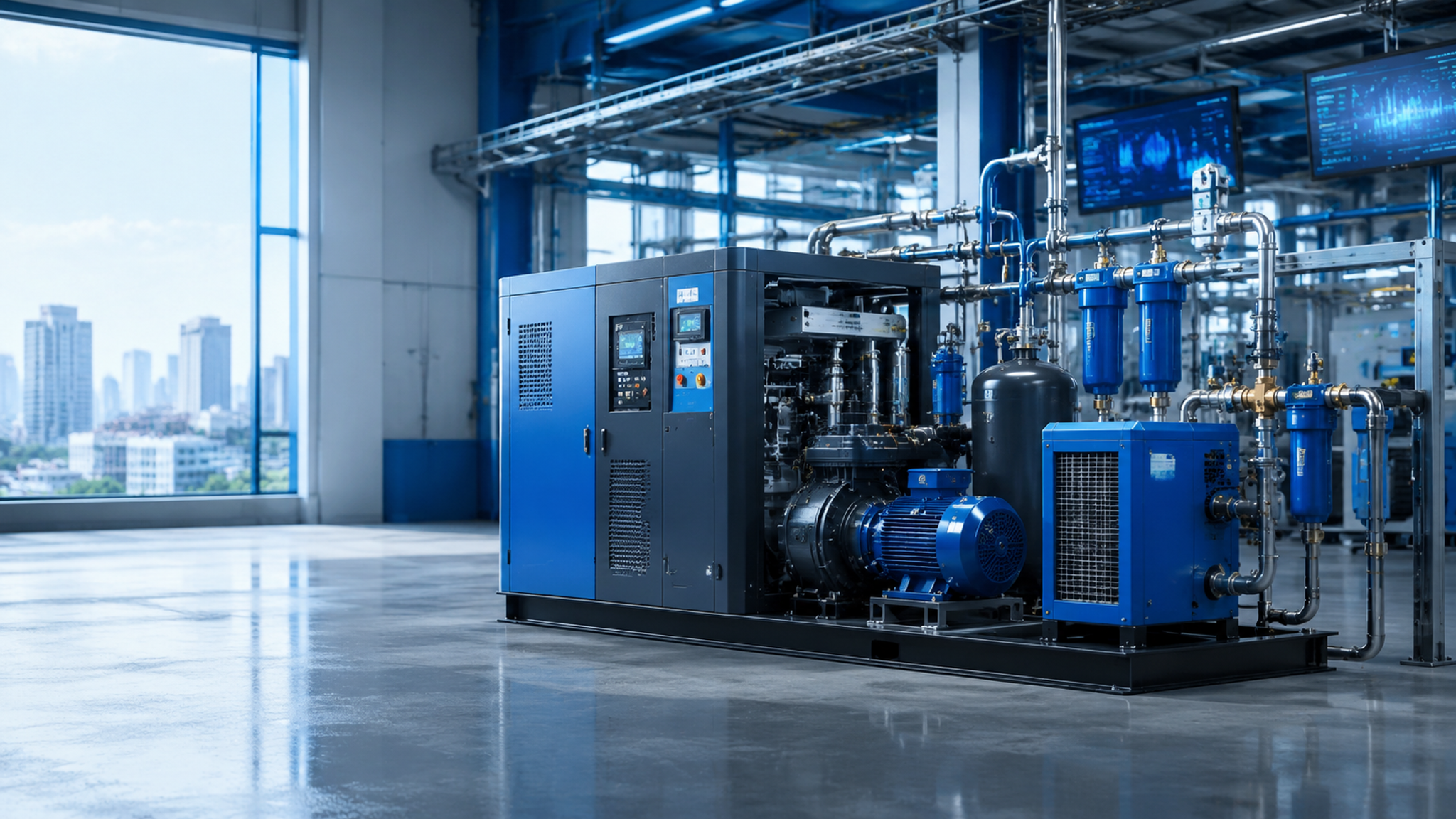
If you manage a manufacturing facility in Guangdong, you have likely experienced at least one of these common compressed air challenges: unreliable equipment causing production interruptions, high electricity bills that seem to increase every month, inconsistent air pressure affecting product quality, or difficulty finding responsive service support when problems arise. These pain points are all too familiar to industrial buyers evaluating Industrial Air Compressor, and they underscore the importance of choosing the right equipment and supplier from the start.
This guide addresses each of these challenges head-on, providing practical strategies for selecting Industrial Air Compressor that delivers reliable performance, energy efficiency, and dependable after-sales support. We draw on extensive experience with Guangdong industrial facilities to offer insights that go beyond manufacturer brochures and specification sheets.
Power Range and Application Matching
5.5-22 kW (Small Shop): Ideal for workshops, repair facilities, light manufacturing. Serves 1-5 consumers, typically 2,000-4,000 hours/year. Fixed-speed usually adequate.
30-75 kW (Medium Manufacturing): The most common range for general manufacturing. Serves 5-20 consumers. Most facilities benefit from VFD technology with 12-24 month payback.
90-200 kW (Large Industrial): For large facilities, process industries, and central systems. Multi-compressor configurations with mixed VFD and fixed-speed are common.
250-500 kW (Heavy Industry): For very large facilities and mining operations. A 1% efficiency improvement can save ¥50,000-150,000 annually.
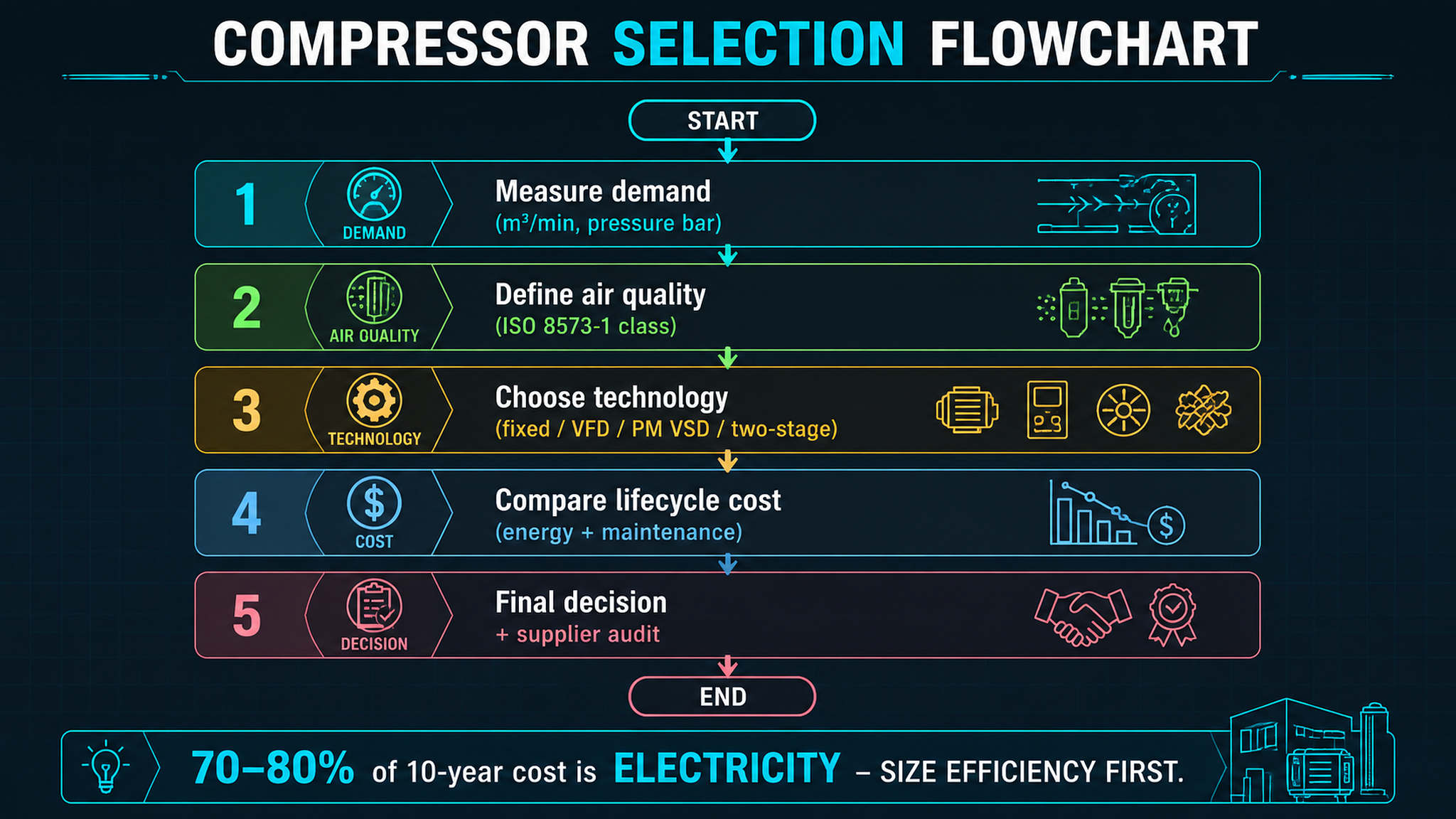
Visual Guide: Compressor Selection Process
[Flowchart: A step-by-step visual guide to selecting the right Industrial Air Compressor in Guangdong, starting from demand measurement and air quality requirements through technology evaluation, supplier comparison, and final decision.]
Oil-Free vs Oil-Injected Industrial Air Compressor: Making the Right Choice for Guangdong
One of the most important decisions when selecting Industrial Air Compressor is whether oil-free or oil-injected technology is appropriate for your application. Each approach has distinct advantages and limitations that make it suitable for different industrial applications. Understanding these differences is essential for making an informed procurement decision that balances performance requirements with budget constraints.
Oil-injected screw compressors — the most common type in Guangdong industrial facilities — use specially formulated compressor oil injected into the compression chamber for three purposes: sealing the clearance between rotors to minimize internal leakage, lubricating the rotors and bearings, and absorbing the heat of compression. This design is simple, reliable, and cost-effective, with lower initial purchase cost and wider service network availability. Modern oil-injected compressors with high-efficiency oil separation systems achieve residual oil content below 3 ppm, which is acceptable for most general industrial applications.
Oil-free screw compressors, by contrast, achieve compression without any oil in the compression chamber through precision-engineered rotor clearances, specialized rotor coatings, and separate lubrication systems. These units deliver 100% oil-free air, making them essential for critical applications such as pharmaceutical manufacturing, food and beverage processing, electronics fabrication, and paint spraying. The trade-offs include higher initial cost and generally lower energy efficiency due to larger rotor clearances required.
For most Guangdong manufacturing applications, high-quality oil-injected Industrial Air Compressor with appropriate filtration provides adequate air quality at a significantly lower total cost of ownership. However, for facilities in the pharmaceutical, food processing, electronics, or precision coating industries, the investment in oil-free technology is justified by the quality assurance requirements and the cost of potential contamination incidents.
Compressed Air Quality Standards for Guangdong Industries
The quality of compressed air required varies significantly across different industrial applications, and selecting the appropriate air quality level for your operations has important implications for both equipment selection and operating costs. The international standard ISO 8573-1 defines nine purity classes for compressed air based on solid particle content, water content, and oil content, with Class 1 being the highest purity and Class 9 the lowest.
For general Guangdong manufacturing applications such as pneumatic tools, material handling, and machine actuation, ISO Class 4-5 air quality is typically sufficient. This level of air quality can be achieved with a standard oil-injected Industrial Air Compressor followed by a refrigerant dryer and basic particulate filtration — a relatively modest investment in air treatment equipment.
Higher quality requirements drive significantly higher air treatment costs. ISO Class 1-2 air quality, required for applications such as pharmaceutical manufacturing, food and beverage processing, electronics fabrication, and critical instrumentation, demands oil-free compressors or comprehensive filtration, desiccant or membrane drying, and careful attention to the entire compressed air system. The total cost of a Class 1 compressed air system can be 2-3 times that of a Class 4 system, making it important to match air quality specifications precisely to actual production requirements.
When evaluating Industrial Air Compressor options for your Guangdong facility, clearly define your air quality requirements before selecting equipment. Overspecifying air quality drives unnecessary capital and operating costs, while underspecifying risks product quality issues or equipment damage. If your air quality requirements vary across different production areas, consider a zoned approach with appropriate treatment at each zone level.
Multi-Compressor System Design: Rightsizing for Variable Demand
For larger Guangdong manufacturing facilities with varying compressed air demand, a single compressor — even a highly efficient VFD model — may not be the optimal solution. Multi-compressor systems, properly designed with a mix of base load and trim compressors, can achieve significantly better part-load efficiency than any single compressor operating alone. The key is to select and configure the compressors so that each unit operates in its most efficient range as the total system demand varies.
The standard configuration for efficient multi-compressor systems pairs one or more VFD compressors serving as trim units with fixed-speed base load compressors. The VFD unit modulates to match the difference between base load output and total system demand, while the base load units operate at their most efficient full-load condition. Modern sequencers optimize the startup and shutdown of base load units based on system pressure and demand trends, minimizing the number of starts and ensuring each unit operates in its optimal efficiency range.
For Guangdong facilities with demand profiles that vary significantly between production shifts or seasons, this approach can deliver system-level efficiencies that approach 90% or more of individual compressor full-load efficiency — far better than the 60-70% system efficiency typical of uncontrolled multi-compressor installations. The additional investment in a sequencer and the incremental cost of multiple smaller compressors versus one large unit is typically recovered within 12-18 months through energy savings.
When planning a multi-compressor system, consider the following design principles: limit the number of compressor sizes to 2-3 for simplicity; ensure total installed capacity covers peak demand plus 20-30% redundancy; select compressors with complementary efficiency characteristics; and include adequate receiver capacity to stabilize pressure during transient demand changes.
Industrial Air Compressor for Construction and Mining in Guangdong
Construction and mining operations in Guangdong require robust, portable, and reliable compressed air solutions for rock drilling, pneumatic tools, concrete spraying, and dust control. Unlike factory installations, these systems must operate in harsh environments with challenging conditions.
For construction and mining applications, the selection of Industrial Air Compressor prioritizes durability, ease of maintenance, and the ability to operate in adverse conditions over efficiency optimization. While energy efficiency is still important, the primary considerations are typically reliability, serviceability, and spare parts availability in remote locations.
Portability is another key consideration. Trailer-mounted compressors, modular units, and systems designed for easy relocation are common. The ability to quickly move compressed air capacity to different locations is essential for operational flexibility.
For Guangdong construction and mining companies, the selection of Industrial Air Compressor should also consider the availability of service and support in the specific geographic areas where operations will be conducted.
Frequently Asked Questions About Industrial Air Compressor in Guangdong
How much does Industrial Air Compressor typically cost in Guangdong?
The cost varies widely depending on capacity, technology, and brand. A basic 37kW fixed-speed oil-injected unit typically costs ¥80,000-120,000 installed, while a premium 75kW VFD permanent magnet unit may cost ¥180,000-280,000. Larger industrial units (160-250kW) can cost ¥350,000-650,000 or more. Installation costs add 15-25% to equipment cost. The most important thing is that energy costs will exceed the purchase price within 2-3 years.
How long does Industrial Air Compressor last in typical Guangdong industrial use?
A well-maintained compressor typically operates for 10-15 years before major component replacement is required, with many units continuing in service for 20+ years. The airend typically requires overhaul at 40,000-80,000 operating hours. Key factors include operating conditions, maintenance quality, and original equipment quality.
Is VFD Industrial Air Compressor worth the extra cost in Guangdong?
For most facilities with variable air demand, VFD technology is very much worth the investment. The typical payback period is 12-24 months, driven by 30-50% energy savings compared to fixed-speed operation. Facilities with constant 24/7 demand may not benefit as much.
What size Industrial Air Compressor do I need for my Guangdong facility?
The right size depends on actual demand measurement. As a rough guide: small workshop with pneumatic tools needs 1-4 m³/min (7.5-22 kW); medium facility needs 5-13 m³/min (30-75 kW); large industrial plant needs 15-35 m³/min (90-200 kW).
Evaluation Framework: How to Compare Industrial Air Compressor Suppliers in Guangdong
Comparing Industrial Air Compressor suppliers in the Guangdong market requires a structured evaluation framework that accounts for multiple dimensions of supplier capability.
Dimension 1: Product Quality and Performance (25%) — Evaluate efficiency specifications, build quality, component sourcing, and design philosophy. Request detailed technical documentation and compare warranty terms.
Dimension 2: Total Cost of Ownership (25%) — Develop a detailed TCO comparison over a 10-year operating life including purchase price, installation, projected energy costs, estimated maintenance costs, and projected major overhaul costs.
Dimension 3: Service and Support Capability (20%) — Assess service infrastructure, technician qualifications, spare parts inventory, emergency response times, and preventive maintenance programs.
Dimension 4: Industry Experience and Reputation (15%) — Evaluate experience with similar installations, contact references, and research reputation through industry associations and trade publications.
Dimension 5: Commercial Terms and Flexibility (10%) — Compare payment schedules, warranty terms, training provisions, and performance guarantees.
Dimension 6: Strategic Alignment (5%) — Consider technology roadmap compatibility, sustainability alignment, and partnership potential.
Technology Selection Matrix: Choosing the Right Industrial Air Compressor Configuration
This technology selection matrix helps Guangdong manufacturers match Industrial Air Compressor configurations to their specific operating profiles.
Demand Profile Dimension: Constant demand — fixed-speed or VFD base load. Variable demand — VFD compressor sized for variable portion. Highly variable demand — multi-compressor system with VFD trim.
Pressure Requirements Dimension: Standard pressure (7-10 bar) — most compressor types suitable. High pressure (10-15 bar) — two-stage compression recommended. Low pressure (below 7 bar) — standard units with derating.
Air Quality Requirements Dimension: General industrial (ISO Class 4-5) — oil-injected with standard filtration. Sensitive applications (ISO Class 1-3) — consider oil-free or enhanced filtration. Critical applications — oil-free compressors required.
Operating Hours Dimension: Low utilization (under 2,000 hours/year) — lower-cost fixed-speed. Medium utilization (2,000-4,000) — VFD recommended for variable demand. High utilization (4,000-8,000) — premium efficiency essential. Continuous operation (8,000+) — maximum efficiency, consider heat recovery.
Energy Cost Savings: Quantifying the Impact of Efficient Industrial Air Compressor
For Guangdong manufacturers, energy cost savings represent the largest and most predictable benefit of investing in efficient Industrial Air Compressor. The magnitude of these savings depends on the efficiency difference between current and new equipment, the operating profile, local electricity rates, and the specific technology choices made.
The most important metric for comparing compressor energy efficiency is specific power. A typical older fixed-speed compressor might have a specific power of 7.0-7.5 kW/(m³/min). A modern premium-efficiency VFD compressor with PMSM motor technology might achieve 5.2-5.8 kW/(m³/min) — representing a 20-30% improvement. For a facility operating a 75kW compressor 6,000 hours per year, this translates to annual energy savings of 100,000-150,000 kWh worth ¥80,000-150,000.
The savings from VFD technology are additional to the savings from improved mechanical efficiency. For facilities with variable air demand, VFD technology typically reduces energy consumption by an additional 30-50%. The combined effect can reduce total compressed air energy costs by 40-60% compared to older fixed-speed equipment.
For Guangdong facilities considering a compressor upgrade, the following steps will produce a reliable energy savings estimate: measure current compressed air energy consumption; determine your facility’s demand profile; obtain specific power data from suppliers of candidate equipment; calculate potential energy savings; and apply your effective electricity rate to convert energy savings to cost savings.
Total Cost of Ownership Analysis for Industrial Air Compressor in Guangdong
For Guangdong manufacturers, understanding the total cost of ownership (TCO) of Industrial Air Compressor is essential for making informed procurement decisions. TCO analysis accounts for all costs associated with owning and operating a compressor over its service life, including initial purchase price, installation costs, energy consumption, maintenance, spare parts, and downtime costs.
The typical TCO breakdown for an industrial screw compressor operating in Guangdong is as follows: energy costs account for 70-80% of total lifetime cost; the initial purchase price accounts for 10-15%; maintenance and spare parts account for 8-12%; and installation, downtime, and other costs account for the remaining 2-5%. This distribution means that a 10% improvement in energy efficiency has roughly the same financial impact as a 50% reduction in purchase price.
To illustrate with a specific example for the Guangdong market: a 75kW Industrial Air Compressor operating 6,000 hours per year with electricity at ¥0.90/kWh will consume approximately ¥405,000 worth of electricity annually. Over a 10-year operating life, the total energy cost exceeds ¥4 million. Comparing two compressor options with a 0.5 kW/(m³/min) difference in specific power, the more efficient unit will save approximately ¥200,000 in energy costs over its life.
When evaluating TCO for Industrial Air Compressor options in Guangdong, the following calculation framework is recommended: estimate annual operating hours; determine your effective electricity cost; obtain specific power data at typical load points from each supplier; calculate annual energy consumption and cost for each option; add estimated maintenance costs; and compare the 5-year and 10-year total costs to identify the most economical option over the long term.
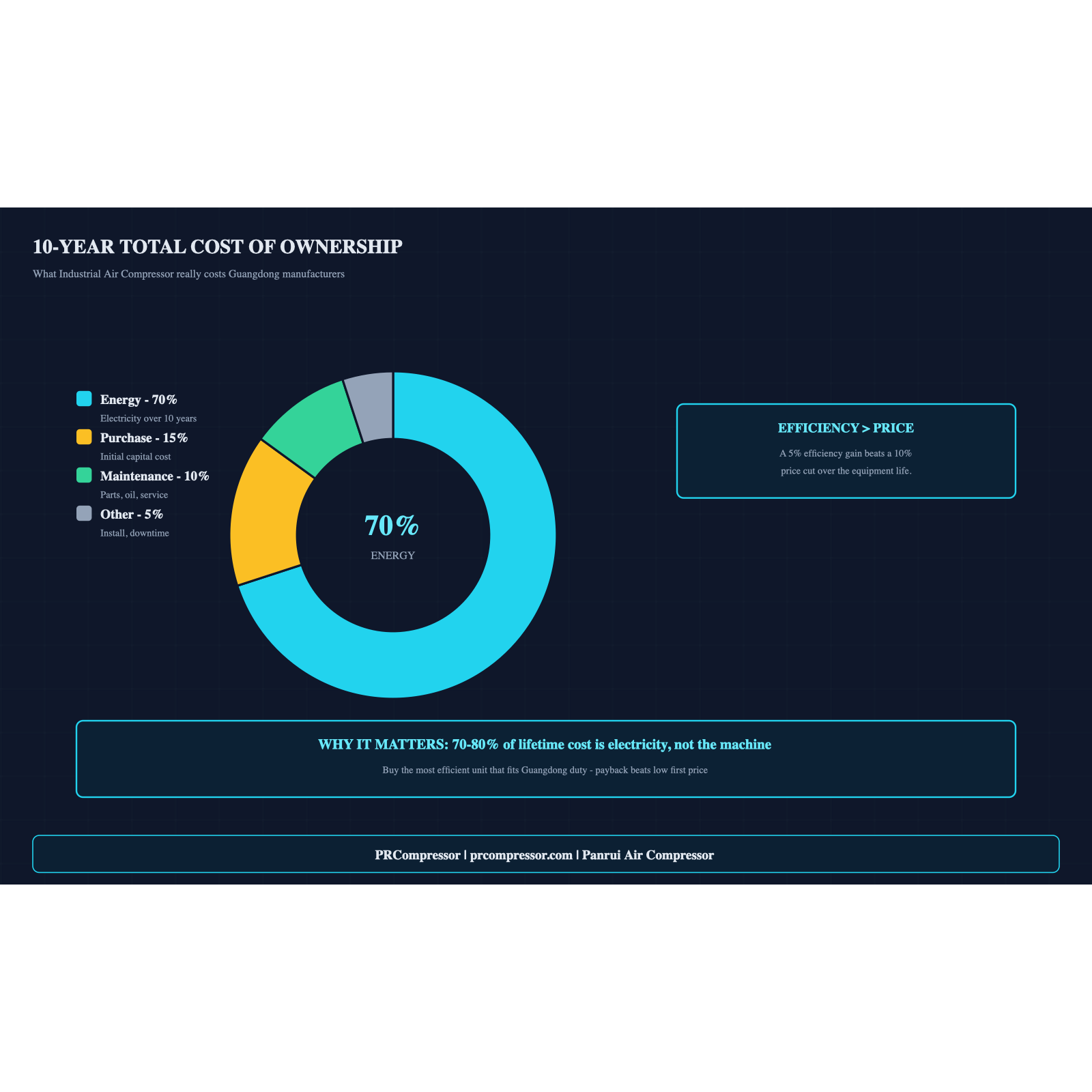
Visual Guide: How Industrial Air Compressor Compares
Looking Ahead: The Future of Industrial Air Compressor Technology in Guangdong
As we look toward the future, several emerging trends will shape the Industrial Air Compressor market in Guangdong over the coming years. Digitalization and smart connectivity will enable compressor systems that self-optimize based on operating conditions. Motor technology continues to advance toward IE5 and IE6 efficiency classes.
Integration with renewable energy sources will become increasingly important as manufacturing facilities adopt on-site solar and wind generation. VFD compressors with sophisticated control systems are naturally suited for this role, as their output can be modulated in response to available renewable power.
For Guangdong manufacturers investing in Industrial Air Compressor today, the key to future-proofing your investment is choosing equipment with robust technology, open standards, and a supplier with a clear technology roadmap.
PRCompressor (Panrui) continues to invest in these technologies to serve the evolving needs of Guangdong manufacturing. Contact us at 13713647073 or visit prcompressor.com.
Keywords: guangdong compressor, compressor supplier, industrial air compressor, guangdong manufacturer, energy saving compressor, industrial air compressor, industrial compressed air, compressor energy efficiency, compressor buyer’s guide, screw air compressor
Contact PRCompressor (Panrui) for industrial air compressor in Guangdong: Phone 13713647073 | prcompressor.com