


Industrial Air Compressor in China: 2026 Manufacturer Selection Guide
If you manage a manufacturing facility in China, you have likely experienced at least one of these common compressed air challenges: unreliable equipment causing production interruptions, high electricity bills that seem to increase every month, inconsistent air pressure affecting product quality, or difficulty finding responsive service support when problems arise. These pain points are all too familiar to industrial buyers evaluating Industrial Air Compressor, and they underscore the importance of choosing the right equipment and supplier from the start.
This guide addresses each of these challenges head-on, providing practical strategies for selecting Industrial Air Compressor that delivers reliable performance, energy efficiency, and dependable after-sales support. We draw on extensive experience with China industrial facilities to offer insights that go beyond manufacturer brochures and specification sheets.
Future-Proofing Your Industrial Air Compressor Investment in China
Investing in Industrial Air Compressor is a long-term commitment that will affect your facility’s operations, energy costs, and environmental performance for a decade or more. Protecting that investment against future changes is an important consideration.
Technology compatibility is key. Choose equipment that supports open communication protocols rather than proprietary systems. Select controllers with upgradeable firmware. If considering IoT capabilities, ensure the platform supports common connectivity standards that will remain relevant.
Regulatory preparedness is another consideration. China’s energy efficiency standards are expected to continue tightening. Choosing equipment that meets anticipated future standards provides a compliance buffer. Selecting equipment with lower environmental impact positions your facility favorably for future regulations.
Flexibility in equipment configuration also supports future-proofing. Modular compressor designs that allow capacity additions or technology upgrades without replacing the entire system provide valuable adaptability.
Step-by-Step Guide to Selecting Industrial Air Compressor in China
Selecting the right Industrial Air Compressor for your China facility does not need to be complicated, but it does require a systematic approach. This step-by-step guide provides a structured process that will help you evaluate your options and make a confident decision.
Step 1: Define Your Compressed Air Demand — Measure your actual air consumption over a representative period. If measurement is not possible, estimate demand by inventorying all air-consuming equipment and calculating total demand with appropriate diversity factors. Add 20-30% for future expansion and system losses.
Step 2: Determine Your Air Quality Requirements — Identify the highest air quality requirement among your applications. If any application requires oil-free air, that will drive the compressor selection toward oil-free technology. Also determine the required pressure dew point and particulate filtration level.
Step 3: Evaluate Technology Options — Based on your demand profile and air quality requirements, evaluate the available technology options. For variable demand with 4,000+ annual operating hours, VFD technology is strongly recommended. For constant high-pressure applications, two-stage compression should be considered.
Step 4: Compare Supplier Proposals — Request proposals from at least three qualified suppliers. Evaluate proposals based on lifecycle cost, not purchase price. Verify service capabilities and warranty terms. Request references and follow up on them.
Step 5: Make a Confident Decision — Combine the technical evaluation, financial analysis, and supplier assessment into a weighted decision framework, balancing quantitative factors with qualitative factors.
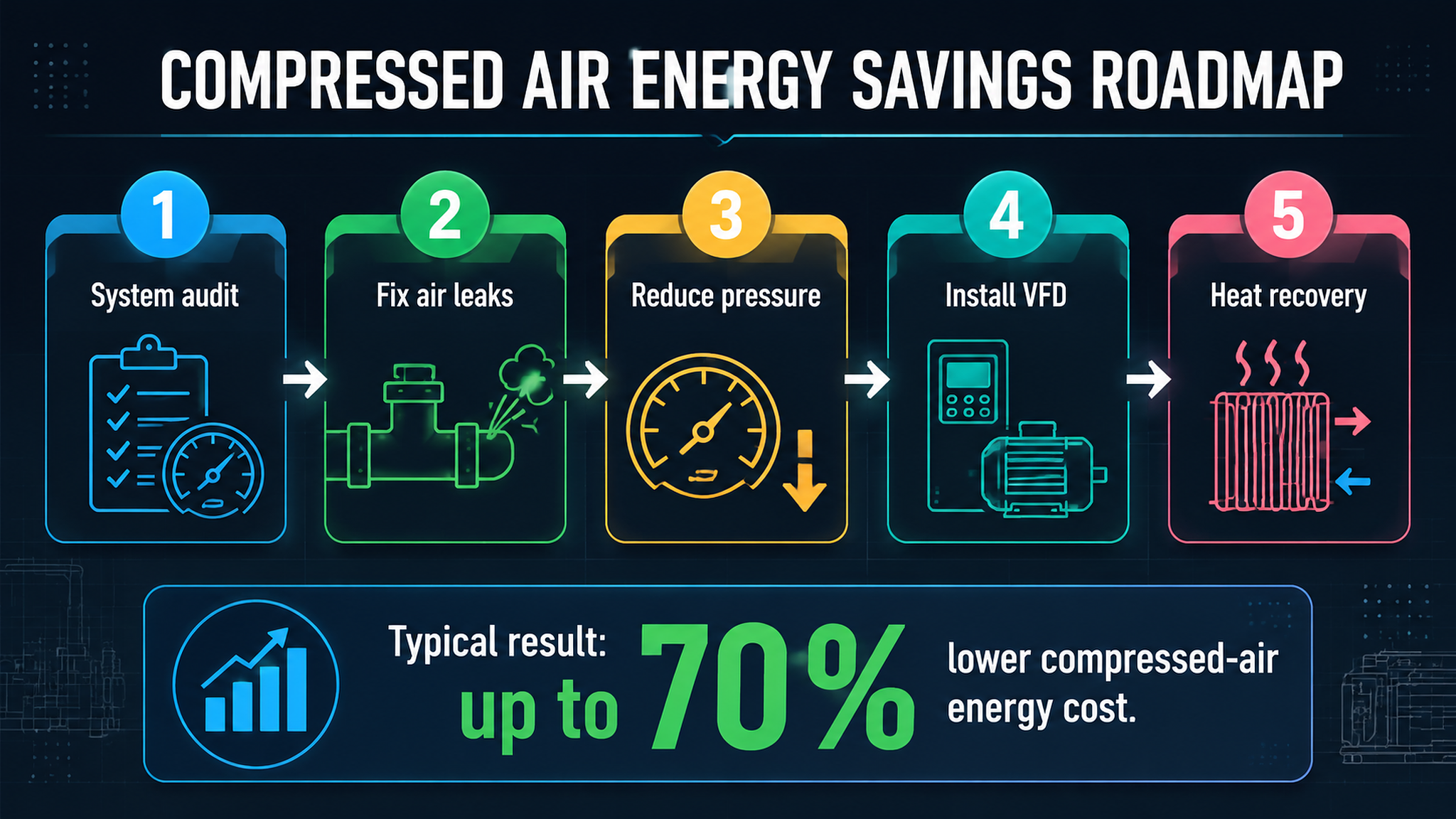
Visual: Energy Savings Roadmap
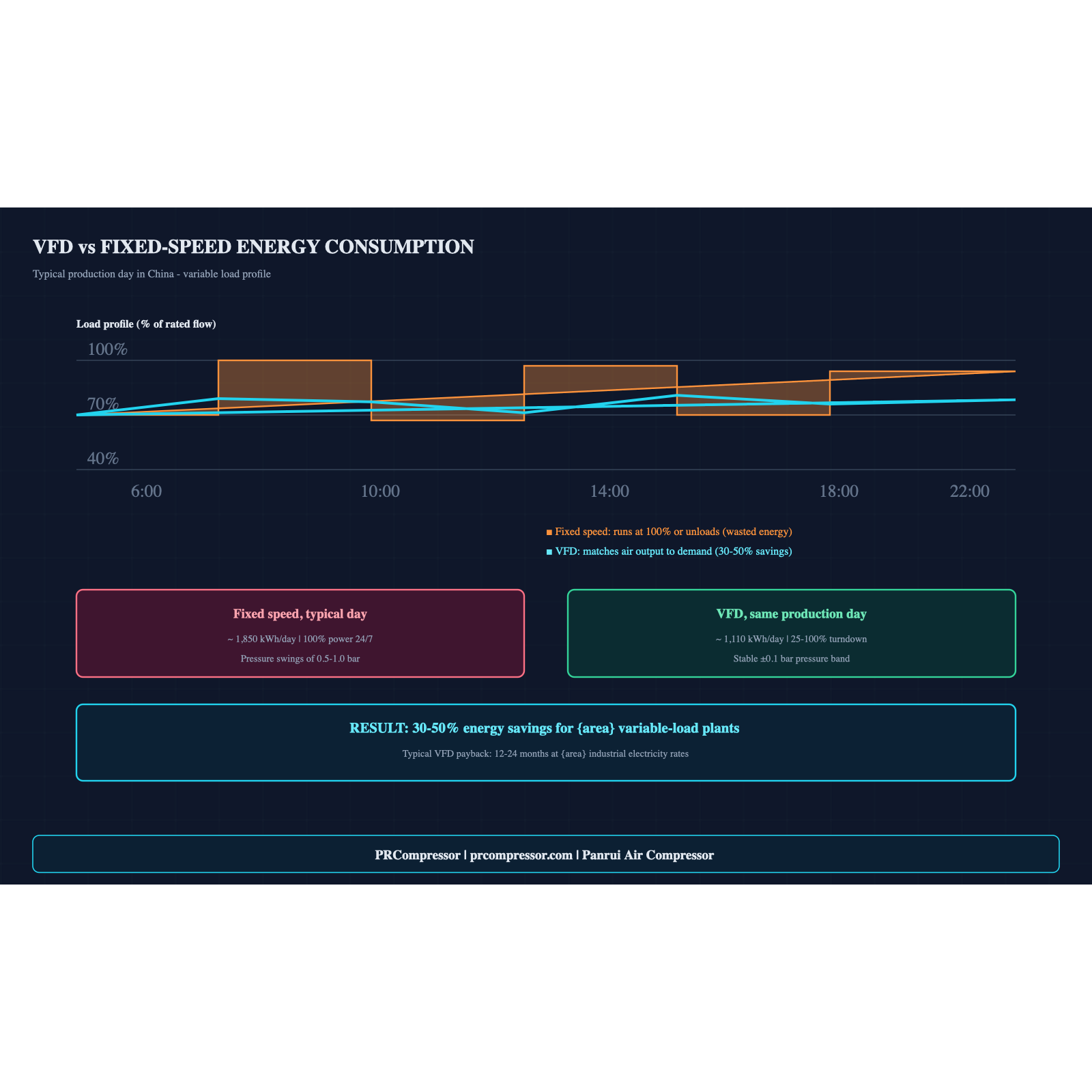
Visual: VFD vs Fixed Speed Energy Consumption
Financial Analysis: Leasing vs Purchasing Industrial Air Compressor in China
For China manufacturers, the decision between leasing and purchasing Industrial Air Compressor involves financial, operational, and strategic considerations beyond simple cost comparison. Each approach offers distinct advantages.
Leasing Industrial Air Compressor preserves working capital, provides predictable fixed monthly payments, may offer tax advantages through deductibility of lease payments, and allows for easier equipment upgrades at lease expiration. Lease terms typically range from 3 to 7 years with residual values of 10-30%.
Purchasing Industrial Air Compressor provides the lowest total cost over the equipment’s life, offers full ownership and control, allows for depreciation benefits, and eliminates ongoing payment obligations after purchase. For China manufacturers with access to capital and a long-term perspective, purchasing typically provides the best financial outcome.
The financial comparison should consider: total cost of leasing over the planned use period; total cost of purchasing; tax implications; the manufacturer’s cost of capital; and the expected useful life relative to the lease term. For most China manufacturers, purchasing provides better 10-year economics while leasing better serves manufacturers with capital constraints.
Energy Cost Savings: Quantifying the Impact of Efficient Industrial Air Compressor
For China manufacturers, energy cost savings represent the largest and most predictable benefit of investing in efficient Industrial Air Compressor. The magnitude of these savings depends on the efficiency difference between current and new equipment, the operating profile, local electricity rates, and the specific technology choices made.
The most important metric for comparing compressor energy efficiency is specific power. A typical older fixed-speed compressor might have a specific power of 7.0-7.5 kW/(m³/min). A modern premium-efficiency VFD compressor with PMSM motor technology might achieve 5.2-5.8 kW/(m³/min) — representing a 20-30% improvement. For a facility operating a 75kW compressor 6,000 hours per year, this translates to annual energy savings of 100,000-150,000 kWh worth ¥80,000-150,000.
The savings from VFD technology are additional to the savings from improved mechanical efficiency. For facilities with variable air demand, VFD technology typically reduces energy consumption by an additional 30-50%. The combined effect can reduce total compressed air energy costs by 40-60% compared to older fixed-speed equipment.
For China facilities considering a compressor upgrade, the following steps will produce a reliable energy savings estimate: measure current compressed air energy consumption; determine your facility’s demand profile; obtain specific power data from suppliers of candidate equipment; calculate potential energy savings; and apply your effective electricity rate to convert energy savings to cost savings.
Industrial Air Compressor for Packaging and Logistics in China
The packaging and logistics sector in China has grown significantly with the expansion of e-commerce and modern retail distribution. Compressed air powers a wide range of equipment including packaging machines, labeling systems, automated sorting equipment, and material handling systems.
Packaging machinery requires compressed air for pneumatic actuators, vacuum systems, and sensing equipment. These applications typically require moderate air quality at pressures of 6-8 bar. The demand is typically intermittent, with peaks during production runs and low demand during changeovers, making VFD technology particularly beneficial.
Automated storage and retrieval systems and sortation systems in logistics facilities also rely on compressed air. For large logistics hubs in China, multi-compressor systems with intelligent sequencing provide the best combination of efficiency and reliability.
For China packaging and logistics facilities, the selection of Industrial Air Compressor should prioritize efficiency across a wide operating range, reliability to avoid shipping delays, and responsive service support.
Quick Answers: Popular Questions About Industrial Air Compressor
How often should I replace air filters on my Industrial Air Compressor?
In clean environments, filters typically last 2,000-4,000 hours. In dusty environments, they may need replacement every 500-1,000 hours. The best indicator is the filter differential pressure gauge — replace when it indicates maximum allowable pressure drop.
Can I use standard compressor oil in any Industrial Air Compressor brand?
No. Different brands require different oil specifications. Critical specifications include viscosity grade, base oil type, and additive package. Some manufacturers formulate proprietary oils. Always consult the compressor manual before changing oil types or brands.
How does ambient temperature affect Industrial Air Compressor performance?
Higher intake air temperature increases the energy required for compression by approximately 3% per 10°C. In summer conditions (35-40°C), compressor performance can be 5-10% lower than under standard rating conditions (20°C).
Technical Specifications Comparison: Industrial Air Compressor Options in China
Fixed-Speed Oil-Injected: 7.5-250 kW, 7-13 bar, specific power 6.5-7.2 kW/(m³/min) at 37kW/8bar, noise 68-78 dB(A), IE3 motor. Best for constant demand.
VFD Oil-Injected (Premium): 7.5-355 kW, 7-13 bar, specific power 5.8-6.5 kW/(m³/min), turndown 25-100%, noise 65-75 dB(A), IE4/IE5 PMSM motor. Best for variable demand.
Two-Stage VFD (Maximum Efficiency): 37-315 kW, 8-15 bar, specific power 5.2-5.8 kW/(m³/min), IE5 PMSM motor. Best for high pressure, maximum efficiency.
Oil-Free (Specialized): 15-250 kW, 7-10 bar, specific power 6.8-7.5 kW/(m³/min). Best for critical applications requiring oil-free air.
Variable Frequency Drive Technology: Matching Supply to Demand
Variable frequency drive (VFD) technology fundamentally changes how screw compressors respond to fluctuating air demand. Instead of the wasteful load/unload cycling that characterizes fixed-speed compressor operation, VFD-equipped compressors automatically adjust their motor speed — and therefore their air output — to match real-time demand. This capability is particularly valuable in China manufacturing environments where air demand frequently varies between shifts, production runs, and seasonal production cycles.
The energy savings from VFD technology are well documented. A Industrial Air Compressor with VFD capability typically uses 30-50% less energy than an equivalent fixed-speed unit operating under the same variable demand profile. The savings come from two primary mechanisms: eliminating the unloaded running time during which fixed-speed compressors continue to consume 25-40% of full-load power while producing no useful work, and operating at reduced speeds during periods of lower demand, where the relationship between speed reduction and power reduction follows the cube law effect.
Modern VFD compressors available in the China market offer operating ranges from 25% to 100% of rated capacity. Advanced control algorithms manage the transition between VFD and fixed-speed operation in multi-compressor systems, ensuring optimal efficiency across the full range of facility demand. Pressure stability is maintained within ±0.1 bar, compared to ±0.5-1.0 bar typical of load/unload controlled systems — a significant advantage for processes sensitive to pressure variation.
For China manufacturers with variable air demand — which includes most facilities outside of truly continuous 24/7 operations — VFD technology represents the most cost-effective path to reduced compressed air energy costs. The typical payback period for the VFD premium in China industrial applications ranges from 12 to 24 months, after which the savings contribute directly to improved profitability.
Two-Stage Compression: Maximizing Efficiency for China Industries
Two-stage compression technology represents the pinnacle of screw compressor efficiency, offering measurable advantages over single-stage designs for applications requiring consistent high-pressure output. In a two-stage compressor, air is partially compressed in the first stage to 3-4 bar, cooled in an intercooler to remove a significant portion of the heat of compression, and then further compressed in the second stage to the final discharge pressure.
The thermodynamic advantage of this approach is substantial. By cooling the air between compression stages, the system removes heat energy that would otherwise need to be overcome in a single-stage compression cycle, reducing the total work required by 15-25% depending on the discharge pressure and operating conditions. This efficiency advantage is particularly valuable for China manufacturers operating at pressures above 8 bar, where two-stage compression delivers the greatest benefit.
PRCompressor’s PRCF/PRSF two-stage permanent magnet VFD series, available throughout the China market, exemplifies the best of this technology. These units combine two-stage airends with PMSM motors and precision VFD control to achieve verified specific power values below 5.2 kW/(m³/min) — among the best available in the industrial compressor market. For a medium-sized China factory operating a 110kW compressor 6,000 hours per year, this efficiency advantage translates to annual electricity savings of ¥150,000-250,000 compared to conventional single-stage fixed-speed equipment.
Beyond energy savings, two-stage compressors offer several other advantages for industrial users. The lower compression ratio per stage reduces mechanical stress on the rotors and bearings, potentially extending the service life of the airend. The inter-stage cooling also reduces the discharge temperature, which improves oil life and reduces the load on downstream air treatment equipment. For China manufacturers with continuous or high-duty-cycle operations, these benefits add significant value over the equipment’s operating life.
The Science of Air Compression: How Industrial Air Compressor Achieve Efficiency
At its core, air compression is a thermodynamic process that follows the fundamental laws of gas behavior. When air is compressed, its temperature rises significantly — a 100 kPa (1 bar) increase in pressure can raise the air temperature by approximately 80-100°C under adiabatic conditions. Managing this heat is one of the key challenges in compressor design, as excessive temperatures can degrade lubricating oil, damage components, and reduce overall system efficiency.
Modern Industrial Air Compressor address this challenge through sophisticated thermal management systems that optimize the compression process across a wide range of operating conditions. Oil-injected screw compressors use the injection of specially formulated compressor oil directly into the compression chamber to seal rotor clearances, lubricate the rotors and bearings, and absorb the heat of compression. The oil is then circulated through an oil cooler before being reinjected, maintaining optimal operating temperatures even under continuous full-load operation.
The specific power consumption of a compressor — measured in kW per m³/min of delivered air — is the most important indicator of its energy efficiency. Premium Industrial Air Compressor in the China market typically achieve specific power values ranging from 5.5 to 6.5 kW/(m³/min) at full load, with the most efficient models falling below 5.5 kW/(m³/min). By comparison, older or lower-quality units may require 7.0 kW/(m³/min) or more, representing a 20-30% efficiency penalty that translates directly to higher electricity costs over the equipment’s operating life.
Understanding these technical fundamentals is essential for making informed procurement decisions. When evaluating Industrial Air Compressor options in China, look beyond the headline specifications to examine the specific power curves at different load points, the efficiency of the drive system, and the effectiveness of the cooling and oil management systems. These factors collectively determine the real-world performance and operating cost of the equipment.
Call to Action: Start Your Industrial Air Compressor Evaluation Today
The information in this guide provides a comprehensive foundation for evaluating Industrial Air Compressor options in China. Now the most important step is to take action — every month of delay is a month of unnecessarily high energy costs and missed opportunity.
The first step is simple: contact PRCompressor (Panrui) for a free, no-obligation consultation. Our experienced team will help you assess your current system, identify improvement opportunities, and develop a recommendation tailored to your needs.
Don’t let another day of inefficient compressed air operation erode your profitability. Contact us today.
Phone: 13713647073 | Email: info@panrui.com | Web: prcompressor.com
Keywords: industrial compressed air, industrial air compressor, compressor supplier, screw air compressor, compressor energy efficiency, industrial air compressor, energy saving compressor, china manufacturer, compressor buyer’s guide, china compressor
Contact PRCompressor (Panrui) for industrial air compressor in China: Phone 13713647073 | prcompressor.com