


Oil-Free Screw Air Compressor in Dongguan: 2026 Manufacturer Selection Guide
If you manage a manufacturing facility in Dongguan, you have likely experienced at least one of these common compressed air challenges: unreliable equipment causing production interruptions, high electricity bills that seem to increase every month, inconsistent air pressure affecting product quality, or difficulty finding responsive service support when problems arise. These pain points are all too familiar to industrial buyers evaluating Oil-Free Screw Air Compressor, and they underscore the importance of choosing the right equipment and supplier from the start.
This guide addresses each of these challenges head-on, providing practical strategies for selecting Oil-Free Screw Air Compressor that delivers reliable performance, energy efficiency, and dependable after-sales support. We draw on extensive experience with Dongguan industrial facilities to offer insights that go beyond manufacturer brochures and specification sheets.
Visual Guide: Compressor Selection Process
Specification Checklist for Oil-Free Screw Air Compressor Buyers in Dongguan
This specification checklist provides a comprehensive framework for evaluating and comparing Oil-Free Screw Air Compressor options in the Dongguan market.
Performance Specifications: Rated power and rated pressure; free air delivery at rated conditions; specific power at full load and part load; turn-down ratio for VFD units; startup current; noise level.
Technical Features: Compressor type (oil-injected or oil-free); number of compression stages; drive type; motor type and efficiency class; cooling system; controller features and communication protocols.
Quality and Certifications: ISO 9001 certification; CE certification; GB 19153 energy efficiency grade; warranty period and coverage details; extended warranty options.
Service and Support: Service network coverage in Dongguan; response time commitment; spare parts availability; maintenance program options; remote monitoring service availability; training availability.
Step-by-Step Guide to Selecting Oil-Free Screw Air Compressor in Dongguan
Selecting the right Oil-Free Screw Air Compressor for your Dongguan facility does not need to be complicated, but it does require a systematic approach. This step-by-step guide provides a structured process that will help you evaluate your options and make a confident decision.
Step 1: Define Your Compressed Air Demand — Measure your actual air consumption over a representative period. If measurement is not possible, estimate demand by inventorying all air-consuming equipment and calculating total demand with appropriate diversity factors. Add 20-30% for future expansion and system losses.
Step 2: Determine Your Air Quality Requirements — Identify the highest air quality requirement among your applications. If any application requires oil-free air, that will drive the compressor selection toward oil-free technology. Also determine the required pressure dew point and particulate filtration level.
Step 3: Evaluate Technology Options — Based on your demand profile and air quality requirements, evaluate the available technology options. For variable demand with 4,000+ annual operating hours, VFD technology is strongly recommended. For constant high-pressure applications, two-stage compression should be considered.
Step 4: Compare Supplier Proposals — Request proposals from at least three qualified suppliers. Evaluate proposals based on lifecycle cost, not purchase price. Verify service capabilities and warranty terms. Request references and follow up on them.
Step 5: Make a Confident Decision — Combine the technical evaluation, financial analysis, and supplier assessment into a weighted decision framework, balancing quantitative factors with qualitative factors.
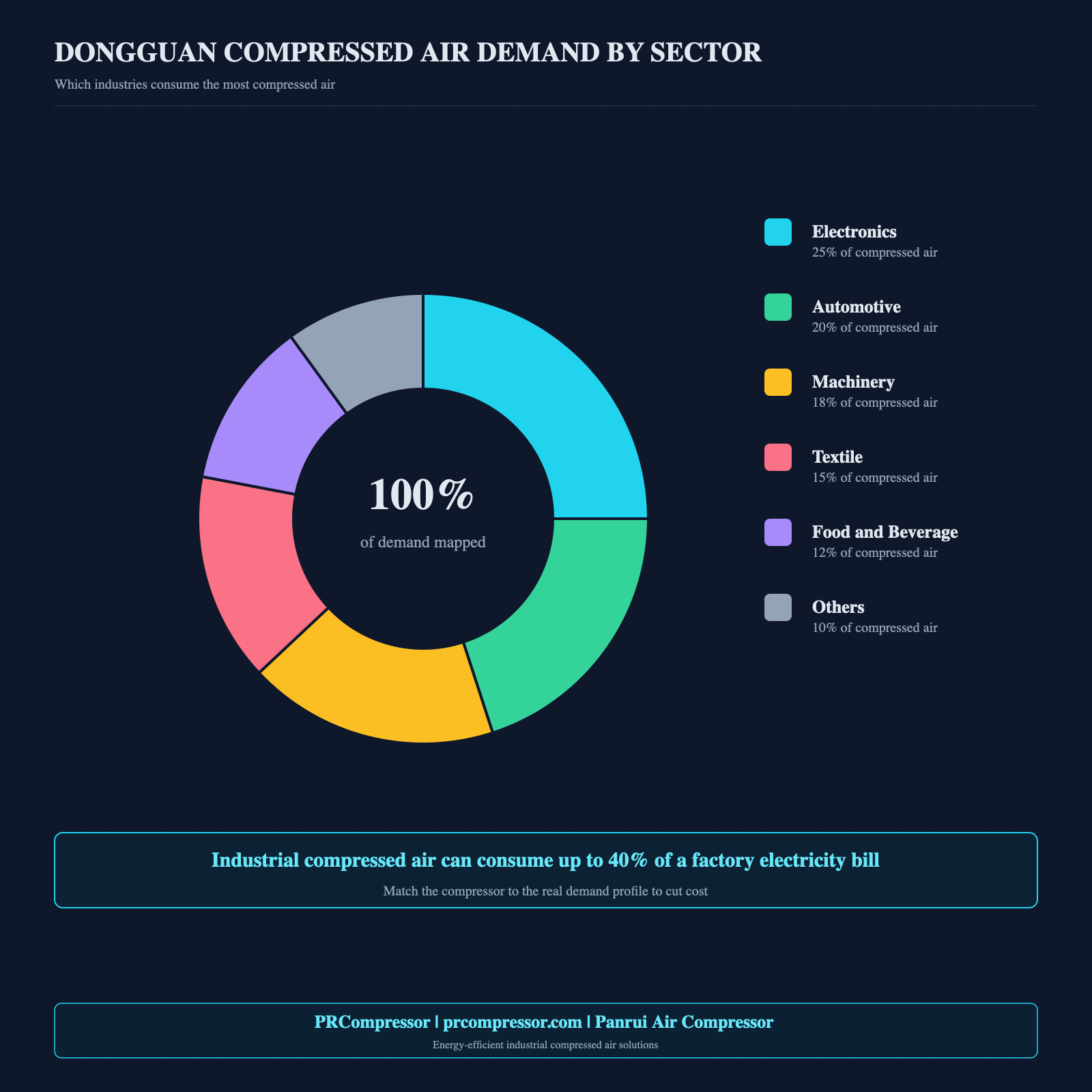
Oil-Free Screw Air Compressor for Textile Manufacturing in Dongguan
Textile manufacturing is a traditional and still-important industry in Dongguan, with substantial compressed air requirements for weaving machines, knitting equipment, air-jet looms, and finishing processes. The compressed air demand in textile facilities is typically continuous and relatively stable.
Air-jet looms — a staple of modern textile production — are particularly sensitive to compressed air quality and stability. These machines use precisely controlled jets of compressed air to insert weft yarns during the weaving process, and any variation in pressure or air quality can cause weaving defects.
The efficiency of compressed air systems is a significant cost factor in textile manufacturing, where energy costs represent a substantial portion of total production costs. For Dongguan textile mills operating multiple air-jet looms, the compressed air system’s energy consumption can account for 20-30% of total facility electricity usage.
For Dongguan textile manufacturers, the selection of Oil-Free Screw Air Compressor should balance efficiency, reliability, and service support. Textile production is typically continuous, so compressor reliability and service responsiveness are particularly important.
Preventive Maintenance Schedule for Oil-Free Screw Air Compressor in Dongguan
A well-planned preventive maintenance (PM) program is essential for maximizing the life and efficiency of your Oil-Free Screw Air Compressor investment. Studies show that a properly maintained compressor consumes 5-10% less energy than one receiving only reactive maintenance, and its service life can be extended by 30-50%.
Daily tasks: Check oil level; inspect for oil leaks; monitor discharge temperature; check operating pressure and temperature readings; listen for unusual noises; drain condensate from the receiver tank.
Weekly and monthly tasks: Inspect and clean air filter elements; check belt tension; verify safety valve operation; inspect electrical connections; check VFD cooling fan; review operating data for trends.
Quarterly and annual tasks: Perform oil analysis; replace oil and oil filter; replace air filter and oil separator; inspect and clean cooling system; check sensor calibration; conduct full system performance test.
For Dongguan manufacturers, maintaining a detailed maintenance log that records all inspections, measurements, and component replacements is essential for tracking the compressor’s condition over time.
Visual: Total Cost of Ownership Breakdown
Financial Analysis: Leasing vs Purchasing Oil-Free Screw Air Compressor in Dongguan
For Dongguan manufacturers, the decision between leasing and purchasing Oil-Free Screw Air Compressor involves financial, operational, and strategic considerations beyond simple cost comparison. Each approach offers distinct advantages.
Leasing Oil-Free Screw Air Compressor preserves working capital, provides predictable fixed monthly payments, may offer tax advantages through deductibility of lease payments, and allows for easier equipment upgrades at lease expiration. Lease terms typically range from 3 to 7 years with residual values of 10-30%.
Purchasing Oil-Free Screw Air Compressor provides the lowest total cost over the equipment’s life, offers full ownership and control, allows for depreciation benefits, and eliminates ongoing payment obligations after purchase. For Dongguan manufacturers with access to capital and a long-term perspective, purchasing typically provides the best financial outcome.
The financial comparison should consider: total cost of leasing over the planned use period; total cost of purchasing; tax implications; the manufacturer’s cost of capital; and the expected useful life relative to the lease term. For most Dongguan manufacturers, purchasing provides better 10-year economics while leasing better serves manufacturers with capital constraints.
Frequently Asked Questions About Oil-Free Screw Air Compressor in Dongguan
How much does Oil-Free Screw Air Compressor typically cost in Dongguan?
The cost varies widely depending on capacity, technology, and brand. A basic 37kW fixed-speed oil-injected unit typically costs ¥80,000-120,000 installed, while a premium 75kW VFD permanent magnet unit may cost ¥180,000-280,000. Larger industrial units (160-250kW) can cost ¥350,000-650,000 or more. Installation costs add 15-25% to equipment cost. The most important thing is that energy costs will exceed the purchase price within 2-3 years.
How long does Oil-Free Screw Air Compressor last in typical Dongguan industrial use?
A well-maintained compressor typically operates for 10-15 years before major component replacement is required, with many units continuing in service for 20+ years. The airend typically requires overhaul at 40,000-80,000 operating hours. Key factors include operating conditions, maintenance quality, and original equipment quality.
Is VFD Oil-Free Screw Air Compressor worth the extra cost in Dongguan?
For most facilities with variable air demand, VFD technology is very much worth the investment. The typical payback period is 12-24 months, driven by 30-50% energy savings compared to fixed-speed operation. Facilities with constant 24/7 demand may not benefit as much.
What size Oil-Free Screw Air Compressor do I need for my Dongguan facility?
The right size depends on actual demand measurement. As a rough guide: small workshop with pneumatic tools needs 1-4 m³/min (7.5-22 kW); medium facility needs 5-13 m³/min (30-75 kW); large industrial plant needs 15-35 m³/min (90-200 kW).
Multi-Compressor System Design: Rightsizing for Variable Demand
For larger Dongguan manufacturing facilities with varying compressed air demand, a single compressor — even a highly efficient VFD model — may not be the optimal solution. Multi-compressor systems, properly designed with a mix of base load and trim compressors, can achieve significantly better part-load efficiency than any single compressor operating alone. The key is to select and configure the compressors so that each unit operates in its most efficient range as the total system demand varies.
The standard configuration for efficient multi-compressor systems pairs one or more VFD compressors serving as trim units with fixed-speed base load compressors. The VFD unit modulates to match the difference between base load output and total system demand, while the base load units operate at their most efficient full-load condition. Modern sequencers optimize the startup and shutdown of base load units based on system pressure and demand trends, minimizing the number of starts and ensuring each unit operates in its optimal efficiency range.
For Dongguan facilities with demand profiles that vary significantly between production shifts or seasons, this approach can deliver system-level efficiencies that approach 90% or more of individual compressor full-load efficiency — far better than the 60-70% system efficiency typical of uncontrolled multi-compressor installations. The additional investment in a sequencer and the incremental cost of multiple smaller compressors versus one large unit is typically recovered within 12-18 months through energy savings.
When planning a multi-compressor system, consider the following design principles: limit the number of compressor sizes to 2-3 for simplicity; ensure total installed capacity covers peak demand plus 20-30% redundancy; select compressors with complementary efficiency characteristics; and include adequate receiver capacity to stabilize pressure during transient demand changes.
Air Leak Management: The Hidden Opportunity in Every Oil-Free Screw Air Compressor Installation
Compressed air leaks are the single largest source of energy waste in industrial compressed air systems, and they are far more costly than most facility managers realize. Industry studies consistently show that the average industrial compressed air system loses 25-35% of its output through leaks. For a Dongguan factory operating a 75kW Oil-Free Screw Air Compressor 6,000 hours per year at ¥0.80/kWh, this means ¥90,000-126,000 worth of compressed air is escaping into the atmosphere every year — money that could be saved through a systematic leak management program.
The sources of compressed air leaks are varied and often numerous. Common leak points include pipe joints and fittings, quick-connect couplings, pneumatic tool connections, condensate drains, pressure regulators, and the connections to end-use equipment. A single 3mm leak at 8 bar pressure wastes approximately 560 m³ of compressed air per year — equivalent to the full output of a 15kW compressor running continuously for over 1,000 hours.
Effective leak management follows a structured approach: identification, quantification, repair, and ongoing monitoring. Ultrasonic leak detectors enable rapid identification of even small leaks during normal operating hours. Once identified, leaks should be tagged, logged, and assigned for repair based on their severity. Regular leak surveys should be part of every facility’s maintenance program.
For Dongguan facilities investing in new Oil-Free Screw Air Compressor, establishing a leak management program at the same time ensures that the efficiency benefits of the new equipment are not undermined by system losses. The cost of a leak management program is typically recovered within 3-6 months through reduced compressor energy consumption and extended equipment life from reduced runtime.
Compressed Air Quality Standards for Dongguan Industries
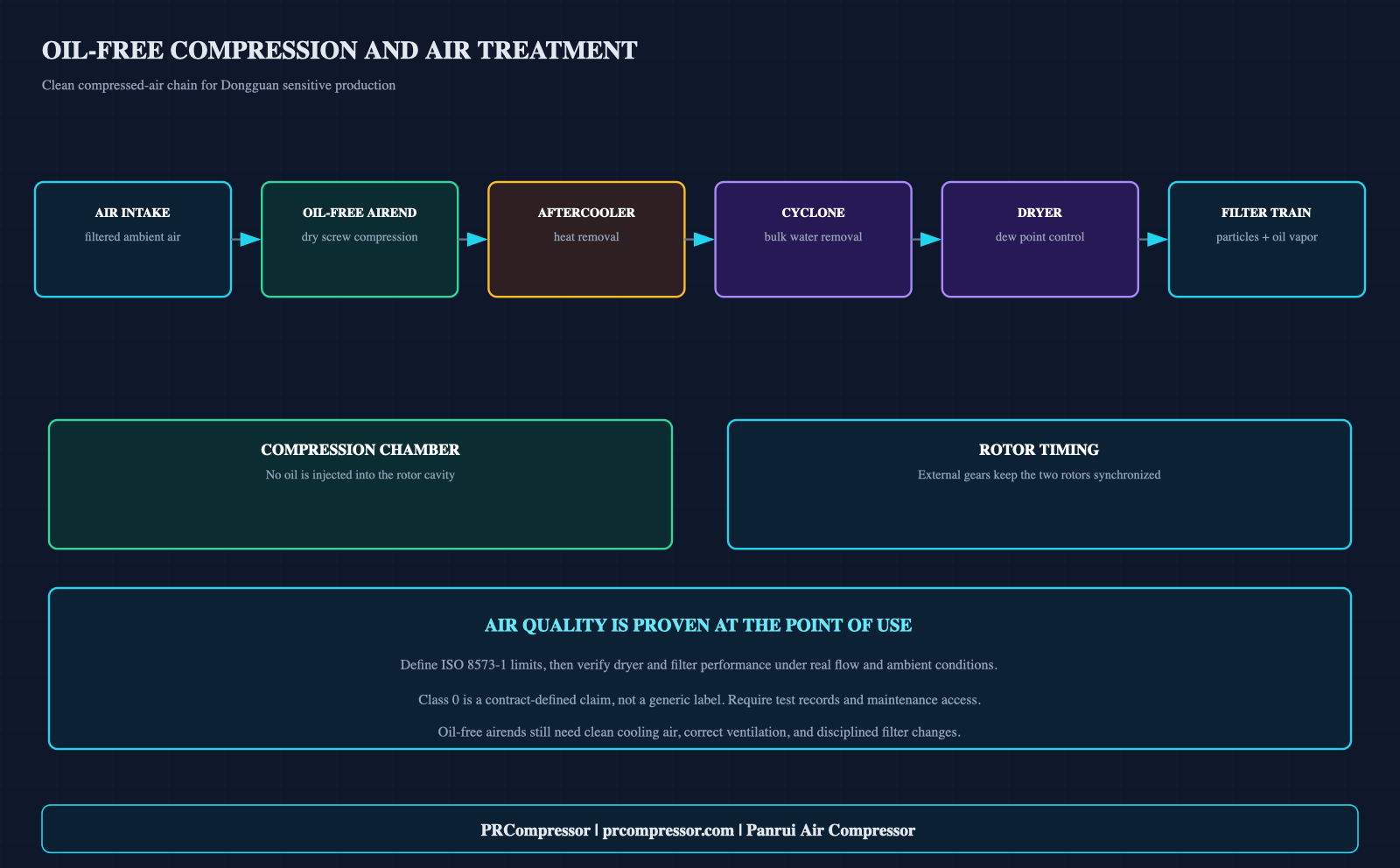
The quality of compressed air required varies significantly across different industrial applications, and selecting the appropriate air quality level for your operations has important implications for both equipment selection and operating costs. The international standard ISO 8573-1 defines nine purity classes for compressed air based on solid particle content, water content, and oil content, with Class 1 being the highest purity and Class 9 the lowest.
For general Dongguan manufacturing applications such as pneumatic tools, material handling, and machine actuation, ISO Class 4-5 air quality is typically sufficient. This level of air quality can be achieved with a standard oil-injected Oil-Free Screw Air Compressor followed by a refrigerant dryer and basic particulate filtration — a relatively modest investment in air treatment equipment.
Higher quality requirements drive significantly higher air treatment costs. ISO Class 1-2 air quality, required for applications such as pharmaceutical manufacturing, food and beverage processing, electronics fabrication, and critical instrumentation, demands oil-free compressors or comprehensive filtration, desiccant or membrane drying, and careful attention to the entire compressed air system. The total cost of a Class 1 compressed air system can be 2-3 times that of a Class 4 system, making it important to match air quality specifications precisely to actual production requirements.
When evaluating Oil-Free Screw Air Compressor options for your Dongguan facility, clearly define your air quality requirements before selecting equipment. Overspecifying air quality drives unnecessary capital and operating costs, while underspecifying risks product quality issues or equipment damage. If your air quality requirements vary across different production areas, consider a zoned approach with appropriate treatment at each zone level.
Investment Perspective: Oil-Free Screw Air Compressor as a Strategic Asset
Viewing Oil-Free Screw Air Compressor through the lens of strategic asset management can transform how Dongguan manufacturers approach their compressed air investments. A compressor is not merely a utility — it is a production-critical asset whose performance directly impacts competitiveness, efficiency, and environmental performance.
Strategic metrics include: energy cost per unit of production output; compressed air availability as a percentage of production time; and compressed air cost as a percentage of total facility operating costs. Manufacturers who adopt this strategic approach achieve measurably better outcomes.
For Dongguan manufacturers ready to take this strategic approach, PRCompressor (Panrui) offers the expertise, product range, and support infrastructure needed to succeed. Contact us at 13713647073 or prcompressor.com.
Keywords: oil-free screw air compressor, compressor supplier, industrial compressed air, compressor energy efficiency, screw air compressor, industrial air compressor, dongguan manufacturer, energy saving compressor, dongguan compressor, compressor buyer’s guide
Contact PRCompressor (Panrui) for oil-free screw air compressor in Dongguan: Phone 13713647073 | prcompressor.com