


PM VSD Screw Compressor in Foshan: 2026 Complete Buyer’s Guide
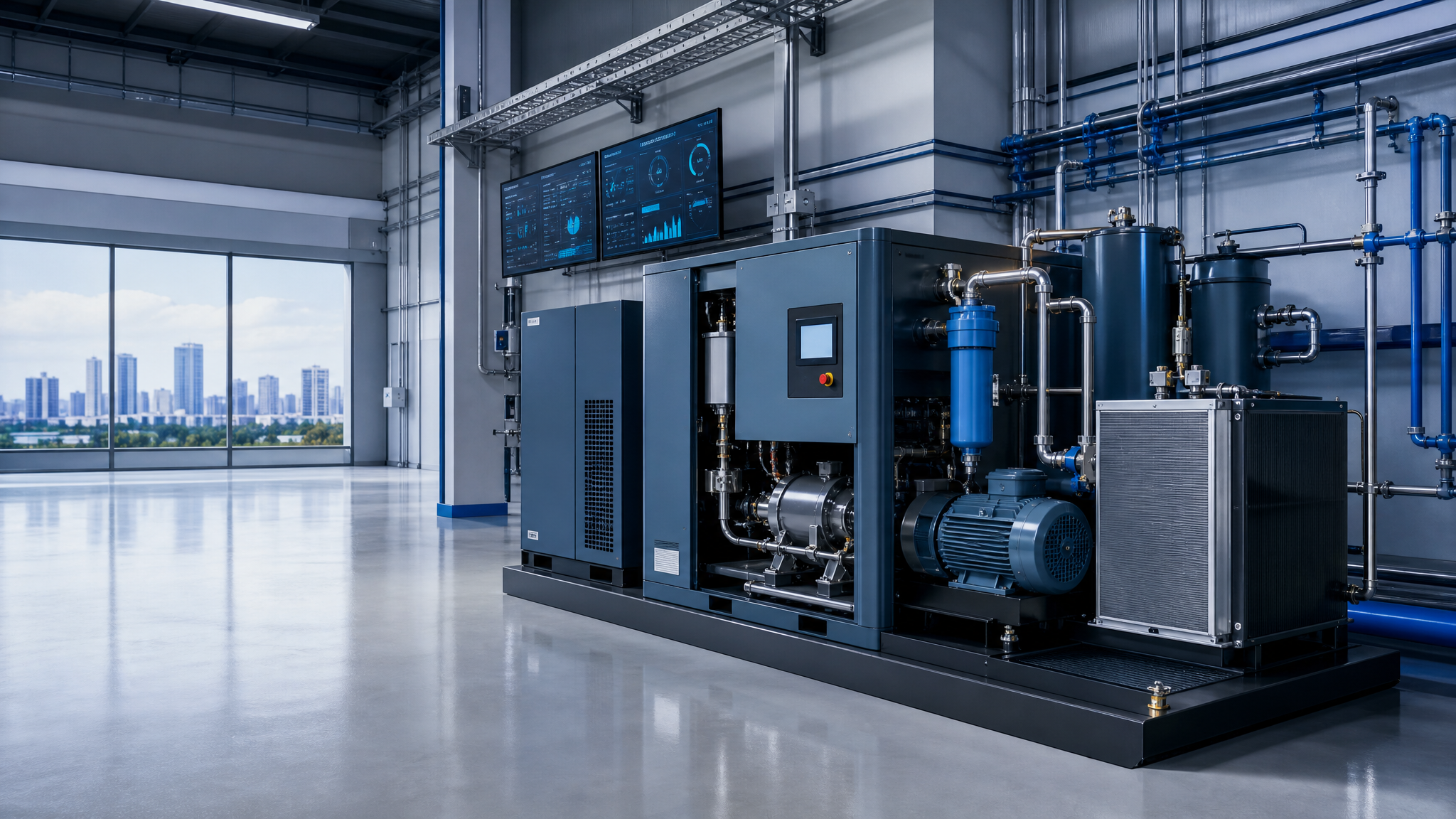
According to recent industry reports, the global industrial air compressor market is projected to grow significantly through 2030, with the Asia-Pacific region accounting for the largest share of growth. Within China, Foshan represents a significant and growing market for PM VSD Screw Compressor, driven by ongoing industrial automation, factory modernization initiatives, and increasing emphasis on energy efficiency. Understanding the key trends shaping this market is essential for making informed procurement decisions.
This report provides a thorough analysis of the PM VSD Screw Compressor market in Foshan, including technology trends, competitive landscape, pricing dynamics, and selection criteria. Drawing on industry data, manufacturer specifications, and real-world installation experience, we offer practical guidance for Foshan facilities seeking to optimize their compressed air infrastructure.
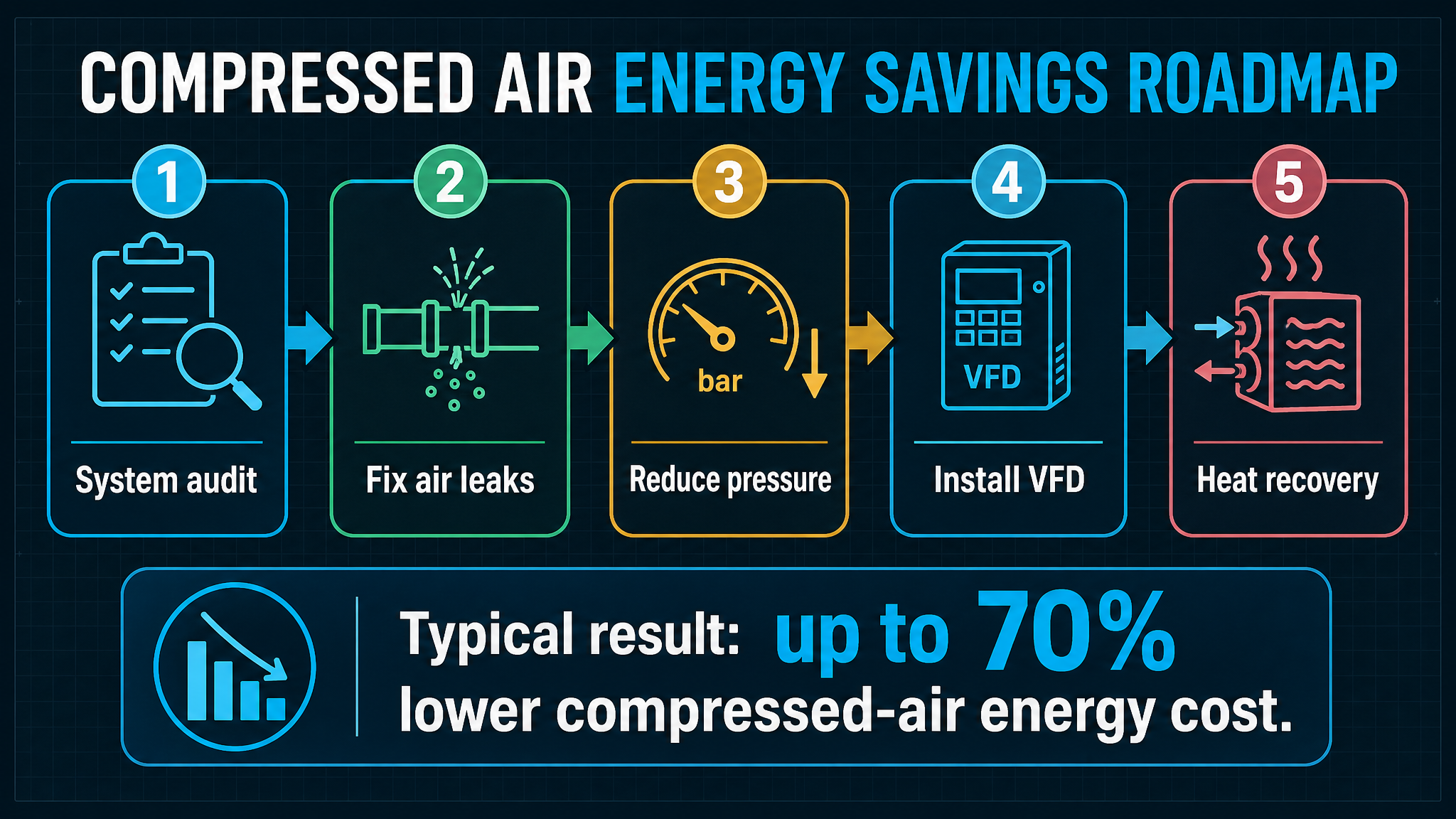
Visual: Energy Savings Roadmap
Heat Recovery Systems: Unlocking Hidden Value in PM VSD Screw Compressor
One of the best-kept secrets in industrial compressed air is that approximately 90% of the electrical energy consumed by a screw compressor is converted into heat. In a typical PM VSD Screw Compressor installation, this heat is simply dissipated to the atmosphere through the cooling system — representing a substantial missed opportunity for energy recovery. Modern heat recovery systems can capture 70-80% of this waste heat and repurpose it for facility heating, process hot water, preheating boiler feedwater, or other thermal applications.
For Foshan manufacturing facilities operating compressors year-round, the potential savings from heat recovery are substantial. A 75kW compressor operating 6,000 hours per year generates approximately 400,000 kWh of thermal energy annually — equivalent to the heating needs of 30-40 typical homes. Capturing even 70% of this energy can reduce facility heating costs by ¥100,000-200,000 per year, depending on local energy prices and the efficiency of the heat recovery system.
Heat recovery systems are available in several configurations to suit different facility requirements. The simplest approach uses the compressor’s existing oil cooling circuit to transfer heat to a water loop, which can then be used for space heating via fan coils or radiant heating panels. More sophisticated systems integrate with the facility’s central heating or process hot water system, providing year-round thermal energy.
When evaluating PM VSD Screw Compressor for your Foshan facility, consider whether heat recovery capability should be a selection criterion. While not all compressor installations are suitable for heat recovery, for facilities with significant year-round heating requirements, the additional investment in heat recovery infrastructure can deliver returns that rival or exceed the energy savings from the compressor’s efficiency features alone.
Compressed Air System Design: Beyond the Compressor Itself
The compressor is only one component of a complete compressed air system, and optimizing the system as a whole is essential for achieving the best possible performance and efficiency. For Foshan manufacturers investing in PM VSD Screw Compressor, attention to system design — including intake air quality, piping configuration, air treatment, and condensate management — can significantly impact both the efficiency of the compressor itself and the quality of the compressed air delivered to production equipment.
The quality of intake air is a frequently overlooked factor in compressor performance. Every 10°C reduction in intake air temperature reduces the energy required for compression by approximately 3%. For Foshan facilities in hot climates, locating the compressor intake on the north side of the building or drawing air from a cooler area can yield meaningful energy savings. Similarly, keeping intake air filters clean is essential — a dirty intake filter can increase pressure drop across the filter housing, effectively reducing the compressor’s capacity and increasing its specific power consumption.
Proper piping design is equally important. Undersized piping creates excessive pressure drop, forcing the compressor to operate at a higher discharge pressure to compensate. The rule of thumb is to design piping for a maximum pressure drop of 3-5% of the system pressure — for an 8 bar system, this means keeping total piping pressure drop below 0.4 bar. Loop-configuration piping rather than dead-end branches improves pressure stability and allows maintenance on sections without disrupting the entire system.
Air treatment is the final critical element of system design. The appropriate combination of aftercooler, dryer, and filters depends on the air quality requirements of your specific applications. For most Foshan general manufacturing applications, a refrigerant dryer and particulate filter provide adequate air quality at moderate cost. For facilities requiring higher air quality, additional treatment including desiccant dryers and coalescing filters may be necessary.
Smart Control Systems: The Brain Behind Modern PM VSD Screw Compressor
The controller is the brain of any modern screw compressor, and the sophistication of the control system has a direct impact on operating efficiency, reliability, and maintenance costs. Contemporary PM VSD Screw Compressor available in the Foshan market feature advanced microprocessor-based controllers that do far more than simply start and stop the compressor. These intelligent systems continuously monitor operating parameters, optimize performance based on real-time conditions, communicate with other equipment, and provide actionable data for maintenance planning and energy management.
Key control features to look for when evaluating PM VSD Screw Compressor include adaptive PID pressure control that minimizes pressure band width and reduces energy consumption; multi-compressor sequencing logic that optimizes the operation of multiple units for maximum system efficiency; and configurable operating schedules that match compressor availability to production requirements. Premium controllers offer additional capabilities such as automatic restart after power failure, remote monitoring via web-based dashboards or mobile apps, and integration with facility management systems through standard communication protocols including Modbus, Profibus, and Ethernet/IP.
The data generated by modern compressor controllers is valuable for ongoing optimization. Parameters such as specific power, load/unload ratio, operating hours, number of starts, and temperature trends provide insight into both compressor performance and the health of the system. By tracking these parameters over time, facility managers in Foshan can identify emerging issues before they cause downtime and optimize compressor operation for changing production requirements.
For Foshan manufacturers managing compressed air systems across multiple facilities or remote locations, IoT-enabled remote monitoring represents a particularly valuable capability. Centralized monitoring platforms allow compressor performance, energy consumption, and maintenance status to be tracked across all facilities from a single dashboard, enabling proactive management and consistent optimization across the enterprise.
Frequently Asked Questions About PM VSD Screw Compressor in Foshan
How much does PM VSD Screw Compressor typically cost in Foshan?
The cost varies widely depending on capacity, technology, and brand. A basic 37kW fixed-speed oil-injected unit typically costs ¥80,000-120,000 installed, while a premium 75kW VFD permanent magnet unit may cost ¥180,000-280,000. Larger industrial units (160-250kW) can cost ¥350,000-650,000 or more. Installation costs add 15-25% to equipment cost. The most important thing is that energy costs will exceed the purchase price within 2-3 years.
How long does PM VSD Screw Compressor last in typical Foshan industrial use?
A well-maintained compressor typically operates for 10-15 years before major component replacement is required, with many units continuing in service for 20+ years. The airend typically requires overhaul at 40,000-80,000 operating hours. Key factors include operating conditions, maintenance quality, and original equipment quality.
Is VFD PM VSD Screw Compressor worth the extra cost in Foshan?
For most facilities with variable air demand, VFD technology is very much worth the investment. The typical payback period is 12-24 months, driven by 30-50% energy savings compared to fixed-speed operation. Facilities with constant 24/7 demand may not benefit as much.
What size PM VSD Screw Compressor do I need for my Foshan facility?
The right size depends on actual demand measurement. As a rough guide: small workshop with pneumatic tools needs 1-4 m³/min (7.5-22 kW); medium facility needs 5-13 m³/min (30-75 kW); large industrial plant needs 15-35 m³/min (90-200 kW).
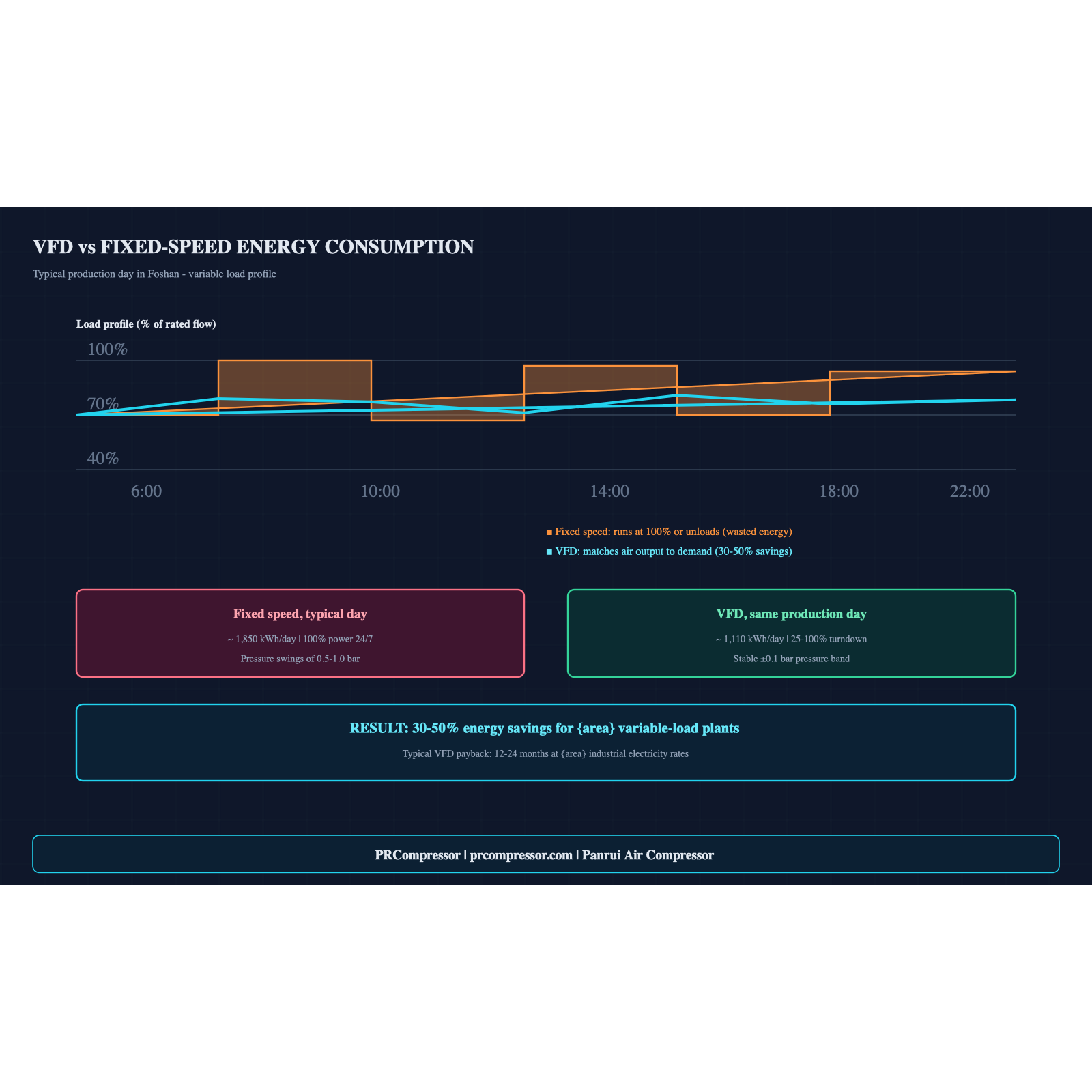
Visual: VFD vs Fixed Speed Energy Consumption
Energy Cost Savings: Quantifying the Impact of Efficient PM VSD Screw Compressor
For Foshan manufacturers, energy cost savings represent the largest and most predictable benefit of investing in efficient PM VSD Screw Compressor. The magnitude of these savings depends on the efficiency difference between current and new equipment, the operating profile, local electricity rates, and the specific technology choices made.
The most important metric for comparing compressor energy efficiency is specific power. A typical older fixed-speed compressor might have a specific power of 7.0-7.5 kW/(m³/min). A modern premium-efficiency VFD compressor with PMSM motor technology might achieve 5.2-5.8 kW/(m³/min) — representing a 20-30% improvement. For a facility operating a 75kW compressor 6,000 hours per year, this translates to annual energy savings of 100,000-150,000 kWh worth ¥80,000-150,000.
The savings from VFD technology are additional to the savings from improved mechanical efficiency. For facilities with variable air demand, VFD technology typically reduces energy consumption by an additional 30-50%. The combined effect can reduce total compressed air energy costs by 40-60% compared to older fixed-speed equipment.
For Foshan facilities considering a compressor upgrade, the following steps will produce a reliable energy savings estimate: measure current compressed air energy consumption; determine your facility’s demand profile; obtain specific power data from suppliers of candidate equipment; calculate potential energy savings; and apply your effective electricity rate to convert energy savings to cost savings.
Financial Analysis: Leasing vs Purchasing PM VSD Screw Compressor in Foshan
For Foshan manufacturers, the decision between leasing and purchasing PM VSD Screw Compressor involves financial, operational, and strategic considerations beyond simple cost comparison. Each approach offers distinct advantages.
Leasing PM VSD Screw Compressor preserves working capital, provides predictable fixed monthly payments, may offer tax advantages through deductibility of lease payments, and allows for easier equipment upgrades at lease expiration. Lease terms typically range from 3 to 7 years with residual values of 10-30%.
Purchasing PM VSD Screw Compressor provides the lowest total cost over the equipment’s life, offers full ownership and control, allows for depreciation benefits, and eliminates ongoing payment obligations after purchase. For Foshan manufacturers with access to capital and a long-term perspective, purchasing typically provides the best financial outcome.
The financial comparison should consider: total cost of leasing over the planned use period; total cost of purchasing; tax implications; the manufacturer’s cost of capital; and the expected useful life relative to the lease term. For most Foshan manufacturers, purchasing provides better 10-year economics while leasing better serves manufacturers with capital constraints.
Common PM VSD Screw Compressor Problems and Troubleshooting Guide for Foshan Users
Even the best-maintained PM VSD Screw Compressor can experience operational issues. This troubleshooting guide covers the most common problems and provides a systematic approach to resolving them.
Problem: Compressor fails to start — Check power supply and electrical connections. Verify safety interlocks are satisfied. Check controller display for error codes. For VFD units, verify the VFD is powered and not reporting a fault.
Problem: Low discharge pressure — Check for excessive air demand. Inspect air filter for clogging. Check for leaks in the distribution system. Verify pressure control settings and sensor function.
Problem: High discharge temperature — Check oil level. Inspect oil cooler for dirt or debris. Verify ambient temperature is within design range. Check oil filter for clogging.
Problem: Excessive oil consumption — Check oil separator element for saturation. Inspect oil return line and check valve. Verify correct oil level. Check for air filter restrictions.
Problem: Unusual noise or vibration — Check for loose mounting bolts. Inspect coupling alignment (direct-drive) or belt condition (belt-driven). Listen for bearing noise. For persistent issues, conduct vibration analysis.
Emergency Response Plan for PM VSD Screw Compressor Failures in Foshan
Even with the best preventive maintenance program, failures can occur. Having a well-rehearsed emergency response plan can mean the difference between a brief interruption and a prolonged shutdown.
Plan Element 1: Immediate Response Procedures — Document who to notify, what information to collect, and how to restore minimum compressed air supply including backup compressor startup procedures and prioritization of critical consumers.
Plan Element 2: Equipment Information — Maintain accessible documentation for all compressors including manufacturer and model information, key specifications, warranty status, service contract information, and critical spare parts locations.
Plan Element 3: Service Provider Contact — Establish relationships with at least two qualified service providers. Document their emergency contact numbers, typical response times, and capabilities.
Plan Element 4: Backup Capacity Planning — Develop a plan for maintaining compressed air supply during extended outages, including rental compressor arrangements, mutual aid agreements, or maintaining a spare compressor on-site.
Supplier Qualification: Questions to Ask Before Buying PM VSD Screw Compressor in Foshan
Asking the right questions during supplier evaluation is essential for making an informed purchasing decision. Here are the key questions organized by topic.
Product Performance: Can you provide verified specific power data at full load and part load? How do you verify your efficiency claims? What is your policy if the installed equipment fails to meet specified performance? What is the expected service life under our operating conditions?
Service and Support: How many service technicians do you have in the Foshan region? What is your typical response time for emergency calls? Do you maintain local spare parts inventory? Can you provide a sample maintenance contract? What training do you provide?
Company Background: How long have you been supplying the Foshan market? Can you provide references from three customers in similar industries? What certifications do you hold? What is your approach to product development?
Commercial Terms: What is your standard warranty coverage? Can extended warranty be purchased? What are your payment terms? Do you offer performance guarantees? What is the expected delivery lead time?
Step-by-Step Guide to Selecting PM VSD Screw Compressor in Foshan
Selecting the right PM VSD Screw Compressor for your Foshan facility does not need to be complicated, but it does require a systematic approach. This step-by-step guide provides a structured process that will help you evaluate your options and make a confident decision.
Step 1: Define Your Compressed Air Demand — Measure your actual air consumption over a representative period. If measurement is not possible, estimate demand by inventorying all air-consuming equipment and calculating total demand with appropriate diversity factors. Add 20-30% for future expansion and system losses.
Step 2: Determine Your Air Quality Requirements — Identify the highest air quality requirement among your applications. If any application requires oil-free air, that will drive the compressor selection toward oil-free technology. Also determine the required pressure dew point and particulate filtration level.
Step 3: Evaluate Technology Options — Based on your demand profile and air quality requirements, evaluate the available technology options. For variable demand with 4,000+ annual operating hours, VFD technology is strongly recommended. For constant high-pressure applications, two-stage compression should be considered.
Step 4: Compare Supplier Proposals — Request proposals from at least three qualified suppliers. Evaluate proposals based on lifecycle cost, not purchase price. Verify service capabilities and warranty terms. Request references and follow up on them.
Step 5: Make a Confident Decision — Combine the technical evaluation, financial analysis, and supplier assessment into a weighted decision framework, balancing quantitative factors with qualitative factors.
PM VSD Screw Compressor for Construction and Mining in Foshan
Construction and mining operations in Foshan require robust, portable, and reliable compressed air solutions for rock drilling, pneumatic tools, concrete spraying, and dust control. Unlike factory installations, these systems must operate in harsh environments with challenging conditions.
For construction and mining applications, the selection of PM VSD Screw Compressor prioritizes durability, ease of maintenance, and the ability to operate in adverse conditions over efficiency optimization. While energy efficiency is still important, the primary considerations are typically reliability, serviceability, and spare parts availability in remote locations.
Portability is another key consideration. Trailer-mounted compressors, modular units, and systems designed for easy relocation are common. The ability to quickly move compressed air capacity to different locations is essential for operational flexibility.
For Foshan construction and mining companies, the selection of PM VSD Screw Compressor should also consider the availability of service and support in the specific geographic areas where operations will be conducted.
Call to Action: Start Your PM VSD Screw Compressor Evaluation Today
The information in this guide provides a comprehensive foundation for evaluating PM VSD Screw Compressor options in Foshan. Now the most important step is to take action — every month of delay is a month of unnecessarily high energy costs and missed opportunity.
The first step is simple: contact PRCompressor (Panrui) for a free, no-obligation consultation. Our experienced team will help you assess your current system, identify improvement opportunities, and develop a recommendation tailored to your needs.
Don’t let another day of inefficient compressed air operation erode your profitability. Contact us today.
Phone: 13713647073 | Email: info@panrui.com | Web: prcompressor.com
Keywords: industrial air compressor, foshan manufacturer, foshan compressor, compressor supplier, compressor buyer’s guide, industrial compressed air, energy saving compressor, compressor energy efficiency, pm vsd screw compressor, screw air compressor
Contact PRCompressor (Panrui) for pm vsd screw compressor in Foshan: Phone 13713647073 | prcompressor.com