


Shenzhen Permanent Magnet Screw Compressor Market Analysis: 2026 Edition
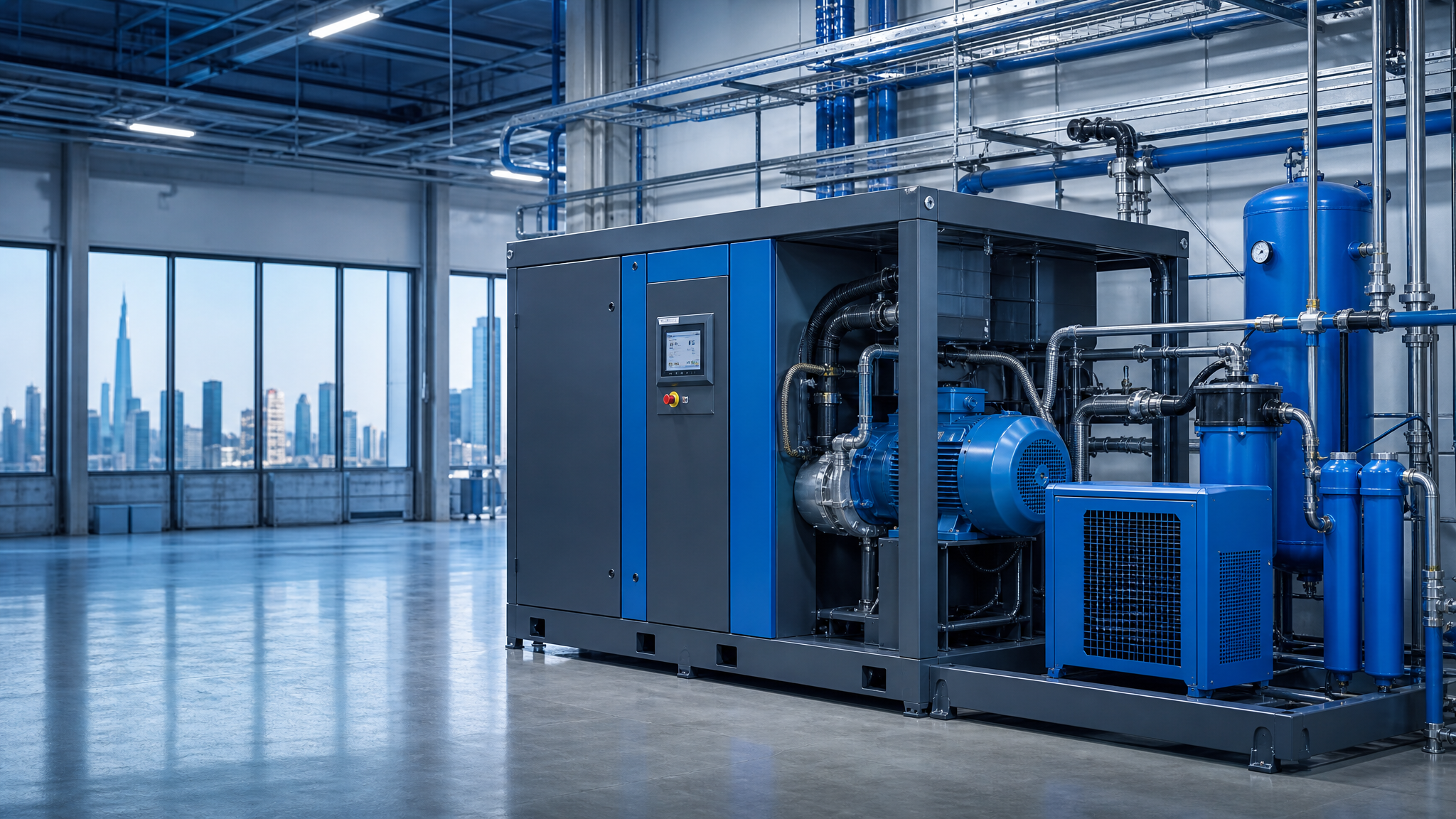
The compressed air industry is undergoing a technological transformation that will fundamentally change how manufacturing facilities in Shenzhen power their operations. From AI-optimized compressor control systems and predictive maintenance algorithms to IoT-enabled remote monitoring and smart grid integration, the next generation of Permanent Magnet Screw Compressor will offer capabilities that were unimaginable just a few years ago. Understanding these trends is essential for making forward-looking procurement decisions.
This guide examines both the current state of the Permanent Magnet Screw Compressor market in Shenzhen and the emerging technologies that will shape its future. We provide practical advice for buyers who want to invest in equipment that not only meets today’s needs but is also positioned to take advantage of tomorrow’s innovations.
Technology Selection Matrix: Choosing the Right Permanent Magnet Screw Compressor Configuration
This technology selection matrix helps Shenzhen manufacturers match Permanent Magnet Screw Compressor configurations to their specific operating profiles.
Demand Profile Dimension: Constant demand — fixed-speed or VFD base load. Variable demand — VFD compressor sized for variable portion. Highly variable demand — multi-compressor system with VFD trim.
Pressure Requirements Dimension: Standard pressure (7-10 bar) — most compressor types suitable. High pressure (10-15 bar) — two-stage compression recommended. Low pressure (below 7 bar) — standard units with derating.
Air Quality Requirements Dimension: General industrial (ISO Class 4-5) — oil-injected with standard filtration. Sensitive applications (ISO Class 1-3) — consider oil-free or enhanced filtration. Critical applications — oil-free compressors required.
Operating Hours Dimension: Low utilization (under 2,000 hours/year) — lower-cost fixed-speed. Medium utilization (2,000-4,000) — VFD recommended for variable demand. High utilization (4,000-8,000) — premium efficiency essential. Continuous operation (8,000+) — maximum efficiency, consider heat recovery.
Supplier Qualification: Questions to Ask Before Buying Permanent Magnet Screw Compressor in Shenzhen
Asking the right questions during supplier evaluation is essential for making an informed purchasing decision. Here are the key questions organized by topic.
Product Performance: Can you provide verified specific power data at full load and part load? How do you verify your efficiency claims? What is your policy if the installed equipment fails to meet specified performance? What is the expected service life under our operating conditions?
Service and Support: How many service technicians do you have in the Shenzhen region? What is your typical response time for emergency calls? Do you maintain local spare parts inventory? Can you provide a sample maintenance contract? What training do you provide?
Company Background: How long have you been supplying the Shenzhen market? Can you provide references from three customers in similar industries? What certifications do you hold? What is your approach to product development?
Commercial Terms: What is your standard warranty coverage? Can extended warranty be purchased? What are your payment terms? Do you offer performance guarantees? What is the expected delivery lead time?
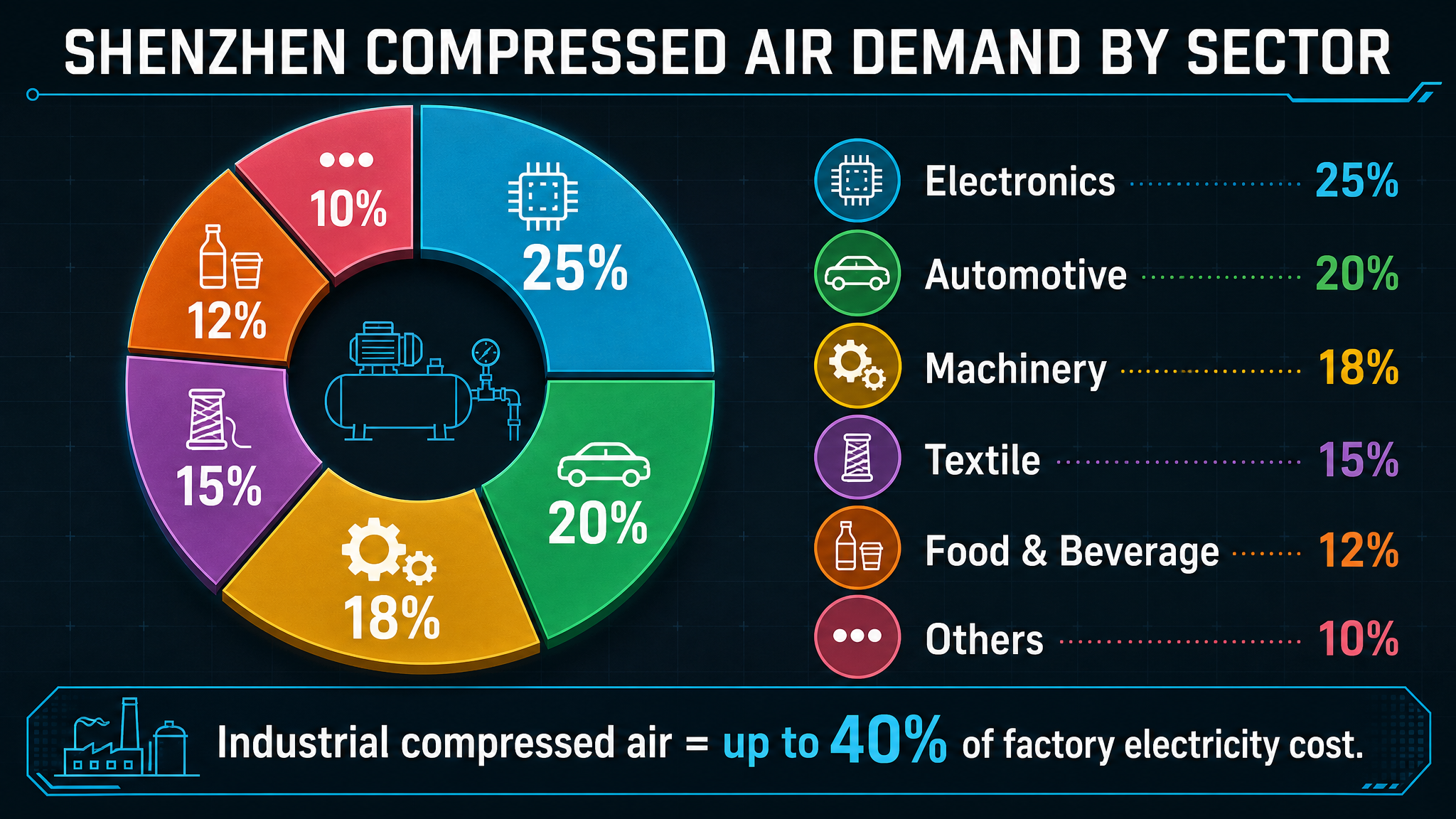
Industry Applications at a Glance
Expert Answers: Common Questions About Permanent Magnet Screw Compressor
What is the difference between single-stage and two-stage Permanent Magnet Screw Compressor?
Single-stage compressors compress air from atmospheric to final pressure in one step. Two-stage compressors divide this process with inter-stage cooling, reducing energy required by 15-25% depending on discharge pressure. Two-stage units are particularly well-suited for applications requiring 10 bar or higher.
How often should I change the oil in my Permanent Magnet Screw Compressor?
Standard interval is 2,000-4,000 operating hours or annually. However, the optimal interval depends on operating conditions and oil type. The most reliable method is regular oil analysis to determine when oil properties degrade beyond acceptable limits.
Can I install a Permanent Magnet Screw Compressor outdoors in Shenzhen’s climate?
Outdoor installation is possible but requires a weatherproof enclosure. Additional considerations include low-temperature operation below 5°C, adequate ventilation, and security. Indoor installation is strongly recommended for most applications.
How do I choose between domestic and international Permanent Magnet Screw Compressor brands?
International premium brands offer the highest efficiency and most comprehensive service networks at a 30-60% price premium. Domestic brands offer competitive efficiency and reliability at lower prices with shorter lead times and potentially more responsive local service. The choice depends on your specific priorities.
Permanent Magnet Technology: The Efficiency Revolution in Permanent Magnet Screw Compressor
The integration of permanent magnet synchronous motor (PMSM) technology represents one of the most significant advances in compressed air efficiency over the past decade. Unlike traditional induction motors that consume electrical current to create a magnetic field in the rotor, permanent magnet motors use high-strength neodymium magnets mounted on the rotor to provide the magnetic field continuously. This eliminates the electrical losses associated with rotor field creation, resulting in efficiency improvements of 5-10% across the motor’s operating range.
When combined with variable frequency drive (VFD) technology, PMSM motors create a powertrain that is exceptionally efficient across a wide speed range. The PRCompressor PMV series, widely available in the Shenzhen market, exemplifies this approach with IE4 and IE5 efficiency class motors coupled to precision VFD controllers that optimize motor speed and torque for any operating condition. Field data from installations across Shenzhen manufacturing facilities shows that this combination typically delivers 30-45% energy savings compared to fixed-speed induction motor compressors.
The advantages of PMSM-VFD technology extend beyond energy savings. These systems provide exceptionally stable discharge pressure, typically maintaining within ±0.1 bar of the setpoint regardless of demand fluctuations. This pressure stability is critical for sensitive manufacturing processes common in Shenzhen industries such as electronics assembly, precision machining, and pharmaceutical production. Additionally, the soft-start capability of VFD systems eliminates the high inrush current associated with direct-on-line motor starting, reducing electrical infrastructure requirements and extending the life of electrical components.
For Shenzhen manufacturers evaluating Permanent Magnet Screw Compressor, the PMSM-VFD combination represents the current state of the art in compressed air efficiency. The higher initial investment — typically 30-50% more than a comparable fixed-speed unit — is usually recovered within 12-24 months through electricity savings alone, after which the efficiency advantage contributes directly to improved profitability.
Oil-Free vs Oil-Injected Permanent Magnet Screw Compressor: Making the Right Choice for Shenzhen
One of the most important decisions when selecting Permanent Magnet Screw Compressor is whether oil-free or oil-injected technology is appropriate for your application. Each approach has distinct advantages and limitations that make it suitable for different industrial applications. Understanding these differences is essential for making an informed procurement decision that balances performance requirements with budget constraints.
Oil-injected screw compressors — the most common type in Shenzhen industrial facilities — use specially formulated compressor oil injected into the compression chamber for three purposes: sealing the clearance between rotors to minimize internal leakage, lubricating the rotors and bearings, and absorbing the heat of compression. This design is simple, reliable, and cost-effective, with lower initial purchase cost and wider service network availability. Modern oil-injected compressors with high-efficiency oil separation systems achieve residual oil content below 3 ppm, which is acceptable for most general industrial applications.
Oil-free screw compressors, by contrast, achieve compression without any oil in the compression chamber through precision-engineered rotor clearances, specialized rotor coatings, and separate lubrication systems. These units deliver 100% oil-free air, making them essential for critical applications such as pharmaceutical manufacturing, food and beverage processing, electronics fabrication, and paint spraying. The trade-offs include higher initial cost and generally lower energy efficiency due to larger rotor clearances required.
For most Shenzhen manufacturing applications, high-quality oil-injected Permanent Magnet Screw Compressor with appropriate filtration provides adequate air quality at a significantly lower total cost of ownership. However, for facilities in the pharmaceutical, food processing, electronics, or precision coating industries, the investment in oil-free technology is justified by the quality assurance requirements and the cost of potential contamination incidents.
Multi-Compressor System Design: Rightsizing for Variable Demand
For larger Shenzhen manufacturing facilities with varying compressed air demand, a single compressor — even a highly efficient VFD model — may not be the optimal solution. Multi-compressor systems, properly designed with a mix of base load and trim compressors, can achieve significantly better part-load efficiency than any single compressor operating alone. The key is to select and configure the compressors so that each unit operates in its most efficient range as the total system demand varies.
The standard configuration for efficient multi-compressor systems pairs one or more VFD compressors serving as trim units with fixed-speed base load compressors. The VFD unit modulates to match the difference between base load output and total system demand, while the base load units operate at their most efficient full-load condition. Modern sequencers optimize the startup and shutdown of base load units based on system pressure and demand trends, minimizing the number of starts and ensuring each unit operates in its optimal efficiency range.
For Shenzhen facilities with demand profiles that vary significantly between production shifts or seasons, this approach can deliver system-level efficiencies that approach 90% or more of individual compressor full-load efficiency — far better than the 60-70% system efficiency typical of uncontrolled multi-compressor installations. The additional investment in a sequencer and the incremental cost of multiple smaller compressors versus one large unit is typically recovered within 12-18 months through energy savings.
When planning a multi-compressor system, consider the following design principles: limit the number of compressor sizes to 2-3 for simplicity; ensure total installed capacity covers peak demand plus 20-30% redundancy; select compressors with complementary efficiency characteristics; and include adequate receiver capacity to stabilize pressure during transient demand changes.
Permanent Magnet Screw Compressor for Metalworking and Machinery Manufacturing in Shenzhen
Metalworking and machinery manufacturing facilities in Shenzhen use compressed air for a wide range of applications including CNC machine tools, pneumatic clamping systems, chip removal, and surface finishing equipment. The compressed air requirements vary widely depending on the specific processes involved.
CNC machining centers — common in Shenzhen metalworking facilities — typically require compressed air at 6-8 bar for tool changing, workholding, and chip evacuation. These applications are sensitive to pressure drops and benefit from stable pressure supplied by well-designed systems. The intermittent nature of machining operations often creates variable air demand patterns that favor VFD compressor technology.
Surface finishing and coating operations require clean, oil-free air to prevent surface defects. For these applications, appropriate filtration and drying equipment is essential, and oil-free compressors may be specified for the most demanding finishing operations.
For Shenzhen metalworking and machinery manufacturers, the selection of Permanent Magnet Screw Compressor should consider both general shop air requirements and any special requirements for finishing or coating processes.
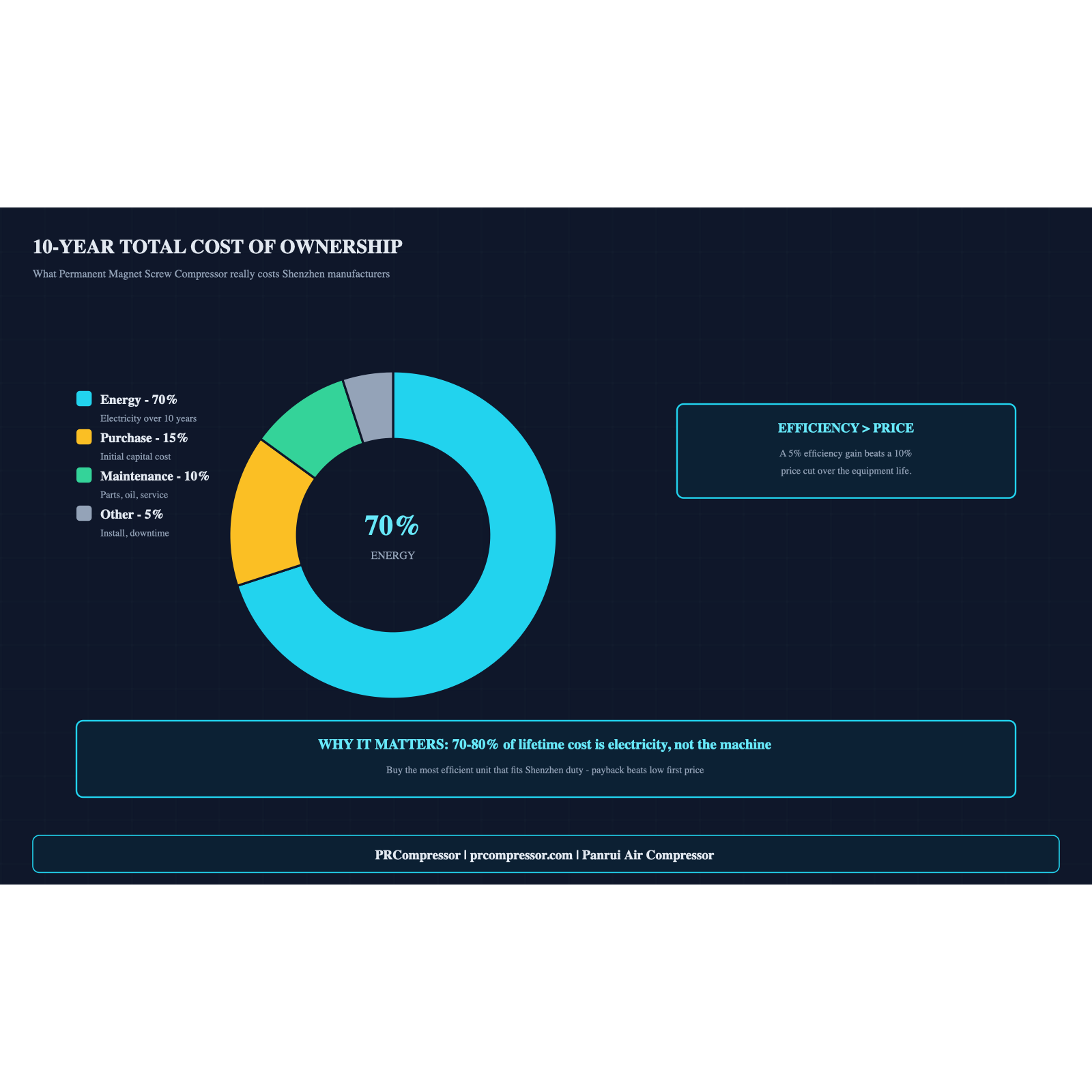
Visual: Total Cost of Ownership Breakdown
Maintenance Cost Analysis for Permanent Magnet Screw Compressor in Shenzhen
Maintenance costs represent a significant component of the total cost of ownership for Permanent Magnet Screw Compressor, typically accounting for 8-12% of lifetime costs. Understanding the maintenance requirements and costs of different compressor types and brands is essential for accurate TCO analysis.
Routine maintenance for oil-injected Permanent Magnet Screw Compressor includes oil and oil filter changes at 2,000-4,000 hour intervals; air filter replacement at similar intervals; oil separator replacement at 4,000-8,000 hour intervals; and annual inspection of safety devices and control system. The annual maintenance cost for a typical mid-range installation in the 37-75 kW range is approximately ¥8,000-15,000 for routine parts and labor.
Major maintenance events, including bearing replacement and airend overhaul, occur at 20,000-40,000 hour intervals with costs ranging from ¥15,000 to ¥80,000 or more depending on unit size. The timing and cost of major maintenance varies significantly between brands and models.
For Shenzhen manufacturers, selecting Permanent Magnet Screw Compressor with accessible service points, readily available spare parts, and a competent local service network is essential for controlling maintenance costs. Asking suppliers for detailed maintenance schedules, parts pricing, and service labor rates during the evaluation process will provide the data needed for accurate comparison.
Energy Costs in Shenzhen: Why Efficiency Matters More Than Ever
Electricity costs for industrial users in Shenzhen have risen steadily over the past five years, with current rates typically ranging from ¥0.75 to ¥1.25 per kWh depending on voltage level, time of use, and total consumption. For manufacturing facilities where compressed air accounts for 10-30% of total electricity consumption, the impact of compressor efficiency on operating costs is substantial and growing.
To illustrate the financial impact: a Shenzhen factory operating a 110kW Permanent Magnet Screw Compressor 6,000 hours per year at an average electricity cost of ¥0.90/kWh will spend approximately ¥594,000 annually on compressed air energy alone. Improving the compressor’s specific power by just 0.5 kW/(m³/min) saves approximately ¥49,500 per year. Over a 10-year operating life, this efficiency improvement alone saves nearly ¥500,000.
Time-of-use electricity pricing, which is common in Shenzhen, adds another dimension to the efficiency calculation. Many industrial users pay significantly higher rates during peak daytime hours. Intelligent compressor control systems that can shift some compression to off-peak periods can capture additional savings beyond what the compressor’s mechanical efficiency alone provides.
For Shenzhen manufacturers, the message is clear: investing in premium-efficiency Permanent Magnet Screw Compressor — even at a higher initial cost — is one of the highest-return investments available in the industrial equipment budget, with typical internal rates of return exceeding 30-50% over the equipment’s operating life.
Final Recommendations for Shenzhen Permanent Magnet Screw Compressor Buyers
After examining the full landscape of Permanent Magnet Screw Compressor options in Shenzhen, several clear recommendations emerge:
Know Your Numbers — Invest in understanding your compressed air demand, air quality requirements, and operating profile before talking to suppliers. A professional audit is a worthwhile investment.
Compare on Lifecycle Cost — Evaluate proposals based on 5-year TCO, considering purchase price, energy costs, maintenance, and expected service life. Energy costs will dominate the total.
Evaluate Service Capability Thoroughly — The best compressor is worthless if it cannot be serviced promptly. Verify service network coverage in Shenzhen and check references.
Plan for the Complete System — The compressor is the centerpiece, but the complete system includes piping, storage, air treatment, controls, and monitoring. Invest in system design commensurate with your equipment investment.
For personalized assistance, contact PRCompressor at 13713647073 or visit prcompressor.com.
Keywords: industrial compressed air, compressor supplier, shenzhen compressor, shenzhen manufacturer, compressor energy efficiency, screw air compressor, energy saving compressor, compressor buyer’s guide, permanent magnet screw compressor, industrial air compressor
Contact PRCompressor (Panrui) for permanent magnet screw compressor in Shenzhen: Phone 13713647073 | prcompressor.com