


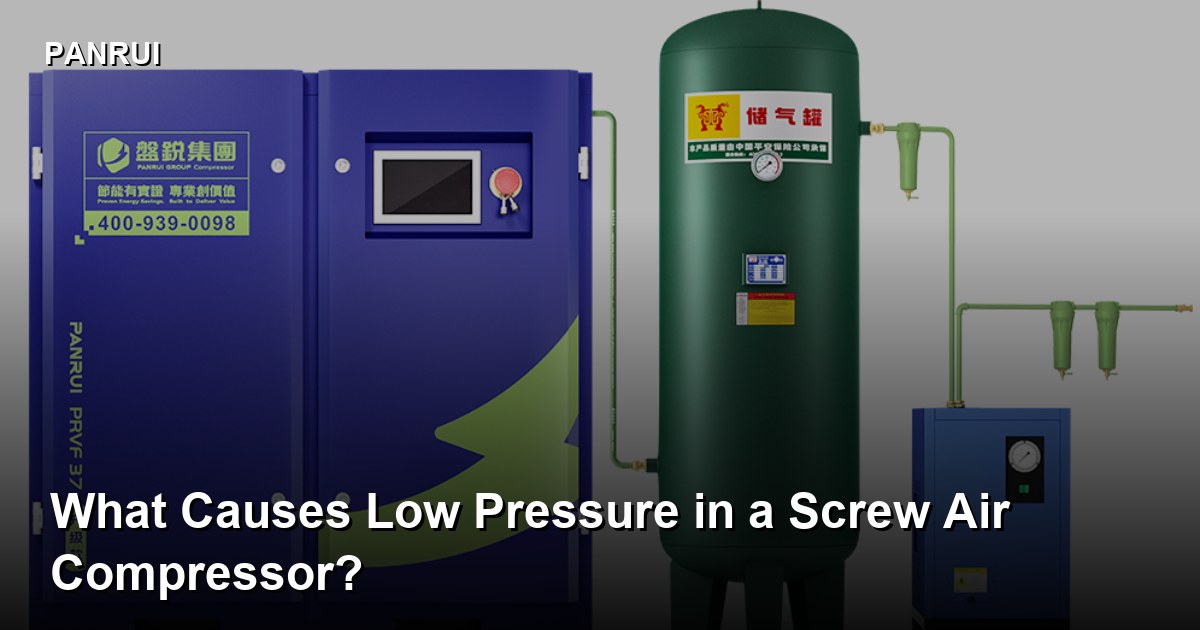
Your tools stall at 6 bar when the compressor is set for 8 bar, and nobody in the plant can explain where the pressure went. Low pressure does not save energy – it forces the machine to run longer to make up the shortfall, and production slows with it. In most cases, screw air compressor low pressure causes sit in the system around the machine, not inside the machine itself.
Compressed air pressure below spec shows up as slow drills, weak cylinders, inconsistent spray finishing, and longer cycle times on CNC and laser-cutting lines. Operators often turn the setpoint up to compensate, which does not fix the loss and usually makes the next problem worse.
What Low Pressure Really Costs
Every extra bar of discharge pressure adds roughly 6-7% to energy consumption, so pushing pressure up is never a free fix. When pressure is genuinely low, the real cost is hidden: machines run longer, more compressors come online, and tools underperform. Over a year, the lost production and wasted electricity add up to far more than the price of a filter.
Screw Air Compressor Low Pressure Causes: 7 to Check
- Air leaks – the number one cause. Industry audits typically find 20-30% of compressor output lost through leaks in piping, fittings, and tools.
- A clogged intake filter – restricted airflow means the air end cannot pull its rated free air, so pressure and flow both drop.
- Pressure drop across dryers, filters, and piping – a clogged filter element or an undersized pipe can cost you 0.5 bar or more before the air reaches the tool.
- Worn or slipping drive belts – on belt-driven units, slip reduces air end speed, so the compressor delivers less flow at the same pressure.
- A wrong setpoint or a failed pressure transducer – the controller may believe it is holding 8 bar while the plant actually gets 6.5.
- Demand exceeding capacity – production growth adds tools and shifts faster than compressor capacity grows.
- A leaking condensate trap or check valve – air bleeds back or out, and the system never builds stable pressure.
How to Find the Loss
Diagnose with gauges, not guesses. Measure pressure at the compressor outlet, after the dryer and filters, and at the farthest point of use. The difference between readings tells you exactly where the pressure disappears. A drop at the compressor itself points to intake, belts, or setpoint; a drop further down the line points to leaks or restrictions.
Then fix in order of cost: repair or replace leaky fittings (soap-and-water or ultrasonic testing finds them fast), replace clogged filter elements on schedule, check belt tension, and verify the controller setpoint against a calibrated gauge. Re-test after each fix so you know what actually worked.
The arithmetic is simple. A system that leaks 25% of its output effectively runs four compressors where it needs three. Closing the leaks and dropping the setpoint by 1 bar can cut energy use by roughly 6-7% on top of the recovered flow – often the cheapest “new compressor” you will ever buy.
FAQs: Low Pressure Problems
Is low pressure a compressor problem or a system problem? Usually a system problem. Leaks, restrictions, and setpoint errors account for most cases. Measure at several points before assuming the compressor itself is at fault.
Will a bigger compressor fix low pressure? Not if the pressure is lost in the piping or leaks – a bigger machine just leaks more. Fix the system first, then re-check the capacity.
Do I need higher pressure or more flow? Check the tools’ requirement. Many processes need flow more than pressure; matching supply to actual demand – for example with a variable-speed unit – avoids both low pressure and wasted energy.
Restore Full Pressure
Screw air compressor low pressure causes are usually findable in an afternoon with the right gauges. Hunt the leaks, clear the restrictions, and set the pressure honestly – then measure the result. If demand really has outgrown the machine, size the replacement against actual usage, not nameplate claims; our rotary screw air compressor range and variable-speed models are built for fluctuating loads. Contact our team for a free sizing discussion.